
Defining research problems in archaeology
Every doctoral study needs a clearly stated research problem: the issue or gap in understanding that makes the study necessary (see why problem identification matters). In archaeology, framing that problem is unusually demanding because the evidence is fragmentary, unevenly preserved and often recovered long after it was deposited. A question that would be straightforward with written records or living participants can become unanswerable when only material remains survive.
Paleodemography shows the difficulty clearly. Boldsen et al. (2022) review how human skeletons are used to reconstruct the demography of preindustrial populations. They identify problems with existing practice, especially in estimating age at death for adults: individuals over about 50 years are, in their view, mistakenly under-represented in published studies of archaeological skeletons, which distorts the age-at-death distributions on which interpretations rest. A doctoral problem about life expectancy or mortality in a past community therefore has to begin with the limits of the age estimates, not only with the historical question.
Field-wide agendas can help locate problems that matter. Kintigh et al. (2014) combined a crowd-sourced survey of archaeologists with a two-day workshop to identify 25 "grand challenges" for archaeology, grouped under five themes: emergence, communities and complexity; resilience, persistence, transformation and collapse; movement, mobility and migration; cognition, behaviour and identity; and human-environment interactions. A doctoral problem rarely addresses a grand challenge directly, but linking a local question to one of these themes is a good way to show why it matters beyond a single site.
Wicked problems in heritage management
Some of the most pressing problems archaeologists face are not about the past at all, but about how its remains are managed today. Rittel and Webber (1973) introduced the term "wicked problems" for planning problems that, unlike tame problems in mathematics or chess, have no definitive formulation and no final solution, because every attempt to address them changes the situation and stakeholders disagree about what success would look like.
Schofield (2024) applies the idea to archaeology and heritage, arguing that heritage practice can contribute to wicked problems facing the planet, such as climate change, pollution, health and wellbeing, social injustice and conflict, through interdisciplinary and often messy approaches. For a doctoral researcher, the practical implication is that a heritage problem should be framed so that it can be studied, not solved: for example, how different groups value a site and how those values conflict, rather than "how to protect the site". Such problems usually need methods from the social sciences and policy analysis alongside archaeological ones, and they need the perspectives of local communities, professionals, authorities and visitors to be built into the design.
Regional constraints on archaeological practice
What counts as a feasible research problem depends on where the work is done. Nomishan et al. (2021) discuss the challenges confronting archaeology and its practice in Nigeria. In a later article on public archaeology in the country, Nomishan et al. (2025) name limited funding and resources, which also create reliance on laboratories abroad; political instability and insecurity, including kidnapping and banditry that endanger researchers and sites; insufficient training, with fewer than 500 active archaeologists by their estimate; weak community engagement; corruption that facilitates looting; and rapid urban development that destroys sites.
These constraints should shape the problem from the start rather than appear later as limitations. A project that depends on extensive excavation and radiocarbon dating may be unrealistic where funding and laboratory access are scarce; one built on survey, museum collections, archival work or community interviews may answer an equally important question. Partnerships with local and international institutions, and early discussion of security and permissions with supervisors, are part of research design, not administration.
Technology and scientific methods: opportunities and demands
Geographic information systems (GIS) are now central to archaeological research, but their use has limits worth knowing before a problem is built around them. In a systematic review of 571 publications from 1990 to 2022, Menéndez-Marsh et al. (2023) found that GIS in archaeology was used mainly for mapping and information management, that spatial analysis was the commonest type of study, and that theoretical papers were scarce. They concluded that a lack of theoretical grounding may underlie some of the problems of GIS applications in archaeology. The lesson for a doctoral problem is to ask what spatial question the GIS will answer, not only what it will map.
Open-source software has made specialist tools more accessible, but it brings its own demands. Batist and Roe (2024) analysed archaeological software listed in the open-archaeo registry and the activity of related GitHub repositories. Most repositories had only one to three contributors, and direct collaboration on code was limited; research software in archaeology remains embedded in conventional academic norms. A researcher who builds a thesis on such tools should check how well they are maintained, document versions carefully and budget time to learn them.
Scientific dating raises similar questions of design. Radiocarbon measurements must be calibrated to calendar dates, and Bayliss (2009) describes how Bayesian modelling of radiocarbon dates, combined with stratigraphic information, has allowed English archaeology to build much more precise chronologies and to engage with historical questions. Such modelling depends on selecting the right samples in relation to the question, which is why dating should be planned when the problem is framed rather than added after excavation. Costs, laboratory access and the expertise to build models all need to be part of that plan.
Tourism and preservation: a balancing act
Archaeological tourism can bring income and recognition to sites and their communities, yet visitor pressure and development can damage the remains that attract them. Pacifico and Vogel (2012) note that archaeology is an important element of tourism economies in both wealthier and poorer countries, with particular consequences for indigenous and marginalised groups, and ask what responsibilities archaeologists have. Drawing on their fieldwork, they suggest that archaeologists should act as mediators who help all stakeholders discuss how tourism affects them, rather than as parties to disputes over ownership.
Tourism problems are a clear example of the wicked problems discussed above. A doctoral study might examine how visitor numbers relate to measurable deterioration at a site, how local residents experience tourism-led change, or how management plans weigh access against conservation. Each is a different problem and calls for a different design: monitoring data, qualitative fieldwork or documentary and policy analysis.
Battlefield archaeology: meaning from conflict sites
Battlefield and conflict archaeology faces a distinctive version of the evidence problem. Battles are short events, often spread over large landscapes, and the material they leave is scattered, fragmentary and frequently disturbed by later activity or collecting. Scott and McFeaters (2011) trace how the archaeology of historic battlefields developed and how its theoretical foundations were built, while Ushchipovskiy et al. (2025) address the problems of extracting material culture from battlefield sites.
Because the material record is thin, research problems in this field usually depend on combining archaeological evidence with historical sources such as accounts, maps and military records, and on systematic survey methods that record where objects lie, not only what they are. A problem framed as "what happened at this battle" is too broad; one framed as "does the distribution of recovered projectiles support or contradict the documented position of a particular unit" is answerable.
Problem areas at a glance, with a worked example
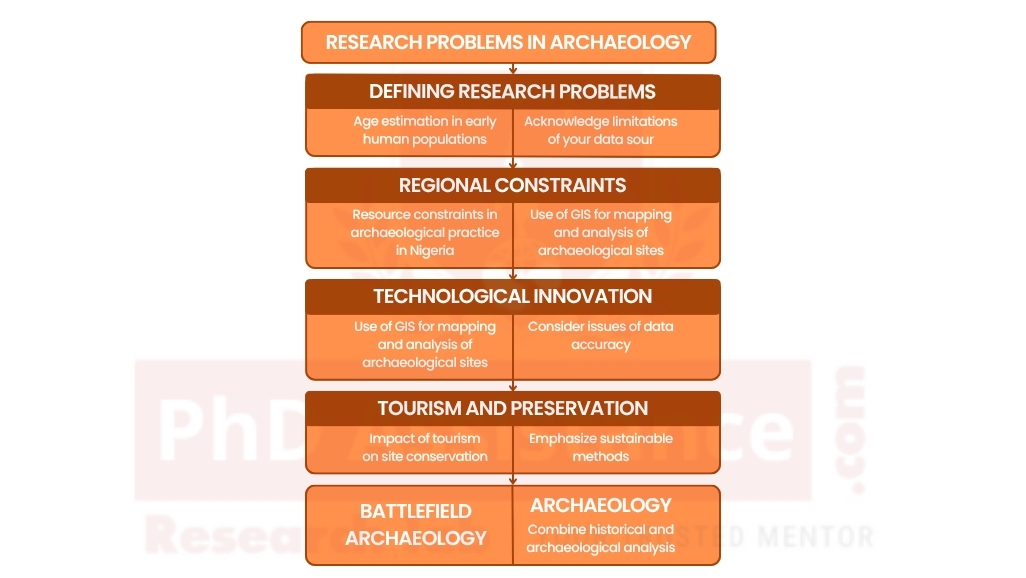
| Research problem area | Challenges | Tips for doctoral researchers |
|---|---|---|
| Defining research problems | Fragmentary data, variable preservation of material culture, lack of written records | State the limits of the evidence and the effects of preservation when you frame the question |
| Wicked problems in heritage management | Balancing conservation, public access and tourism; conflicting stakeholder needs | Include the perspectives of local communities, authorities, professionals and visitors in the design |
| Regional constraints | Limited funding, insecurity, shortage of trained professionals | Collaborate with local and international institutions and plan for access and safety early |
| Technological innovation | GIS used mainly for mapping; limited theoretical grounding; small, thinly maintained software projects | Define the spatial question first, seek training or specialist input, and document software versions |
| Tourism and preservation | Economic benefits against preservation needs; site damage from visitor pressure | Focus on sustainable approaches and on how stakeholders weigh the trade-offs |
| Battlefield archaeology (added) | Scattered, disturbed and sparse material evidence | Combine systematic survey with historical sources and frame narrow, testable questions |
The following example is illustrative. A doctoral researcher wants to study "life and death in an Iron Age community" using a previously excavated cemetery held in a museum.
- Initial idea. Life and death in the community. This is a topic, too broad to answer.
- Evidence check. The skeletons are partly fragmentary, and the original report used age categories that ended at "50+". Following Boldsen et al. (2022), she recognises that older adults are likely to be under-represented by these methods.
- Problem. "Published accounts of the community's mortality rest on age estimates that probably under-represent older adults, so conclusions about life expectancy may be biased."
- Question. How does re-estimating adult age at death with current methods change the age-at-death distribution and the interpretation of the community's mortality?
- Design implications. Access to the collection and permission for analysis; training in the age estimation method; a plan to report uncertainty; and, if dating is needed to phase the burials, a radiocarbon sampling strategy agreed early (Bayliss, 2009).
The final problem is narrower than the initial idea, but it is answerable, it is grounded in a known limitation of the evidence, and it connects to a wider debate. The course Research Methodology covers the design decisions that follow.
Common mistakes
- Framing the problem as a broad historical narrative rather than a specific, answerable question.
- Ignoring how deposition, preservation and recovery have filtered the evidence.
- Building the project around a technique, such as GIS, without a clear question for it to answer.
- Leaving radiocarbon dating, permits or specialist analysis until after fieldwork has begun.
- Treating heritage and tourism issues as technical problems with one solution, and leaving out stakeholders.
- Underestimating regional constraints on funding, access, security and laboratory facilities.
Key takeaways
- Archaeological research problems must be framed around the limits of fragmentary, unevenly preserved evidence (Boldsen et al., 2022).
- Linking a local problem to field-wide challenges, such as those identified by Kintigh et al., shows why it matters (Kintigh et al., 2014).
- Heritage and tourism issues are often wicked problems, best studied by clarifying stakeholder values and trade-offs (Rittel & Webber, 1973; Schofield, 2024).
- Funding, security and training constraints differ by region and should shape the problem from the start (Nomishan et al., 2025).
- GIS, open-source tools and radiocarbon modelling strengthen a study only when the question is clear and their demands are planned (Menéndez-Marsh et al., 2023; Bayliss, 2009).