
The source and why it matters
This review examines Eckstein et al. (2025), "Thirty-five years of sensemaking in the business & management research: A bibliometric analysis, review and discussion", which appeared in Management Review Quarterly (volume 75, issue 4, pages 3191 to 3217) after online publication in 2024. The authors are linked to the University of Southern Queensland, and the article is open access.
Sensemaking describes how people notice ambiguous or surprising cues and work them into a plausible account that lets them act. Weick (1995) characterised the process by seven properties: it is grounded in identity construction, retrospective, enactive of the environment, social, ongoing, focused on extracted cues, and guided by plausibility rather than accuracy. His study of the Mann Gulch fire showed how a breakdown of shared meaning and role structure can turn a hard situation into a disaster (Weick, 1993). Later work placed sensemaking at the heart of organising (Weick et al., 2005), and a landmark review defined it as a process, set off by violated expectations, in which people attend to cues, build shared meaning through cycles of interpretation and action, and so enact a more ordered environment (Maitlis & Christianson, 2014).
The concept now appears in so many guises that management doctoral researchers can easily lose their bearings. A study that charts the whole field offers them a way to see where their own interest lies.
What the study did and found
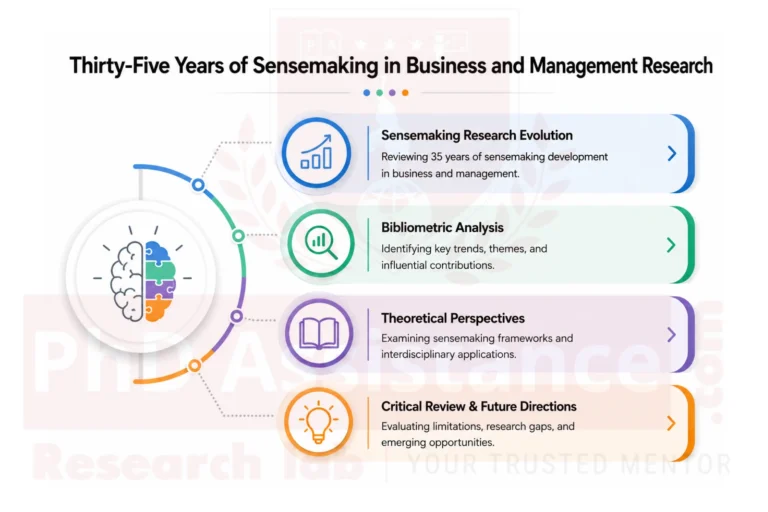
The authors queried Web of Science for sensemaking and allied terms such as sensegiving and sensebreaking, restricting results to English-language articles in business, finance, economics and management categories. The final corpus held 2,838 articles published between 1988 and 2023. Two kinds of analysis followed: performance analysis, which counts publications and citations by year, author and journal, and science mapping, which builds co-citation and keyword co-occurrence networks. The work used the bibliometrix package, with VOSviewer as a cross-check (Eckstein et al., 2025).
| Theme identified | What it brings together |
|---|---|
| Communication and organisational learning | The core of the field: sensemaking, communication, emotion, knowledge and learning |
| Sustainability and corporate social responsibility | A growing theme, including how managers handle paradox and competing goals |
| Innovation and strategy | Knowledge, technology and strategic change |
| Crisis management | Crisis, resilience and disruption, strengthened by research on the COVID-19 pandemic |
Co-citation patterns across four periods suggest that the field's intellectual base moved from psychology and sociology to organisation studies and management, and later towards strategy, marketing and international business. The paper ends with propositions for further work: sensemaking in marketing under volatile conditions, in international business and in small business strategy, plus a realist paradigm as an alternative to the dominant social constructionism. The authors recognise that one database, English-only articles and chosen subject categories bound their results (Eckstein et al., 2025).
Strengths
- Scale and transparency. With 2,838 articles and stated search terms, categories and exclusions, the corpus dwarfs earlier systematic reviews of the concept, and others can repeat the steps.
- Established techniques. Performance analysis and science mapping are standard in management bibliometrics (Zupic & Čater, 2015; Donthu et al., 2021), and bibliometrix is a widely used open tool (Aria & Cuccurullo, 2017).
- A long view. Tracing sensemaking from crisis and organisation studies into marketing and international business gives newcomers a map that no single review provides.
- Agreement with conceptual reviews. The clusters on communication, learning, strategy and crisis are consistent with themes identified in qualitative reviews of the field (Maitlis & Christianson, 2014; Sandberg & Tsoukas, 2015).
- Concrete next steps. The propositions on marketing, international business and small firms give doctoral researchers specific places to start.
Limitations and methodological issues
- Database coverage. Relying on Web of Science alone has consequences. Comparisons with Scopus show that both databases under-represent the social sciences and humanities relative to the natural sciences and favour English-language journals (Mongeon & Paul-Hus, 2016). Books, which are central to sensemaking (Weick's included), fall largely outside the corpus. Guidance on merging Scopus and Web of Science records now exists (Lim et al., 2024), so a single-source design is harder to justify than it was.
- Term-based retrieval. A search for "sensemaking" and its derivatives catches work that uses the label, including loose uses, and misses studies of the same process under other names. The word is also spelt in several ways across disciplines (Urquhart et al., 2025), so readers should check which variants the search string covered.
- Mapping is not synthesis. Co-citation and co-word networks reveal which works are cited together and which terms appear together. They do not reveal what studies found, whether findings agree or how strong the evidence is (Zupic & Čater, 2015). The paper is open that it offers bibliometric analysis and discussion, but its clusters should not be read as conclusions about sensemaking itself.
- Interpretive choices. Labelling clusters and periods involves judgement, and other thresholds or algorithms could yield other maps. Reporting parameters therefore matters (Donthu et al., 2021), and recent guidance asks authors to document how they moved from description to interpretation (Lim & Kumar, 2024).
- Citation bias. Citation counts favour older, more visible and English-language work, so a map built on them can inflate the centrality of established authors and journals.
Here the ethical questions concern representation rather than participants: whose research becomes visible, and how much the conclusions depend on a commercial database's choices. Stating those limits plainly, as the authors partly do, is the right response.
How the study sits in the wider literature
The bibliometric picture is best read alongside conceptual reviews. Maitlis and Christianson (2014) organised the field around what triggers sensemaking, how it unfolds and what it produces. Sandberg and Tsoukas (2015) identified its main constituents and argued that research had concentrated on discrete episodes prompted by disruption, neglecting everyday, embodied and prospective sensemaking. Brown et al. (2015) showed how diverse the concept had become in organisation studies, and Cristofaro (2022) proposed a co-evolutionary model connecting individual and organisational sensemaking. These reviews explain what the clusters mean, whereas Eckstein et al. show where, and how much, the work has been published.
The paradigm question in the propositions deserves more room than the paper gives it. Most sensemaking research is qualitative and interpretive, often inductive in the manner of the Gioia methodology (Gioia et al., 2013). International business leans more towards positivism, yet Welch et al. (2011) counted interpretive sensemaking among several legitimate ways of theorising from case studies in that field. A realist turn is therefore one route into international business, not the only one, and a doctoral researcher should let the question rather than disciplinary habit decide the paradigm. The pandemic also revived interest in how people make sense of prolonged, collective disruption (Christianson & Barton, 2021), which matches the crisis cluster.
What newer research adds (2024 to 2026)
Work published since 2024 bears on the paper in two ways: it refines how bibliometric reviews should be designed and judged, and it extends the conceptual debate about sensemaking. The table summarises seven contributions.
| Study | Design and data | Key finding | What it means for the reviewed paper |
|---|---|---|---|
| Lim and Kumar (2024) | Methodological guidance for interpreting bibliometric results | Interpretation adds subjectivity to quantitative results; a three-stage process of scanning, sensing and substantiating is proposed | The interpretive step, where the paper is thinnest, can be structured and reported |
| Öztürk et al. (2024) | Overview of the literature and framework proposal | Distinguishes bibliometric analysis from bibliometric research and sets out stages, steps and reporting headings | Offers a design template against which the study's research framing can be checked |
| Hoang (2025) | Framework for peer review and critical reading of bibliometric reviews | The VALOR framework: verification, alignment, logging, overview and reproducibility | Gives readers a structured way to appraise the paper |
| Lim et al. (2024) | Procedural guidelines with a worked case on metaverse research | Shows how to combine and clean Scopus and Web of Science data and use bibliometrix and VOSviewer together | Addresses the single-database limitation directly |
| Culbert et al. (2025) | Comparison of 16.8 million publications shared by OpenAlex, Web of Science and Scopus | OpenAlex has comparable reference coverage, more ORCID identifiers and fewer abstracts | An open source could make a replication cheaper and fully reproducible |
| Urquhart et al. (2025) | Systematic review and meta-synthesis across information science and education | Sense-making, sensemaking and sense making carry different traditions; Dervin dominates information science, Weick organisational and education research | A business-only, single-spelling search sees only part of the concept's history |
| Calvard (2025) | Critical essay on sensemaking in Management Learning | Calls for critical sensemaking that foregrounds power, politics and ethics, and for traditions beyond Weick | Extends the paper's paradigm proposition beyond realism versus constructionism |
Some of this work confirms the paper's approach. The guidance from Lim et al. (2024) endorses the pairing of bibliometrix and VOSviewer that Eckstein et al. used, and Öztürk et al. (2024) treat performance analysis and science mapping as standard components of a well-designed study. Calvard (2025) shows that sensemaking remains a live, debated idea in management learning, consistent with the growth the paper documents.
Other contributions challenge it. Urquhart et al. (2025) show that the concept has parallel lives under different spellings and founders, so a search limited to business categories maps one branch of a larger tree. Culbert et al. (2025) suggest that open data could now support a fuller and more reproducible corpus. Lim and Kumar (2024) argue that interpretation is unavoidable in bibliometrics and should be made systematic, which exposes how briefly the paper explains its cluster labels. Read through the VALOR lens (Hoang, 2025), the study scores well on overview and alignment but leaves logging of cleaning decisions and full reproducibility for readers to check.
Several questions remain open. Nobody has yet tested whether a multi-database or open-data replication, including books and non-English work, would yield the same four clusters. The critical and phenomenological directions that Calvard (2025) proposes are not yet visible as a cluster, and the map ends in 2023, before much work on sensemaking about generative AI could appear.
What a bibliometric review should report
Whether you are reading a bibliometric study or planning one for your thesis, the same reporting items decide how far it can be trusted and repeated. Eckstein et al. report most of them. The checklist draws on established and recent guidance for bibliometric work in management (Zupic & Čater, 2015; Donthu et al., 2021; Öztürk et al., 2024).
| Item | Why it matters | In Eckstein et al. (2025) |
|---|---|---|
| Database(s) and search date | Coverage differs between databases and changes over time | Web of Science only; searched in early 2024 |
| Full search string | Lets others repeat or extend the search | Sensemaking and related terms such as sensegiving |
| Inclusion and exclusion criteria | Defines the boundaries of the field mapped | Business and management categories; English; 1988 to 2023 |
| Cleaning of records | Duplicates and author name variants distort counts | Should be checked in the full text |
| Software and parameters | Thresholds and algorithms change the maps | bibliometrix, with VOSviewer for checking |
| Interpretation of clusters | Labels are the authors' judgement | Four clusters named and discussed |
| Interpretive procedure | Shows how description became insight | Not set out as a separate step (Lim & Kumar, 2024) |
| Limitations | Tells readers what the map leaves out | Database, language and category limits acknowledged |
The paper is well organised, moving from the origins of sensemaking through method to findings and propositions, and its figures make the networks easy to follow. Its discussion is more descriptive than evaluative: it shows where the field has gone but says little about where findings conflict or which strands are weakest. That is a natural limit of the method rather than a fault of execution, and it is precisely the gap a doctoral literature review, which must compare and judge studies, exists to fill.
What it means for doctoral researchers
Treat a bibliometric study as a starting map, not as your literature review. The table compares the main review types a doctoral researcher might use.
| Review type | What it can show | What it cannot show | Use in a thesis |
|---|---|---|---|
| Bibliometric analysis | Growth, influential works, intellectual structure, emerging themes | What studies found or how strong the evidence is | Scoping the field; justifying where you focus |
| Systematic review | What studies on a defined question found, with appraisal of quality | The wider shape of a large, loosely bounded field | Answering a focused question rigorously |
| Narrative or conceptual review | Theoretical development, debates and tensions | Complete coverage; it depends on the author's selection | Building your theoretical framework |
If you run a bibliometric analysis yourself, the newer guidance raises the bar. Search more than one source or justify why not (Lim et al., 2024; Culbert et al., 2025), record every cleaning decision, and write up how you interpreted the maps as a method in its own right (Lim & Kumar, 2024; Hoang, 2025).
Worked example (illustrative)
A doctoral candidate plans to study how export managers in small firms make sense of sudden tariff changes. Because Eckstein et al. list both international business and small business strategy among their propositions, the candidate can cite the map to show that the area is emerging. Next, the candidate reads the conceptual reviews to pin down a definition of sensemaking (Maitlis & Christianson, 2014; Sandberg & Tsoukas, 2015), searches Scopus and OpenAlex as well as Web of Science, includes the hyphenated spelling and book chapters, and chooses a qualitative multiple-case design with an interpretive logic (Welch et al., 2011). The gap is then framed as a question about a process in a setting, not merely as "few papers exist", and the candidate considers whether to question an assumption of existing work rather than only fill a gap (Sandberg & Alvesson, 2011).
Common mistakes when using bibliometric reviews
- Presenting cluster labels as if they were findings about the phenomenon.
- Assuming the most cited works are the most relevant to your question.
- Relying on one database, or on journal articles alone, without saying so.
- Searching for one spelling of a concept that different fields write in different ways.
- Claiming a gap because few papers use a keyword, rather than because a question remains unanswered.
- Leaving out search strings, inclusion criteria, software, thresholds and interpretive steps, so the map cannot be reproduced.
- Borrowing a concept such as sensemaking without stating which version of it you use.
Key takeaways
- Eckstein et al. (2025) map 2,838 Web of Science articles from 1988 to 2023 and identify four themes: communication and learning, sustainability, innovation and strategy, and crisis.
- The study shows sensemaking spreading from organisation studies into strategy, marketing and international business.
- Bibliometric mapping reveals the structure of a field, not what its studies found (Zupic & Čater, 2015; Donthu et al., 2021).
- Single-database, English-only and single-spelling searches shape the map; multi-source and open data now make broader searches feasible (Mongeon & Paul-Hus, 2016; Lim et al., 2024; Urquhart et al., 2025).
- Recent guidance treats interpretation and reproducibility as reportable parts of bibliometric method (Lim & Kumar, 2024; Hoang, 2025).
- Doctoral researchers should combine the map with conceptual reviews and a clearly defined version of sensemaking (Maitlis & Christianson, 2014; Sandberg & Tsoukas, 2015).