
How to use this list
Sustainable supply chain management asks firms to manage material, information and money flows while meeting environmental and social goals as well as economic ones (Seuring & Müller, 2008). Interest in the link between supply chains and sustainable development has grown quickly (da Silva et al., 2025), and artificial intelligence is now applied to many supply chain tasks, from demand forecasting to risk assessment (Baryannis et al., 2019).
The rebuilt titles below keep every idea but make each one specific. Each table gives a possible research question, a likely design and why the topic matters now. Change the sector or country to match the data you can reach. For firm-level questions see sustainable business model titles and generative AI in sustainable business ecosystems; for the wider field, business topics and the topics hub.
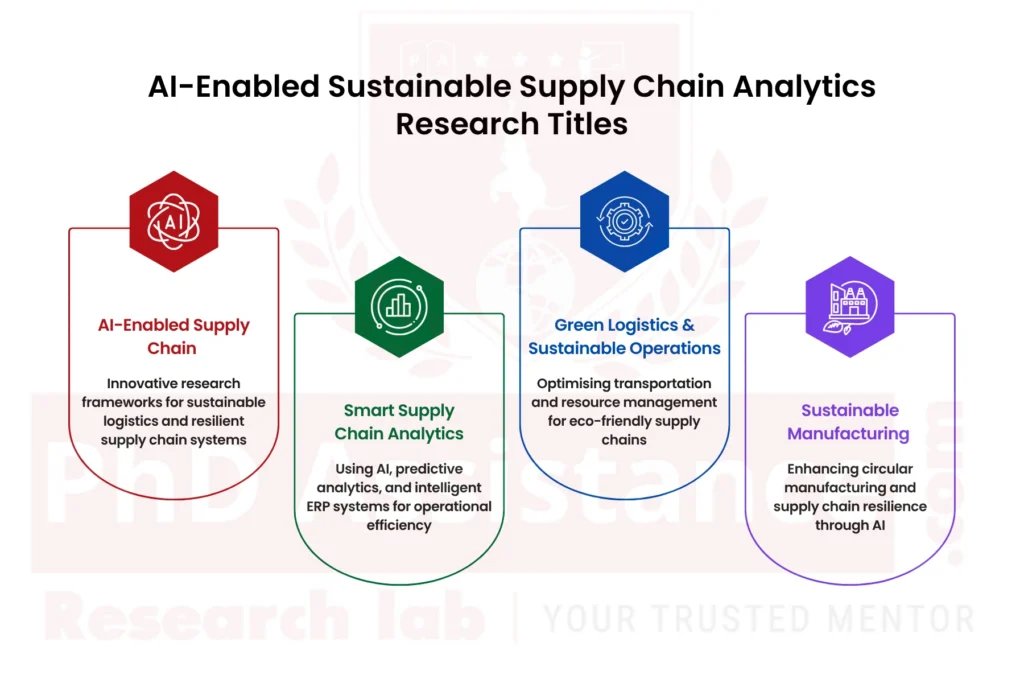
Theme 1: Circular manufacturing and green logistics
| Dissertation title | Possible research question | Likely design and data | Why it matters now |
|---|---|---|---|
| Machine-learning forecasting of product returns and remanufacturing yield in reverse logistics: evidence from an electronics or automotive parts manufacturer | Do machine-learning models forecast return volumes and recoverable yield more accurately than current planning methods, and does better forecasting change remanufacturing capacity decisions? | Quantitative study of historical returns and inspection records from a company partner; time-ordered evaluation; simulation of capacity decisions under each forecast | Circular strategies depend on returns that are hard to predict, and sustainability research increasingly links supply chains to wider development goals (da Silva et al., 2025) |
| Predictive arrival estimates and the environmental performance of distribution networks: a retrospective study of lateness, empty running and emissions | Are shipments with machine-learning arrival estimates delivered on time more often, and do they reduce empty running and estimated fuel use compared with shipments planned without them? | Secondary analysis of telematics and order data from a logistics provider; matched or difference-in-differences comparison before and after adoption | Visibility tools are widely promoted, but their environmental effect is rarely measured |
Evidence that the gap is real. Seuring and Müller (2008) reviewed the early literature and proposed a framework that separates supplier management for risk and performance from supply chain management for sustainable products, a distinction that still helps a doctorate decide what it is measuring. The more recent systematic review by da Silva et al. (2025) traces how supply chain research has been tied to sustainable development. What remains thin is evidence that analytics tools change operational decisions and environmental outcomes in practice, which is the question both titles above put to the test.
Theme 2: Forecasting, inventory and risk
| Dissertation title | Possible research question | Likely design and data | Why it matters now |
|---|---|---|---|
| Machine-learning demand forecasting, perishable waste and resilience under disruption: evidence from a grocery retailer | Does a machine-learning forecast reduce stockouts and waste compared with the retailer's current method, and does the advantage hold during a demand or supply shock? | Store-level sales, stock and waste data; rolling-origin evaluation; separate analysis of normal and disrupted periods | Disruptions such as the COVID-19 pandemic showed that efficiency-focused supply chains can fail under stress (Ivanov & Dolgui, 2020) |
| AI-supported supplier risk assessment with environmental and social criteria: a comparison with conventional supplier scoring | Does a machine-learning risk model that adds environmental and social indicators identify problem suppliers earlier than the firm's existing scorecard? | Supplier audit, delivery and incident records from a buying firm; model comparison on later periods; interviews with buyers on how scores are used | AI methods for supply chain risk are growing, and social risk at suppliers remains hard to detect (Baryannis et al., 2019; Huq et al., 2014) |
Evidence that the gap is real. Baryannis et al. (2019) classify AI work on supply chain risk management by method and by risk task (identification, assessment and response) and set out open research directions. Ivanov and Dolgui (2020) argue that supply chains should be studied for viability, meaning their ability to survive long disruptions, not only for efficiency. Huq et al. (2014) explore how suppliers in the Bangladeshi ready-made garments industry approach social sustainability, a reminder that social risk sits with suppliers that a buyer's scorecard may barely reach.
Theme 3: Collaboration in agri-food supply chains
| Dissertation title | Possible research question | Likely design and data | Why it matters now |
|---|---|---|---|
| Data sharing and AI-supported collaboration in agri-food supply chains: effects on food loss and emissions among smallholder cooperatives | Do cooperatives that share harvest, storage and demand data with buyers through a digital platform record lower post-harvest loss and lower emissions per tonne than comparable cooperatives that do not? | Mixed methods: cooperative records and a structured survey with a matched comparison group; interviews on trust and data ownership | Food systems account for about a third of global anthropogenic greenhouse gas emissions (Crippa et al., 2021) |
Evidence that the gap is real. Crippa et al. (2021) estimate that food systems are responsible for about a third of global anthropogenic greenhouse gas emissions, with emissions arising across production, processing, transport and consumption. Collaboration between farmers and buyers is often proposed as a way to cut loss and emissions, but evidence on whether shared data and AI tools deliver this for smallholders, and who controls the data, is limited.
How to test a title before you commit
Use the general method in how to choose a PhD topic and how to select a PhD topic, or our topic selection support, and screen each idea with the FINER criteria (feasible, interesting, novel, ethical, relevant) (Hulley et al., 2013). For supply chain analytics titles, check four things early.
- Data access: operational data belong to companies; agree access, anonymity and publication rights in writing before you commit.
- Outcome: name the sustainability measure (waste, emissions per unit, loss, supplier incidents) as well as cost or service level.
- Comparison: compare the AI method with what the firm does now, not only with another algorithm.
- Time: evaluate on later periods than you trained on, and look separately at disrupted periods.
Worked example (illustrative). A student starts from the live title on "AI in supply chain management for sustainable inventory forecasting and operational resilience". It names no sector, data or measure. A regional grocery chain agrees to share three years of store-level sales, stock and waste records. He narrows the title to fresh produce, compares a gradient-boosted forecast with the chain's current method, and measures stockouts and waste as well as forecast error, reporting results separately for a known disruption period. The title now states its sector, its data, its comparison and its outcomes.
Common mistakes
- Assuming AI improves sustainability rather than testing whether it does.
- Reporting forecast accuracy without its effect on stock, waste or emissions.
- Treating sustainability as environmental only and ignoring social conditions at suppliers.
- Choosing a title before securing company or cooperative data.
- Comparing only algorithms, with no baseline from current practice.
- Ignoring who owns shared data in collaborative supply chains.
Key takeaways
- Sustainable supply chain management covers environmental and social goals as well as economic ones (Seuring & Müller, 2008).
- AI methods for supply chain risk are maturing, but their effect on decisions still needs testing (Baryannis et al., 2019).
- Resilience research should ask how supply chains survive long disruptions, not only how efficient they are (Ivanov & Dolgui, 2020).
- Agri-food supply chains are a major source of emissions, which makes them a strong setting for sustainability analytics (Crippa et al., 2021).
- Screen every shortlisted title for feasibility, novelty, ethics and relevance (Hulley et al., 2013).