
- / Title
AI-Enabled Sustainable Supply Chain Analytics Titles | phdassistance.com
Info: AI-Enabled Sustainable Supply Chain Analytics Titles | phdassistance.com
Published: 18th May 2026 in AI-Enabled Sustainable Supply Chain Analytics Titles | phdassistance.com
Share this:
Related Services
Introduction
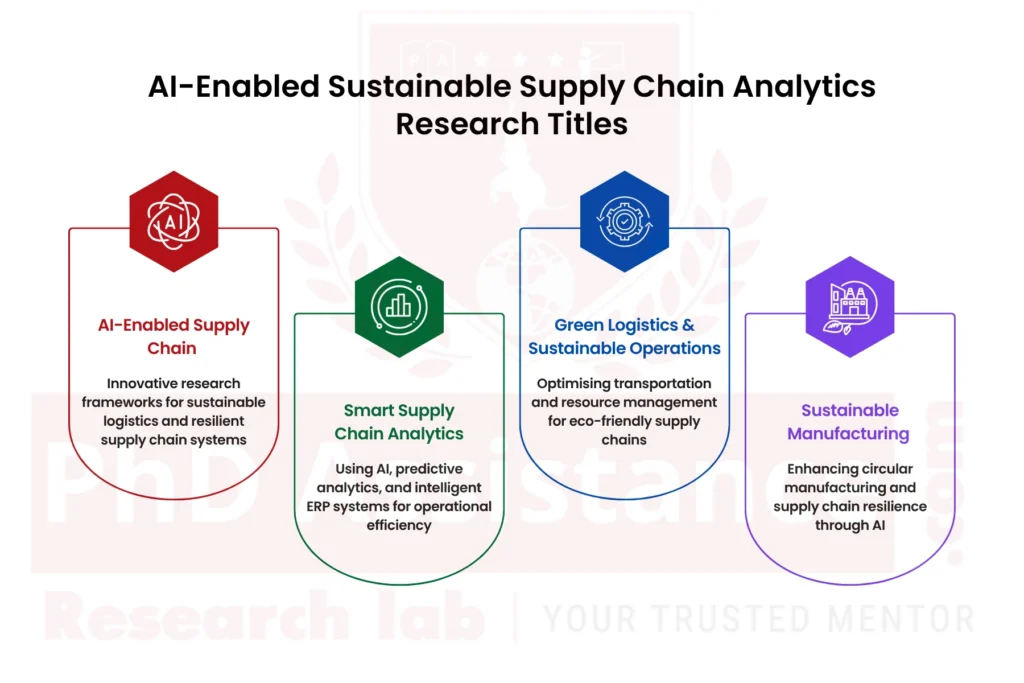
The growing demands for sustainability and efficient logistics have led to a rise in research on novel ways through which supply chains can be managed. Issues that companies currently face include disrupted supply chains, poor utilisation of resources, emission of carbon dioxide, and a lack of live logistics information. Current studies are exploring Sustainable Supply Chain Analytics Solutions for improving efficiency and adopting greener logistics, as well as enhancing resilience in supply chains. The combination of AI, predictive analytics, automation, and intelligent ERP is proving to be helpful in optimising logistics, minimising wastage, improving forecasting, and adopting sustainable manufacturing processes. The PhD Assistance helps in developing creative and publishable topics that involve sustainable supply chain management, AI-driven logistics, predictive analysis, and green supply chain management.
Proposed PhD Title 1: AI-Driven Supply Chain Analytics Solutions for Circular Manufacturing and Green Logistics Optimisation
Scholars at Supply Chain Analytics are studying how Artificial Intelligence may assist in circular production processes, reduce wastages, and streamline eco-friendly logistics operations. Today’s business world faces problems like high carbon footprint, inefficient inventory management, supply chain process disruption, and wastage of resources. The application of AI in Supply Chain Management using advanced analysis and intelligent ERP software can assist firms to be effective and sustainable in their operations. As pointed out by Hasan (2025), ERP systems powered by AI are very efficient in enhancing the recycling process.
Problem Statement:
However, the existing supply chain systems find it challenging to maintain the balance of efficiency and sustainability because of limited predictive capacity, inadequate visibility, and inefficient resource management. The existing logistics and manufacturing systems are unable to integrate the AI-enabled sustainability assessment capabilities within their circular economy systems because they generate waste and operate inefficiently.
Research Gap:
Few research works have attempted to integrate Sustainable Supply Chain Analytics Solutions that include AI-enabled ERP systems, circular economy models, and Green Supply Chain solutions for sustainable manufacturing operations.
Research Question:
How could AI-based Sustainable Supply Chain models enhance the effectiveness of circular manufacturing and sustainable logistics?
Outcome:
In this study, a new framework using artificial intelligence will be created that uses predictive analytics and automation, and also incorporates circular supply chain techniques into manufacturing.
Reference:
Hasan, M. M. (2025). A Framework-Based Meta-Analysis of Artificial Intelligence-Driven ERP Solutions for Circular and Sustainable Supply Chains.
Proposed PhD Title 2. Artificial Intelligence for Logistics and Real-Time Supply Chain Visibility in Smart Distribution Networks
Artificial Intelligence for Sustainable Logistics researchers are investigating the potential impacts of AI-based predictive analytics and real-time data integration capabilities on reducing ship delivery delays and boosting logistics efficiency. Contemporary logistics management is faced with serious problems such as delivery delays, disjointed data management, inefficiencies in route optimisation, and a lack of shipment tracking visibility. As pointed out by Yerra (2025), AI-based predictive analytics, ETL systems, and real-time data monitoring are very efficient in logistics improvement and supply chain management.
Problem Statement:
The conventional logistics systems are heavily reliant on manual monitoring and batch processing of data, leading to no real-time availability of data and delaying of shipping. Lack of predictive analytics and logistic monitoring negatively affects sustainable transportation and logistics systems.
Research Gap:
Current studies have made little progress in developing frameworks for integrating Supply Chain Solutions, AI-based predictive analytics, real-time ETL processing, and logistics optimisation sustainability
Research Question:
How can AI-based predictive analysis be used for visibility in smart logistics and sustainable logistics management?
Outcome:
The study will develop an AI logistics analytics framework using real-time predictions, automation of ETL processes, and sustainable route optimisation.
Reference:
Yerra, S. (2025). Optimising Supply Chain Efficiency Using AI-Driven Predictive Analytics in Logistics.
Proposed PhD Title 3. AI in Supply Chain Management for Sustainable Inventory Forecasting and Operational Resilience
AI researchers in the field of SCM investigate the use of ML and prediction analytics to better inventory predictions, coordination of suppliers, and supply chain resilience. In this context, the following factors are important: ineffective demand forecasting, high costs associated with the maintenance of surplus stocks, and disturbances in the supply chain. The traditional forecasting systems do not have flexibility and predictive capabilities. In such a way, the application of AI technologies combined with predictive analytics and automation assists businesses in increasing the level of accuracy in forecasting and optimising operations.
Problem Statement:
The conventional models for forecasting the supply chain suffer from a lack of predictive intelligence and an inability to adapt to the changes in demand, supply, and inventory due to its inadequacies. Most companies use historical information and conventional techniques of forecasting to estimate demand and supply, which creates issues like overstocking, stockouts, and decision-making delays.
Research Gap:
The existing literature offers little academic research on the application of AI-based forecast models and Predictive Maintenance techniques for developing an Integrated Supply Chain Analytics approach.
Research Question:
How can an efficient inventory system be created with the help of predictive AI-based forecasting systems?
Outcome:
The objective of this research paper is to design an innovative predictive framework based on AI for the supply chain, which would help in enhancing inventory forecasting and operations.
Reference:
Yusuf, S. O., et al. (2025). The Impact of AI on Supply Chain Operations: A Comparative Analysis of Traditional vs AI-Enabled Processes.
Proposed PhD Title 4. Green Supply Chain Analytics for AI-Enabled Collaborative Agricultural Supply Chain Performance
In the field of Green Supply Chain Analytics, researchers have shown great interest in the ways in which the power of AI collaboration is leveraged to enhance sustainability and coordination within agricultural supply chains. Agricultural supply chains suffer from several problems, such as inefficient logistics and delays, poor quality control, etc. Due to poor coordination and a lack of information-based decision-making, traditional agricultural supply chains fail to achieve transparency and sustainability. With the incorporation of artificial intelligence technology with predictive analytics and logistics, it becomes easier for companies to manage their performance sustainably.
Problem Statement:
Current urban development systems encounter various difficulties because traditional grey infrastructure systems fail to control increasing environmental threats and urban climate risks. The current resilience planning system experiences operational difficulties because its different components operate as separate entities, and its digital monitoring system lacks sufficient capability; it does not establish proper connections with stakeholders, and it fails to integrate climate adaptation with sustainability practices.
Research Gap:
Very limited studies are available on the design and development of cooperative Supply Chain Analytics frameworks that adopt coordination based on AI, logistics prediction, and sustainability within the agricultural supply chains.
Research Question:
How does integrative analysis help AI attain sustainability and efficiency in the supply chain of agriculture?
Outcome:
The present research work discusses an AI-based collaborative approach for the agricultural supply chain with an emphasis on predictive collaboration, logistics, and sustainability.
Reference:
Paul, T., et al. (2025). The Impact of Artificial Intelligence (AI)-Enabled Collaborative Approach: Achieving Sustainable Supply Chain Performance.
Proposed PhD Title 5. Smart Supply Chain for AI-Enabled Sustainable Decision-Making and Risk Management
In Smart Supply Chain Solutions research, scientists have focused on how AI would be beneficial for decision-making processes and sustainable risk management. The supply chains in the world today are constantly facing challenges such as interruptions in operations, variable demands, logistical delays, and inefficiencies within resource use. Traditional models find it difficult to cope with these issues. The incorporation of AI within SCM through predictive analysis, automation, and logistics intelligence allows companies to enhance their operational robustness and sustainable supply chain performance. According to Yusuf et al. (2025), the adoption of AI-based supply chains increases demand forecasting accuracy, operational efficiency, and visibility while decreasing disruptions and logistics inefficiencies.
Problem Statement:
The traditional models of the supply chain lack predictive capabilities and intelligent decision-making processes, hence causing low responsiveness and poor decision-making, which in turn cause disruptions within the supply chain. It is hard for many companies to incorporate artificial intelligence analysis into their logistics operations due to sustainable logistics practices.
Research Gap:
Few research efforts have been made to create integrated AI-based Sustainable Supply Chain Solutions based on intelligent decision making, sustainability optimisation, and risk-resilient supply chains.
Research Question:
What advantages can an AI-based smart supply chain provide with sustainable decision-making and risk management within the organisation?
Outcome:
The research will introduce a model of smart AI-based supply chain that will incorporate elements of predictive analytics, intelligent automation, and sustainable risk management.
Reference:
Yusuf, S. O., et al. (2025). The Impact of AI on Supply Chain Operations: A Comparative Analysis of Traditional vs AI-Enabled Processes
Need assistance finalising your dissertation topic? Selecting a strong, researchable topic can be challenging — but you don’t have to do it alone.
Our research consultants can help refine your ideas, identify literature gaps, and guide you toward a topic that aligns with current academic trends and your programme requirements.
Contact us to begin one-on-one topic development and refinement with PhdAssistance.com Research Lab.
Share this:
Cite this work
PhDAssistance. (n.d.). Virtual Influencers Dissertation Titles Retrieved 30th January 2026, from https://phdassistance.com/title/virtual-influencers/
“Virtual Influencers Dissertation Titles, https://phdassistance.com/title/virtual-influencers/
“Virtual Influencers Dissertation Titles” PhDAssistance, PhDAssistance, Tuesday, January 30th,2026.
PhDAssistance, n.d. Virtual Influencers Dissertation Titles[Online]. Available at: https://phdassistance.com/title/virtual-influencers/ [Accessed January 30th, 2026].
PhDAssistance. Virtual Influencers Dissertation Titles[Internet]. PhDAssistance; [cited 2026 January 30th]. Available from: https://phdassistance.com/title/virtual-influencers/
PhDAssistance (n.d.).
Virtual Influencers Dissertation Titles. Retrieved January 30th, 2026, from https://phdassistance.com/title/virtual-influencers/
PhDAssistance, Virtual Influencers Dissertation Titles(PhDAssistance, n.d. January 30th accessed 2026.
Study Resources
Free resources to assist you with your university studies!