
How to use this list
This list is for doctoral and master's researchers in development finance, economics, banking and public policy. Five titles are made specific, with four more on digital credit and adoption. Each row gives a possible research question, a likely design and the reason the problem matters now.
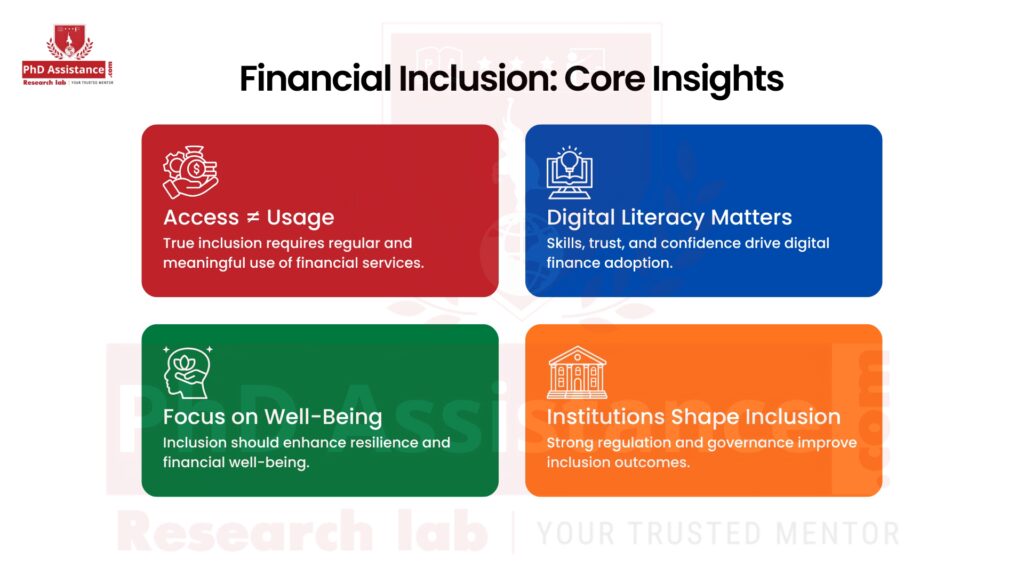
The main data source for cross-country work is the World Bank's Global Findex survey. Its 2021 edition surveyed about 128,000 adults in more than 120 economies, with more detail on digital payments and new measures of financial health and resilience (Demirgüç-Kunt et al., 2022). For credit-programme topics see microfinance research topics; for crypto and on-chain finance see decentralised finance analytics.
Theme 1: From access to meaningful use
Account ownership has grown quickly, but access is not use. The doctoral question is what turns an account into regular saving, payment and borrowing, and whether that use improves lives. Earlier evidence on microfinance shows why care is needed: Morduch (1999) found that the promise of microfinance ran ahead of rigorous evidence on its impact, a lesson that applies to newer products too.
Titles in this theme work best when they define use precisely (for example, at least one deposit or payment a month) and follow the same households over time. A single cross-section can describe who uses accounts, but it cannot show whether use leads to better outcomes; panel data, programme roll-outs or natural experiments give a stronger basis for causal claims.
| Dissertation title | Possible research question | Likely design and data | Why it matters now |
|---|---|---|---|
| From account ownership to active use: dormant accounts in a national account-opening programme | Which household and service factors predict whether accounts opened under the programme are used after two years? | Household survey linked to bank or programme data; logistic regression | Dormant accounts are a known weakness of access-led policy |
| Financial inclusion and household financial well-being: a panel study | Does active use of formal savings and payments predict higher financial well-being and fewer shocks over time? | Household panel data; fixed-effects models | Findex now includes resilience measures (Demirgüç-Kunt et al., 2022) |
| Microcredit and household outcomes: revisiting the evidence in one country | Did access to microcredit change business investment, consumption or vulnerability among borrowers? | Quasi-experimental design using programme roll-out | Impact claims need rigorous testing (Morduch, 1999) |
Theme 2: Digital finance, literacy and algorithmic credit
Digital channels reach people that branches do not, but they need digital and financial skills and trust. Technology adoption models such as UTAUT are widely used to explain uptake (Venkatesh et al., 2003). Digital data also change who can borrow: Berg et al. (2020) showed that simple digital footprint variables predict consumer default, which could extend credit to people without credit histories. The risk is unequal outcomes: Fuster et al. (2022) found that machine learning credit models can widen differences between racial and ethnic groups in US mortgage markets.
| Dissertation title | Possible research question | Likely design and data | Why it matters now |
|---|---|---|---|
| Digital financial literacy and the use of mobile financial services among young adults in one country | Does digital financial literacy predict the use of mobile payments and savings, after controlling for income and education? | Survey with validated literacy measures; structural equation modelling | Adoption depends on skills as well as access (Venkatesh et al., 2003) |
| Digital-footprint credit scoring and access to first-time credit | Does adding digital-footprint data to scoring increase approval rates for thin-file applicants without raising default? | Analysis of lender data under a data-sharing agreement | Digital footprints carry predictive information (Berg et al., 2020) |
| Fairness of machine learning credit models for underserved groups | Do machine learning credit models change approval gaps between groups compared with traditional scoring? | Simulation or lender data with fairness metrics | Algorithmic credit can widen gaps (Fuster et al., 2022) |
Theme 3: Regulation, institutions and gender
Regulation and institutions shape what providers can offer and whom they reach. Stakeholder research shows that social and institutional gaps can slow fintech adoption even in well-resourced, state-led digital economies (Al-Dasuqi, 2025). Gender gaps in account ownership and use persist in many economies, and the Findex data allow them to be tracked across countries and waves (Demirgüç-Kunt et al., 2022).
| Dissertation title | Possible research question | Likely design and data | Why it matters now |
|---|---|---|---|
| Regulatory and institutional determinants of financial inclusion: a cross-country panel analysis | Are agent-banking rules, simplified customer due diligence and deposit insurance associated with higher account use across countries? | Cross-country panel combining Findex waves with regulatory indicators | Findex allows comparison over time (Demirgüç-Kunt et al., 2022) |
| Gender, income and mobile money use: an intersectional analysis in one country | How do gender and income jointly shape mobile money use, and which barriers matter most for low-income women? | Mixed methods: survey analysis with interaction terms and interviews | Gender gaps persist in many economies |
| Institutional barriers to fintech adoption in a Gulf economy | Which regulatory and social barriers do providers and users report in adopting digital financial services? | Stakeholder interviews; thematic analysis | Institutional gaps can slow adoption (Al-Dasuqi, 2025) |
How to test a title before you commit
Check each candidate against the FINER criteria: feasible, interesting, novel, ethical and relevant (Hulley et al., 2013). In this field, feasibility means data you can legally obtain (public survey microdata or a formal agreement with a provider), and ethics means care with personal financial data.
An illustrative example of narrowing: the live well-being title asked whether inclusion affects both individual well-being and the resilience of the economy in the long run. Narrowed, it becomes a household panel study of formal savings use and financial shocks in one country. The macroeconomic question is a separate project.
For a step-by-step method, see how to choose a PhD topic, how to select a PhD topic and our topic selection support. Related lists: finance topics, finance titles, economics topics and the topics hub.
Common mistakes
- Treating account ownership as the outcome when the question is about use or well-being.
- Putting the expected result in the title, for example calling literacy a "catalyst".
- Claiming causal effects from a single cross-section of survey data.
- Ignoring fairness when studying algorithmic credit.
- Planning to use lender data before a data-sharing agreement is in place.
Key takeaways
- Access, use and well-being are different outcomes; good titles name which one they study (Demirgüç-Kunt et al., 2022).
- Impact claims for inclusion products need rigorous designs (Morduch, 1999).
- Digital data can widen access to credit but can also widen gaps between groups (Berg et al., 2020; Fuster et al., 2022).
- Adoption depends on skills, trust and institutions as well as technology (Venkatesh et al., 2003; Al-Dasuqi, 2025).
- Check data access and ethics with FINER before committing (Hulley et al., 2013).