
- / Title
Financial Inclusion Dissertation Titles | phdassistance.com
Info: 1557 words(1 pages) Financial Inclusion Dissertation Titles
Published: 9th February 2026 in Financial Inclusion Dissertation Titles
Share this:
Related Services
Introduction
The rapid improvement of artificial intelligence and digital technologies has made financial systems totally different, especially with the growth of fintech, digital banking, and AI-based financial services. Although the innovations offer scalability, efficient operations, and better access to formal banking systems, the main factors determining their effectiveness are consumer trust, transparency, and ethical governance. The existing financial research usually studies digital access, technology adoption, and financial behaviour separately, providing little insight into the impact of AI-powered financial tools on trust, risk perception, and customer engagement in the long run. The increasing use of AI in financial services thus signals an urgent need for the conduction of theory-driven financial research that integrates technological capacity, behavioural finance, and institutional viewpoints for the purpose of fostering sustainable and inclusive financial systems.
Financial Inclusion Dissertation Titles
Proposed PhD Title 1: From Access to Usage: Examining the Transition from Financial Inclusion to Meaningful Financial Participation
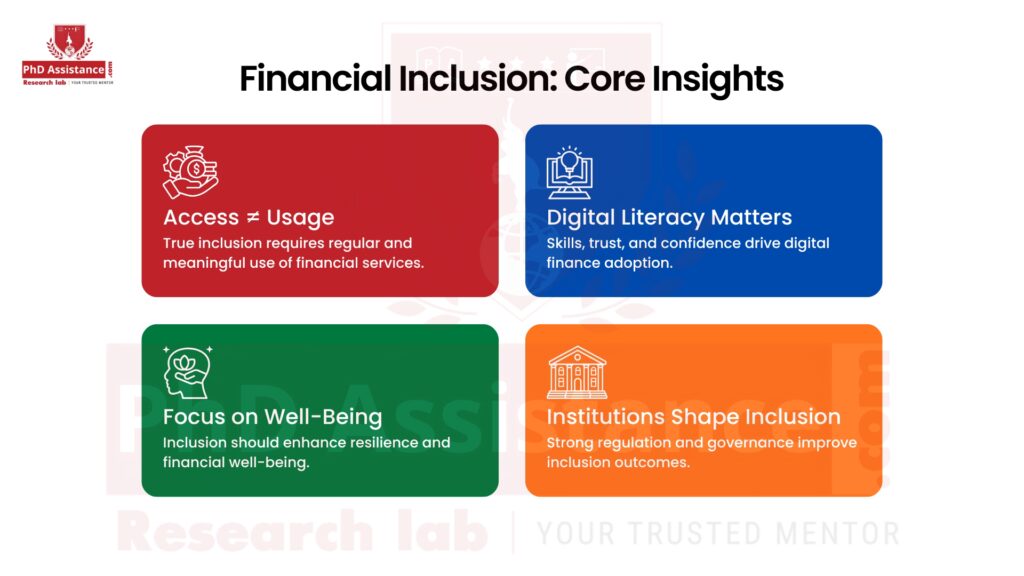
The academic discussion concerning financial inclusion has always focused on the availability of formal financial services like bank accounts, credit access, insurance, and digital payment systems. The government and international development organisations considered the increase in account ownership as the most conclusive factor of financial inclusion, as Kumar and Ahuja (2024), through their systematic literature review, pointed out that availability is not the only indicator of real financial inclusion. Access to financial services is there for the newly included people, but a large chunk of them never use it or use it very infrequently, especially in the case of low-income, rural, and marginalised groups. This disconnect between access and usage results in the raising of some important questions concerning the impact of the inclusion efforts and the value generated for individuals and households.
Problem Statement:
Even though numerous policies and technological measures have been implemented to achieve wider access to financial services, a large number of people remain either partially or completely unbanked. The situation of keeping accounts inactive, performing a few transactions, and using informal financial means continues to be the case, which ultimately lowers the developmental impact of financial inclusion programs. Neither the government nor the private sector have a good grasp of the different factors, behavioural, structural, and contextual, that inhibit access from turning into continuous financial usage.
Research Gap:
Most of the existing literature defines financial inclusion mainly through the use of access-related indicators like owning a bank account or being near a financial institution. A very small amount of empirical research has addressed the usage, continuity, and, lastly, the long-term integration of financial services in people’s economic lives after access is granted.
Research Question:
What are the mechanisms through which the provision of formal financial services leads to the continuous use of such services and the active participation in the financial system among the poor and marginalised groups?
Outcome:
The research will propose a multipronged model that separates the financial inclusion process into the three stages of access, usage, and impact, thus presenting evidence-based recommendations for policymakers and financial service providers about how to make the inclusion more effective.
Reference:
Kumar, J., & Ahuja, A. (2024). Journey of financial inclusion: A systematic literature review and conceptual framework for future research. Asia-Pacific Journal of Business Administration.
Proposed PhD Title 2. Digital Financial Literacy as a Catalyst for Financial Inclusion: A Behavioural and Capability-Based Perspective
The digitalisation of financial services has been a rapid process and has made the world more connected through mobile banking, fintech platforms, digital wallets, and online payment systems, which in turn has a great influence on the financial inclusion initiatives worldwide. The winners of the digital financial services race were not only the organisations that operated in the high-tech regions where there was no need for any extra cost, but also the poor and the unbanked, who got formal access to the financial systems. Kumar and Ahuja (2024), in their systematic review, point to digitalisation as the most important factor for the implementation of modern financial inclusion strategies. Still, accessibility to digital financial infrastructure alone will not bring about participation. Digital finance usage shall be governed by a person’s financial literacy, digital abilities, tech-confidence, and risk awareness. Lack of proper digital financial literacy might result in people having difficulties in understanding the financial offerings, not being able to use the digital platforms or making the wrong financial decisions, which would thus limit the impact of digital inclusion.
Problem Statement:
Across the globe, the outcomes of financial inclusion are still not equal even though the provision of financial services through digital means has rapidly expanded. A large number of users only use the digital platforms very little or not at all because they do not understand how the system works, are afraid of getting robbed online, or simply do not trust it. The presence of people with very low skills in using digital financial tools makes them all the more likely to fall victim to fraud, suffer from cyber risks, and exclude themselves from accessing the digital financial ecosystem. Hence, the policymakers and financial service providers are in a dilemma as to how to go beyond building infrastructure and at the same time, they are addressing the behavioural and capability restrictions, resulting in a gap that is still there between access to technology and effective financial inclusion.
Research gap:
Limited empirical evidence exists that integrates digital financial literacy with behaviour adoption patterns and financial inclusion outcomes. The majority of studies consider literacy as an instrumental variable instead of a leading explanatory mechanism.
Research Question:
How does digital financial literacy influence the eventuality of one being financially included in the digital financial ecosystem?
Outcome:
The proposed research will develop a capability-based framework that will link digital financial literacy, behavioural adoption, and their resultant inclusive financial outcomes, education and policy interventions being the implications.
Reference:
Kumar, J., & Ahuja, A. (2024). Journey of financial inclusion: A systematic literature review and conceptual framework for future research. Asia-Pacific Journal of Business Administration.
Proposed PhD Title 3. Regulatory and Institutional Determinants of Financial Inclusion: A Cross-Country Comparative Analysis
The situation regarding financial inclusion is changing and being recognised as a worldwide phenomenon that is mainly caused by market forces, government policy and regulations, and the strength of the institutional framework. Legal frameworks that cover banking, fintech, consumer rights, and financial supervision are one of the factors that determine the availability, cost and safety of financial services the most. According to the systematic literature review, the quality of institutions, the stability of regulations, and the ability to enforce them are of great importance in the case of emerging and developing economies, where the financial system is still in the process of development. It often happens that differences in the regulation of rules by the authorities and the effectiveness of institutions lead to the same financial inclusion initiatives yielding different results in different countries.
Problem Statement:
While numerous nations have enacted regulatory reforms with the goal of enhancing financial inclusion, the results are still very different from each other. The weak capacity of institutions, lack of coherence in enforcing rules, fragmentation of regulations, and insufficient cooperation among financial authorities can reduce to a large extent the positive effects of the inclusive finance policies. Therefore, the same policy frameworks might be effective in one country, but ineffective in the other. The policymakers are not able to evaluate through comparison which regulatory and institutional setups best stimulate the deep and sustainable financial inclusion, as they lack evidence-based insights.
Research Gap:
Continuous flow of a single country to another with variations in regulatory and institutional frameworks is not mapped out in terms of financial inclusion levels and quality, which shows a major weakness of the prior studies.
Research Question:
What is the impact of the different regulatory and institutional frameworks on financial inclusion in various nations?
Outcome:
The project will establish a regulatory model for comparison, which will reveal the awarding institutions and the policy exchanges that will efficiently extend the area of financial inclusion.
Reference:
Kumar, J., & Ahuja, A. (2024). Journey of financial inclusion: A systematic literature review and conceptual framework for future research. Asia-Pacific Journal of Business Administration.
Proposed PhD Title 4. Gender, Socioeconomic Inequality, and Financial Inclusion: An Intersectional Investigation into Access Disparities, Usage Behaviour, and Developmental Outcomes
Despite the worldwide attempts that have been going on for quite some time now to address inclusive finance, gender, and socioeconomic inequality, the case is that they are deep-rooted and come up as the main barriers again and again to financial inclusion. The systematic review reveals the fact that among the major groups excluded from formal financial systems and experiencing it disproportionately are women, low-income individuals, people living in rural areas, and those with little education. These differences in the situation are influenced by a mix of factors such as the prevailing cultural practices, instability in income, poor access to movement, gaps in digital technologies and also the restriction of access to education and information. Thus, the results of financial inclusion are not the same for everyone but instead show a great difference according to the different social identities and structural conditions that overlap.
Problem Statement:
The uniform policy approaches that are often adopted by the financial inclusion initiatives fail to take into account the compounded disadvantages that individuals at the intersection of gender, income, education, and geography experience. Such one-dimensional tactics are often blind to the fact that the various forms of inequality interact to determine the financial access, usage behaviour, and outcomes. This is why exclusion continues to occur even in those countries that have high overall inclusion rates, and the marginalised groups still reap the least benefits from the financial inclusion policies.
Research gap:
The available literature does not cover the intersectional aspect of the gender-socioeconomic variable interaction that has a pivotal role in determining access, usage, and outcomes of financial inclusion.
Research Question:
In what ways do gender and socioeconomic factors create an interaction that jointly affects financial inclusion and financial behaviour?
Outcome:
The result of this study will be an intersectional framework that could guide the formulation of inclusive and fair financial policies specifically for the marginalised communities.
Reference:
Kumar, J., & Ahuja, A. (2024). Journey of financial inclusion: A systematic literature review and conceptual framework for future research. Asia-Pacific Journal of Business Administration.
Proposed PhD Title 5. From Financial Inclusion to Financial Well-Being: Evaluating Long-Term Developmental Outcomes
Research conducted recently concerning financial inclusion has changed the main theme, even at this early stage, from getting access to basic services to such developmental outcomes as financial well-being, economic resilience, and household stability. The review highlights the growing consensus that inclusion must first of all give power to people so that they can deal with financial uncertainties, stabilise their consumption, and eventually improve their quality of life. Nevertheless, empirical evidence that links financial inclusion and well-being durably is still insufficient, and this lack of evidence is particularly pronounced in developing and emerging economies that are extremely susceptible.
Problem Statement:
Financial inclusion initiatives have mostly been assessed based on short-term performance indicators like account ownership, transaction volumes, or service penetration rates. Such indicators do not reveal the impact of financial inclusion on the long run in terms of improving economic security, resilience to external shocks, or financial well-being. Long-term and outcome-centred evaluations are not available to policymakers, and thus, they cannot decide if the financial inclusion initiatives really help achieve the Sustainable Development Goals.
Research gap:
Very few extensive and outcome-focused studies have connected financial inclusion with aspects like financial well-being, resilience, and socio-economic development through the years.
Research Question:
To what extent does inclusion in the financial system impact the well-being of people and the resilience of the economy in the long run?
Outcome:
The research will create a framework for the long-term impact assessment, which will connect financial inclusion to sustainable development and resilience outcomes in households.
Reference:
Kumar, J., & Ahuja, A. (2024). Journey of financial inclusion: A systematic literature review and conceptual framework for future research. Asia-Pacific Journal of Business Administration.
Need assistance finalising your dissertation topic? Selecting a strong, researchable topic can be challenging — but you don’t have to do it alone.
Our research consultants can help refine your ideas, identify literature gaps, and guide you toward a topic that aligns with current academic trends and your programme requirements.
Contact us to begin one-on-one topic development and refinement with PhdAssistance.com Research Lab.
Share this:
Cite this work
PhDAssistance. (n.d.). Virtual Influencers Dissertation Titles Retrieved 30th January 2026, from https://phdassistance.com/title/virtual-influencers/
“Virtual Influencers Dissertation Titles, https://phdassistance.com/title/virtual-influencers/
“Virtual Influencers Dissertation Titles” PhDAssistance, PhDAssistance, Tuesday, January 30th,2026.
PhDAssistance, n.d. Virtual Influencers Dissertation Titles[Online]. Available at: https://phdassistance.com/title/virtual-influencers/ [Accessed January 30th, 2026].
PhDAssistance. Virtual Influencers Dissertation Titles[Internet]. PhDAssistance; [cited 2026 January 30th]. Available from: https://phdassistance.com/title/virtual-influencers/
PhDAssistance (n.d.).
Virtual Influencers Dissertation Titles. Retrieved January 30th, 2026, from https://phdassistance.com/title/virtual-influencers/
PhDAssistance, Virtual Influencers Dissertation Titles(PhDAssistance, n.d. January 30th accessed 2026.
Study Resources
Free resources to assist you with your university studies!