
Microfinance Access and Smallholder Income Resilience in Sub-Saharan Drought Regions
Info: Microfinance Access and Smallholder Income Resilience in Sub-Saharan Drought Regions Topics I phdassistance.com
Published: 4th August in Microfinance Access and Smallholder Income Resilience in Sub-Saharan Drought Regions Topics I phdassistance.com
Share this:
Related Services
Our academic writing and marking services can help you
Introduction
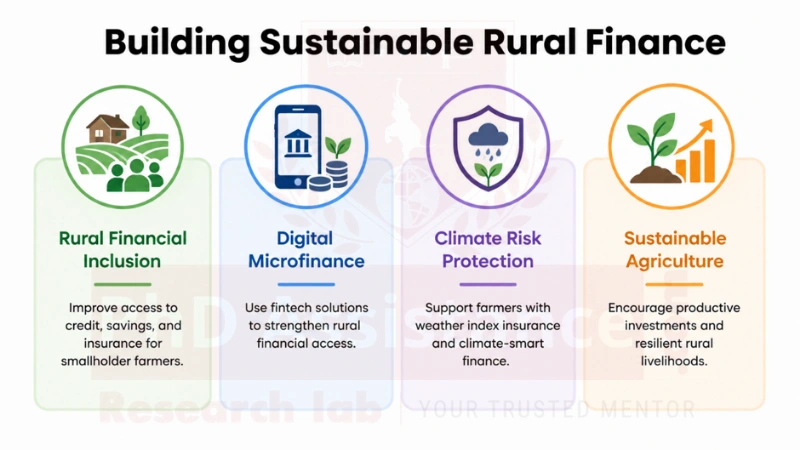
Microfinance has proven to be one of the main ways of promoting financial inclusion through the provision of credit, savings, insurance and other types of financial services to rural poor communities. Considering the issues brought about by climate change, economic uncertainty and agriculture-related risks, innovations in financial services have become more prevalent in the effort to promote sustainable rural development. Recent innovations in digital financial services, weather-index insurance, and rural financial systems have created new opportunities to enhance agricultural investments and the financial resilience of poor farming families. However, there remains much work to do regarding the improvement of credit usage, insurance penetration rates, financial governance and policymaking based on empirical evidence for rural development. The existing literature emphasises the importance of applying an interdisciplinary perspective on microfinance, digital financial technologies, climate change adaptation measures and agriculture policy in addressing these challenges. Microfinance Research Help makes an invaluable contribution to the efforts of researchers to develop new financial mechanisms.
Proposed PhD Topic 1: Integrated Microfinance and Weather Index Insurance Frameworks for Strengthening Rural Household Financial Resilience under Climate Change
Background Context:
Smallholder farmers have continued to experience climate risk exposure in the form of droughts, floods, and erratic rainfall, and such impacts the agricultural practices of the farmers. The microfinance scheme has been used to ensure financial inclusion through the provision of credit facilities for agricultural purposes, while weather index insurance has been used to cater for the climate financial risk. According to Tadesse et al. (2015), weather index insurance has great potential in improving the resilience of farmers to drought but is limited due to problems in implementation. In a similar vein, Bharadwaj et al. (2019) showed that digital financial services enhance the resilience of households by making it possible for them to access emergency loans in case of any shock. On the other hand, according to Mwonge et al. (2026), agricultural loans end up being used for consumption purposes rather than agricultural ventures and hence fail to support rural development.
PhD-Level Verification:
However, previous studies have been conducted in isolation on microfinance, weather-index insurance, digital finance, and climate adaptation. Nonetheless, there has been inadequate attention to the development of holistic financial systems that aim to maximise the use of agricultural credit, climate risk management, digital finance, and building resilience at the household level. Development of such a system will provide a great opportunity in advancing Rural Finance Research through evidence-based financial models.
Research Questions:
Contributions at the PhD-Level:
Suggested Readings:
Bharadwaj, P., Jack, W., & Suri, T. (2019). Fintech and Household Resilience to Shocks: Evidence from Digital Loans in Kenya.
Proposed PhD Topic 2: Behavioural Credit Governance Frameworks for Improving Productive Agricultural Investment among Smallholder Farmers
Background Context:
Microfinance has turned out to be a very crucial financial tool in enhancing agricultural productivity and reducing financial exclusion in the countryside. Microfinance ensures access to credit, thus helping farmers obtain inputs and adopt agricultural technology. Mwonge et al. (2026), however, found that a sizeable portion of agricultural loans is used for personal and social purposes such as buying household items, educating children, accessing healthcare facilities, among others, instead of productive farm investments. The tendency has drastically reduced the effectiveness and impact of agricultural loaning programs in fostering rural economic growth. While financial organisations have continued increasing agricultural loans, less effort has been made to study the behavioural and institutional determinants of credit utilisation. A research-based behavioural governance framework can help increase efficiency and ensure sustainable financial inclusion.
PhD-Level Verification:
The past literature has mostly focused on the socio-economic factors influencing microcredit adoption and diversion by rural households. However, there has been very little work done on creating a behavioural governance framework where decisions made by the borrowers, the monitoring of institutions, financial literacy, and credit usage can all be considered at once. This is an exciting area where Microfinance Dissertation Help can benefit greatly.
Research Questions:
PhD-Level Contributions:
Suggested Readings:
Mwonge, L. A., Tundui, C. S., & Lihawa, R. M. (2026). Exploring Microcredit Use Patterns of Tanzanian Smallholder Farmers through Multinomial Logistic Regression.
Proposed Dissertation topic 3: Digital Microfinance Ecosystems for Strengthening Financial Inclusion and Shock Recovery among Rural Farming Communities
Background Context:
The fast-paced advancement of fintech has revolutionised the provision of financial services in developing nations through the introduction of instant digital credit from mobile devices. Digital credit has enhanced financial inclusion by making credit accessible instantly to rural households in a convenient manner without the need for physical banks. Bharadwaj et al. (2019) noted that digital credit greatly enhances household resilience in that individuals can deal with unexpected expenses without having to skip necessary household expenses. However, while this may be beneficial, it was also evident that digital credit does not substitute conventional sources of finance and has little effect on long-term investments and savings. With the spread of digital financial services in rural areas, there is a need to create comprehensive digital microfinance ecosystems that not only provide better access to financial services but also encourage sustainable investment in agriculture and economic resilience.
PhD Level Verification:
The current literature has concentrated mainly on the immediate impacts of digital loans on financial inclusion and household resilience. Nonetheless, very few empirical investigations have attempted to explore the possibility of integrating the digital microfinance ecosystem with rural finance services with a view to enhancing productive investment and sustainable rural development. It is important to mention that the development of a holistic approach to digital finance provides a great chance for developing Rural Research.
Research Questions:
PhD-Level Contributions:
Suggested Readings:
Bharadwaj, P., Jack, W., & Suri, T. (2019). Fintech and Household Resilience to Shocks: Evidence from Digital Loans in Kenya.
Proposed Dissertation Topic 4: Multidimensional Resilience Assessment Frameworks for Strengthening Climate Adaptation among Smallholder Farming Communities
Background Context:
Climate change remains a major contributor to the rising occurrence and magnitude of droughts, causing many difficulties in agriculture. Smallholder farmers are at greater risk as a result of their dependency on climatically sensitive systems of farming and inadequate financial, institutional, and technological assets. According to the study conducted by Maltou and Bahta (2019), several variables impact the resilience of the farmers, including access to extension services, availability of funds, level of education, farming experience, and institutional resources. Even though such determinants have been extensively considered, current measures of resilience fail to include the dynamic interplay between financial inclusion, adaptation, and preparedness of institutions. Hence, developing a multidimensional framework for assessing resilience can help in making well-grounded decisions regarding climate adaptation policies.
PhD-Level Verification:
The current research mainly emphasises finding factors that can be responsible for making a farmer’s household resilient to drought conditions. However, very few studies have made attempts at developing an integrated resilience model that assesses adaptation through multiple aspects like socioeconomic, financial, institutional, environmental and technological factors. Development of such a comprehensive model is an important area in Climate Resilience Research.
Research Questions:
Contributions at the PhD-Level:
Suggested Readings:
Maltou, R., & Bahta, Y. T. (2019). Factors Influencing the Resilience of Smallholder Livestock Farmers to Agricultural Drought in South Africa.
Proposed Dissertation Topic 5: Institutional Frameworks for Enhancing Weather Index Insurance Adoption among Smallholder Farmers under Climate Risk
Background Context:
Climate change hazards still pose dangers to agricultural production and food security, especially in developing nations where farmers engage in rain-fed farming. Weather Index Insurance (WII) has become an effective financial mechanism that offers payouts in accordance with the set weather parameters, and not the actual crop losses, thus decreasing administrative expenditures. According to Tadesse et al. (2015), it was found that despite having the ability to help reduce the level of risk and increase the adaptive capacities of the farmers, the use of weather index insurance is still quite low due to factors like basis risk, lack of knowledge, unaffordability, and poor institutional support. Despite achieving significant advances in the development of index-based insurance instruments, there is still the need to work further on the improvement of the institutions.
PhD-Level Verification:
Past literature has mainly concentrated on the design and economics of weather index insurance schemes. However, only little has been done to find out how the institutional design of governance, policy, collaboration, and farmer participation could be used as a framework for adopting the technology. Such a research gap provides the chance of enhancing climate research using empirical institutional models.
Research Questions:
PhD-Level Contributions:
Suggested Readings:
Tadesse, M. A., Shiferaw, B. A., & Erenstein, O. (2015). Weather Index Insurance for Managing Drought Risk in Smallholder Agriculture: Lessons and Policy Implications for Sub-Saharan Africa.
Need assistance finalising your dissertation topic? Selecting a strong, researchable topic can be challenging — but you don’t have to do it alone.
Our research consultants can help refine your ideas, identify literature gaps, and guide you toward a topic that aligns with current academic trends and your programme requirements.
Contact us to begin one-on-one topic development and refinement with PhdAssistance.com Research Lab.
Share this:
Cite this work
PhDAssistance. (n.d.). Cybersecurity in business Dissertation Topics Retrieved January 28th, from https://phdassistance.com/topic/cybersecurity-business/
Jalolova, M., and Musawwir, M. “Cybersecurity in business Dissertation Topics for PhD Scholars.” PhDAssistance, https://phdassistance.com/topic/cybersecurity-business/ Accessed 28th January 2026.
Jalolova, M., and Musawwir, M. “Cybersecurity in business Dissertation Topics for PhD Scholars.” PhDAssistance, PhDAssistance, Web. 28th January 2026.
Jalolova, M., and Musawwir, M., n.d. Cybersecurity in business Dissertation Topics for PhD scholars. [online] Available at: https://phdassistance.com/topic/cybersecurity-business/ [Accessed 28th January 2026].
Jalolova M., Musawwir M. Cybersecurity in business Dissertation Topics for PhD scholars [Internet]. PhDAssistance; [cited 2026 28th January]. Available from: https://phdassistance.com/topic/cybersecurity-business/
Jalolova, M., and Musawwir, M. (n.d.). Cybersecurity in business Dissertation Topics for PhD scholars. Retrieved 28th January 2026, from https://phdassistance.com/topic/cybersecurity-business/
Jalolova, M., and Musawwir, M., Cybersecurity in business Dissertation Topics (n.d.) https://phdassistance.com/topic/cybersecurity-business/ accessed 28th January 2026.
Study Resources
Free resources to assist you with your university studies!