
Why your own errors are hard to see
When you reread your own text, you know what it should say, so you read the intended meaning rather than the words on the page. This is why authors miss errors that a fresh reader spots at once. Spellcheckers help only with one kind of error: they will not flag "trail" for "trial", a missing "not", a wrong decimal place or a citation to the wrong year.
These errors matter. Examiners read a thesis as critical experts looking for a coherent, well-presented argument, and presentation problems distract them from the contribution (Golding et al., 2014). In a journal submission, inconsistent numbers can make a reviewer doubt the analysis itself. The techniques below are ways of becoming a fresh reader of your own work.
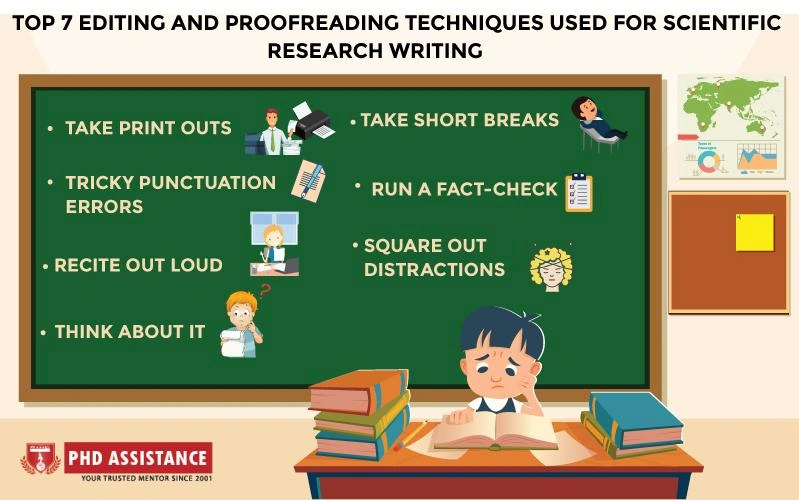
The seven techniques at a glance
| Technique | What it catches | Scientific example |
|---|---|---|
| 1. Change the medium | Errors hidden by a familiar layout | A repeated "the" across a line break |
| 2. Check meaning-bearing punctuation | Ambiguity and wrong values | "0.05" typed as "0,05"; a hyphen missing in "two-tailed test" |
| 3. Read aloud | Missing words, run-on sentences, awkward order | "Patients were not excluded" read as "Patients were excluded" |
| 4. Work in short sessions | Errors missed through fatigue | Inconsistent abbreviations late in a long chapter |
| 5. Fact-check | Wrong numbers, names, units, citations | n = 214 in the abstract but n = 241 in Table 2 |
| 6. Remove distractions | Lapses of attention | A sentence half-revised when a notification arrived |
| 7. Make several passes on different days | Errors you have stopped seeing | A figure renumbered but its in-text call-out unchanged |
Techniques 1 and 2: change the medium, then check punctuation
Print the chapter, or change the font, size and line width on screen. A new layout breaks the visual memory that lets your eye skip familiar lines. Mark problems on the page or as comments, and make corrections in a separate session so that fixing one error does not distract you from finding the next.
In scientific text, punctuation often carries values, not just rhythm. Check decimal points and thousands separators, en rules or "to" in ranges, spaces between numbers and units, signs such as minus and plus-minus, and hyphens in compound modifiers ("a 10-year follow-up"). Check that commas do not change the meaning of lists of conditions or variables. Follow the style your university or journal requires; for APA style, the seventh edition sets current rules for numbers, statistics and references (American Psychological Association, 2020).
Techniques 3 and 4: read aloud, in short sessions
Reading aloud forces you to process every word and makes missing words, doubled words and tangled sentences audible. Text-to-speech software does the same for long chapters and is useful if you are tired of your own voice. Writers of English as an additional language often find this especially helpful, although how far language alone affects publication success is debated (Flowerdew, 2019).
Attention fades with time on task. Proofread in sessions short enough that you are still reading closely, take a real break between them, and stop when you notice yourself skimming. There is no evidence for a single correct session length; find the length that works for you and keep to it.
Technique 5: fact-check everything that could be wrong
Fact-checking is the technique most specific to research writing and the one most often skipped. Make a separate pass for each of the following:
- Numbers. Sample sizes, percentages, means and test statistics must agree across the abstract, text, tables and figures, and percentages must match their denominators. Check them against the analysis output, not against an earlier draft (Van den Broeck et al., 2005).
- Statistics. Each test should be reported with its statistic, degrees of freedom, exact p value and effect size where required, in the same format throughout (Appelbaum et al., 2018).
- Units and symbols. Every quantity needs a unit, and units and abbreviations must be consistent.
- Names. Check the spelling of authors, instruments, software, genes, chemicals, places and institutions.
- Citations. Every in-text citation must match a reference and vice versa, with the same year and spelling, and each reference must say what you cite it for.
Be especially careful with any text or reference produced with an AI tool. In one study, many citations in ChatGPT-generated papers were fabricated or contained errors, although less often with GPT-4 than with GPT-3.5 (Walters & Wilder, 2023). Check each one at its source.
Applying the fact-check to figures, tables and cross-references
Figures and tables deserve their own pass, because they are revised separately from the text and drift out of step with it. For each one, check that it is numbered in order of first mention, that the call-out in the text points to the right item, that the caption describes what is actually shown, and that axis labels, legends and column headings carry units. Check that totals in tables add up, that percentages in a column sum to about 100 where they should, and that the same abbreviation is defined in every caption that uses it if the item may be read on its own.
Cross-references are the other common casualty of revision. When a section, equation or appendix is moved, every reference to it must move too. Use your word processor's or typesetting system's automatic numbering and cross-referencing where you can, then still check the final document by hand, because automatic fields can fail to update or can point to a deleted item. Finally, compare the abstract and conclusion with the results chapter sentence by sentence: these sections are often written first or last and are where inconsistent claims most often survive.
Techniques 6 and 7: remove distractions and make several passes
Proofreading needs sustained attention. Turn off notifications, close email and work where you will not be interrupted. If you are interrupted, reread the whole paragraph you were on, because half-made revisions are a common source of errors.
For any document longer than a few pages, plan several passes, each with one focus: structure, then consistency, then language, then numbers and citations. Leave time between passes, ideally a day or more, so that you return as a fresher reader. Scheduling this in the final weeks matters, because proofreading done in a rush the night before submission is mostly rereading. Keep a short log of the error types you find most often; it tells you what to look for first in the next chapter.
Tools and outside help: what is allowed
Grammar checkers and AI writing assistants can flag problems, and some doctoral programmes now experiment with chatbots as a source of formative feedback on drafts (Krumsvik, 2025). Use them only as your university allows, keep a record of how you used them, and declare their use where required. Accept changes one by one: tools frequently "correct" technical terms and can change meaning.
If you use a human proofreader, check your university's rules first. Research on proofreaders of student writing found that, given the same text, different proofreaders intervened in very different ways, some changing content (Harwood, 2018), and students and staff do not always agree on where acceptable help ends (Kim & LaBianca, 2018). Your thesis must remain your own work.
Worked example (illustrative)
An invented draft sentence reads: "Of the 214 participants, 62% (n = 123) reported improvement at the 6 month follow up (p = 0.03), see Table 3." A fact-checking pass finds three problems. First, 123 of 214 is 57.5%, not 62%, so either the count or the percentage is wrong; the researcher checks the analysis output and finds the count is 133 (62.1%). Second, Table 3 reports outcomes at 12 months; the right call-out is to Table 2. Third, the result omits the test and its effect size. Punctuation and style fixes add the hyphens in "6-month follow-up" and restructure the sentence.
The corrected sentence reads: "Of the 214 participants, 133 (62.1%) reported improvement at the 6-month follow-up (Table 2)", followed by the test result reported in the required format. None of these errors would have been flagged by a spellchecker.
Common mistakes
- Relying on a spellchecker and a single read-through.
- Proofreading on screen in the layout in which you wrote.
- Checking language but not numbers, units and citations.
- Trusting AI-generated references without checking them (Walters & Wilder, 2023).
- Leaving proofreading until the day before submission.
- Accepting a proofreader's changes to content, which may breach university rules (Harwood, 2018).
Structure and expectations differ between traditional theses and theses by publication, so check against your university's model (Paltridge, 2002). For a full self-editing checklist, see how to proofread your own thesis; for peer feedback and the help universities allow, see proofreading and peer feedback.
Key takeaways
- Change the medium and read aloud to become a fresh reader of your own text.
- In scientific writing, punctuation carries values; check decimals, ranges, units and symbols (American Psychological Association, 2020).
- Fact-check numbers, statistics and citations against their sources, not against earlier drafts (Van den Broeck et al., 2005; Appelbaum et al., 2018).
- Verify every AI-generated reference at its source (Walters & Wilder, 2023).
- Presentation errors distract examiners from your contribution (Golding et al., 2014).