
Who this list is for
This list is for doctoral and master's researchers in manufacturing, industrial engineering and related computing fields who want a digital twin topic that is focused and testable.
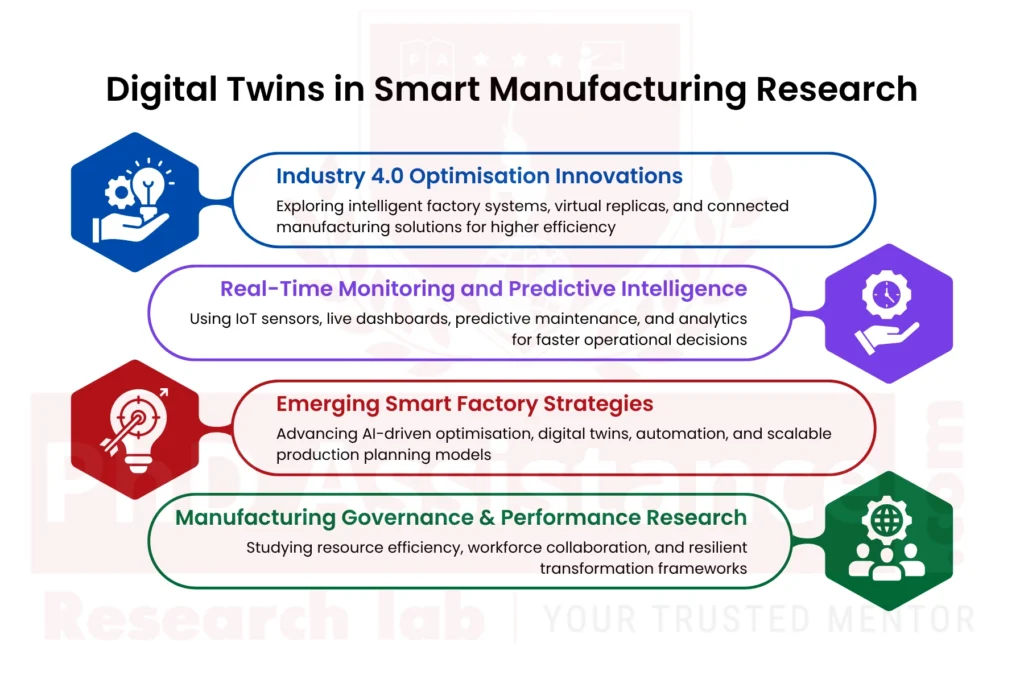
How to use this list
Start by deciding what you mean by a digital twin. Kritzinger et al. (2018) classify systems by data flow: a digital model has no automatic link to the physical object, a digital shadow receives data automatically in one direction, and a digital twin exchanges data automatically in both directions. Jones et al. (2020) and Wright and Davidson (2020) make similar distinctions. Many published "twins" are models or shadows, which is not a flaw, but your title and claims must match what you build. Then read each table row as a starting point: a possible research question, the design and data it would need, and why it matters now.
Theme 1: Predictive maintenance and real-time quality control
Maintenance and quality are the most common entry points because sensor data already exist on many lines. Cyber-physical system architectures for Industry 4.0 describe how machine data can be turned into health information and decisions (Lee et al., 2015), and the choice of machine learning algorithm for predictive maintenance depends on the data available and the maintenance goal (Arena et al., 2024). In a pharmaceutical packaging case, Fantozzi et al. (2025) report that a twin supported maintenance planning and reduced downtime, while noting that data exchange between the twin and the line was still manual.
| Topic | Possible research question | Likely design and data | Why it matters now |
|---|---|---|---|
| A digital twin for predictive maintenance of one critical asset class | Does a twin that combines condition-monitoring data with a failure model predict a defined failure mode earlier and more accurately than the plant's current maintenance policy? | Case study with historical and live sensor data; model comparison against time-based maintenance; evaluation on held-out failure events | Evidence from single cases is promising but data links are often still manual (Fantozzi et al., 2025) |
| Combining industrial IoT data and a process twin for real-time defect detection | Can a twin of one process step, fed by in-line sensor data, detect out-of-specification products earlier than end-of-line inspection, and with what false-alarm rate? | Design science or experimental study on a pilot line or test rig; confusion-matrix evaluation against inspection records | Algorithm choice must match data and goals, which few studies justify explicitly (Arena et al., 2024) |
Choose a failure mode or defect type with enough recorded events to evaluate a model. Rare failures may need simulation or accelerated testing, which should be planned from the start.
Illustrative example. A candidate starts with "digital twins for predictive maintenance in Industry 4.0". After a site visit she narrows it to bearing wear on the packaging line's three main motors, where vibration sensors already log data and maintenance records list past replacements. Her question becomes whether a twin combining vibration features with a wear model flags replacements earlier than the current fixed-interval schedule, without increasing unnecessary stoppages. That is a question one doctorate can answer and evaluate.
Theme 2: Resource and energy efficiency
Twins are also used to test changes to schedules, settings and layouts virtually before trying them on the line. Tao et al. (2018) describe how a twin that links product design, manufacturing and service data can support such decisions. The value of a "what-if" analysis depends on how well the twin reproduces the real line, so validation is central.
| Topic | Possible research question | Likely design and data | Why it matters now |
|---|---|---|---|
| Using a production-line twin to reduce energy and material use | Do schedule or set-point changes identified with a validated twin of one line or cell reduce energy per unit or scrap rate when implemented, compared with the previous baseline? | Simulation-based optimisation, validation against measured line data, then a before-and-after field trial | Energy and material costs make efficiency a priority, and twins allow options to be screened without stopping production (Tao et al., 2018) |
Theme 3: People and system integration
Two gaps recur in the literature. First, human operators add variability that most twins leave out, and Fantozzi et al. (2025) suggest human-in-the-loop approaches as a next step. Second, twins depend on data from many systems, and a National Academies report identifies verification, validation, uncertainty and data integration among the foundational research gaps for digital twins (National Academies of Sciences, Engineering, and Medicine, 2024).
| Topic | Possible research question | Likely design and data | Why it matters now |
|---|---|---|---|
| Representing operator variability in a manufacturing digital twin | Does including measured variation in manual task times improve the twin's prediction of throughput and bottlenecks, and can it flag tasks with ergonomic or safety risk? | Mixed methods: time studies and operator interviews feeding a discrete-event twin; comparison of predictions with and without the human layer | Human factors are acknowledged but rarely modelled (Fantozzi et al., 2025) |
| An interoperability architecture linking twin, execution and enterprise systems | Which architecture lets a twin exchange data automatically with shop-floor sensors and planning systems in a mid-sized plant, and what does it cost to maintain? | Design science research: architecture design, implementation in one case plant, evaluation of data latency, completeness and maintenance effort | Data integration is a recognised foundational gap for twins (National Academies of Sciences, Engineering, and Medicine, 2024) |
How to test a topic before you commit
Apply the FINER criteria: is the topic feasible, interesting, novel, ethical and relevant (Hulley et al., 2013)? For digital twin topics, check four things in particular.
- Industrial access: secure a written agreement on data, site visits and publication before you start.
- Validation: decide how you will compare the twin's outputs with measured behaviour.
- Scope: one asset, line or process is enough for a doctorate.
- Terminology: classify what you build as a model, shadow or twin and keep the claim consistent.
See also how to choose a PhD topic, how to select a PhD topic, PhD topic selection and the lists for mechanical engineering and construction.
Common mistakes
- Calling a one-way simulation a digital twin.
- Promising enterprise-wide transformation from a single case study.
- Reporting a benefit without a baseline or a validation step.
- Starting without a signed data-sharing agreement with the industrial partner.
- Listing several outcomes (cost, quality, safety, customer experience) that need different designs.
Key takeaways
- Classify your system as a digital model, shadow or twin by its data flow before naming the topic (Kritzinger et al., 2018).
- Predictive maintenance and quality topics are feasible where sensor data and recorded events exist (Lee et al., 2015; Arena et al., 2024).
- Case evidence on twins is encouraging, but data links are often still manual (Fantozzi et al., 2025).
- Validation, uncertainty and integration are recognised research gaps (National Academies of Sciences, Engineering, and Medicine, 2024).
- Test each topic for feasibility, novelty, ethics and relevance with FINER (Hulley et al., 2013).