
Why topic choice is harder than it looks
For a doctoral researcher in economics, the topic decides almost everything that follows: which theory you must master, which data you need, which methods you will learn and which job market you will enter. A topic that is interesting but cannot be studied with available data will stall; one that is feasible but adds nothing new will struggle at examination and in journals. Reviews of topic selection advise balancing personal interest, supervisor expertise, feasibility and contribution rather than optimising any one of them (Lei, 2009; Luse et al., 2012).
In Germany the decision has a local dimension. Many economics doctorates are completed in structured graduate programmes, others with an individual supervisor on a research post, and the route shapes how much freedom you have. The doctorate also has a measurable labour-market value in Germany, which differs by field (Mertens & Röbken, 2013), so it is worth thinking early about where the topic leads.
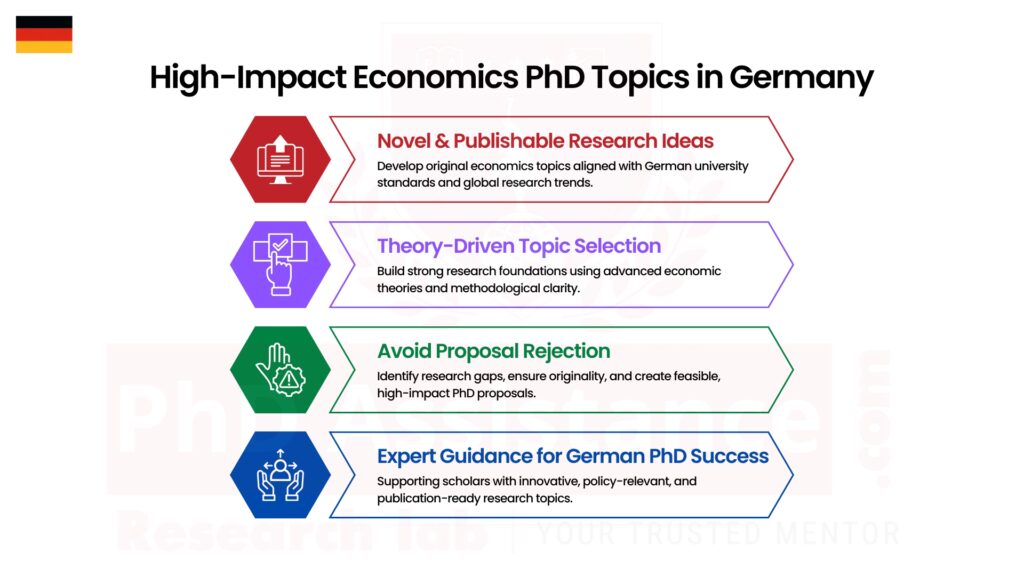
Where novelty in economics comes from
Novelty rarely means a subject no one has studied. In economics it usually comes from one of four sources: a new question about a familiar subject, a new source of variation that allows a causal answer, new data that measure something previously unobserved, or a theoretical argument that reinterprets known facts. Simply finding a gap in coverage is the weakest route; questioning an assumption that the literature takes for granted often produces a more interesting thesis (Sandberg & Alvesson, 2011; Alvesson & Sandberg, 2011).
Theory is what turns a data exercise into economics. Each offers a way to ask why a relationship should exist and what would change it. Aghion et al. (2005), for example, combine growth theory and firm data to examine whether the relationship between product market competition and innovation is inverted-U shaped rather than simply positive or negative. A topic that begins from such a theoretical tension is easier to defend than one that begins from a data set.
Research on the German economy and what it suggests
An honest note on evidence: a full review of recent studies by economists at German institutions, with affiliations checked, was not possible for this page. What follows draws on studies of Germany and on the national research infrastructure. Dustmann et al. (2014) examine how Germany moved from being described as the "sick man of Europe" around the turn of the century to a strong performer a decade later, weighing the role of labour-market institutions against that of policy reforms. Work of this kind shows a recurring pattern in German economics: big questions about institutions, wages and employment, answered with large administrative and survey data sets.
Several infrastructures make such work feasible for doctoral researchers. The German Socio-Economic Panel (SOEP), run at DIW Berlin, follows households over many years. The research data centre of the Federal Employment Agency at the Institute for Employment Research (IAB) provides linked employer-employee data. The research data centres of the federal and state statistical offices give controlled access to official microdata, and the Deutsche Bundesbank runs a research data and service centre for financial data. Many such centres are accredited by the German Data Forum (RatSWD). Access usually requires an application, a data-use agreement and sometimes on-site or remote secure work, which can take months; check the current conditions of each centre before you build a topic around its data.
| Topic area | Possible German data source | Typical design | Feasibility question to ask |
|---|---|---|---|
| Labour market and wages | IAB linked employer-employee data | Panel, event study, difference-in-differences | How long does access take, and can I work remotely? |
| Household behaviour and inequality | SOEP | Panel and life-course analysis | Is the subgroup I care about large enough? |
| Firms, trade and productivity | Official firm microdata via statistical offices | Panel regressions, structural models | Which variables are released, at what level of detail? |
| Banking and monetary policy | Bundesbank research data | Time series, bank-level panels | Are the series I need available for my period? |
| Behaviour and preferences | Your own experiment or survey | Laboratory or online experiment | Do I have funding and ethics approval? |
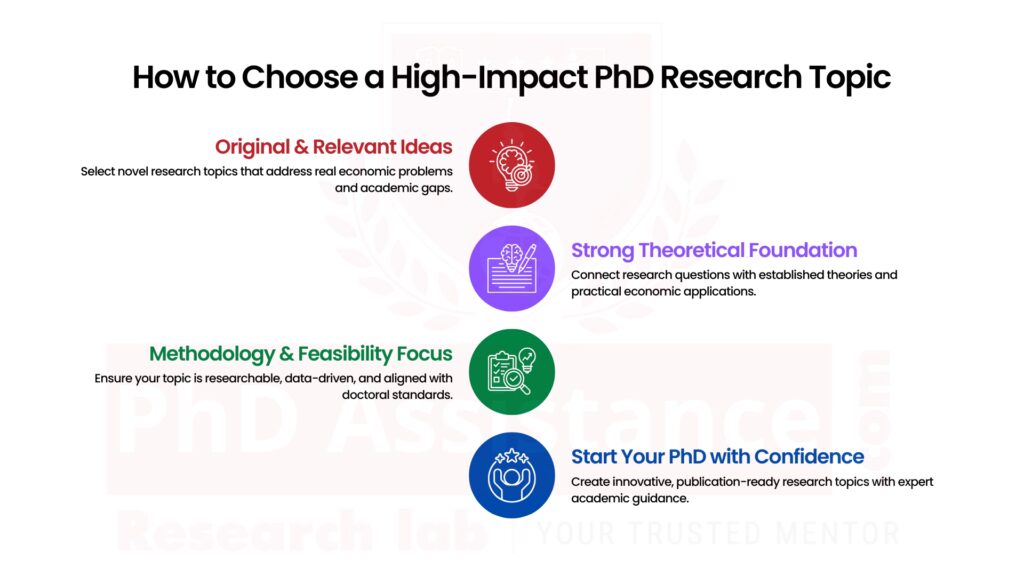
Testing feasibility before you commit
A topic is feasible when the question can be answered with data you can obtain, by a method you can learn, within the time and funding you have. For causal questions, ask early what variation will identify the effect: a policy change, a threshold, a natural experiment or randomisation (Angrist & Pischke, 2009). If you cannot name it, the topic may suit a descriptive or theoretical thesis instead, which is a legitimate choice if made deliberately. Ask too how sensitive the answer is likely to be to analytic choices; when many teams analyse the same data, their estimates can differ widely (Menkveld et al., 2024). A topic whose answer depends on one fragile specification is risky.
Worked example (illustrative)
A first-year researcher is interested in "the digital economy". She narrows this to remote work, then to a question: did the spread of remote work change where new hires live relative to their employer? She checks whether linked employer-employee data record home and workplace locations, how long an application takes, and what has already been published. Finding several recent studies on remote work and productivity but fewer on commuting distance at hiring, she frames the contribution around that difference and drafts a one-page proposal for her supervisor. The scenario is hypothetical.
Policy relevance without policy advocacy
Policy relevance helps a thesis find readers, funders and, later, employers in ministries, central banks and research institutes. But relevance is not the same as taking a side. A strong topic asks a question whose answer would be useful whichever way it comes out, and it defines the policy precisely: which instrument, which population, which period.
A useful test is to write one paragraph stating the question, the answer you expect, what would change your mind and who would act differently if you were right. If you cannot write it, the topic is still a theme. Share the paragraph with your supervisor and with a researcher outside your group; their objections are the cheapest feedback you will ever get.
Originality and integrity
Doctoral work in Germany is governed by university doctoral regulations and by the research integrity code of the German Research Foundation (DFG), which universities adopt and which covers authorship, data documentation and the use of others' work (Deutsche Forschungsgemeinschaft, 2019). An original topic is one you can explain and defend yourself. Keep notes on how your question developed and which sources shaped it; they will help you write the introduction and answer examiners' questions about your contribution.
Common mistakes
- Starting from a fashionable label ("sustainability", "digitalisation") without a precise question.
- Choosing a topic that depends on data you have not confirmed you can access.
- Treating a gap in coverage as a contribution without asking why the gap exists.
- Leaving theory until after the data work.
- Ignoring how the topic positions you for the academic or policy job market.
See also how to select a PhD research topic, how to identify a research gap and how to write an empirical economics paper.
Key takeaways
- Balance interest, supervision, feasibility and contribution when choosing a topic (Luse et al., 2012).
- Build novelty from theory and assumptions, not only from gaps (Alvesson & Sandberg, 2011).
- German panels and administrative data make strong theses possible, but access takes planning.
- Name your source of identifying variation before you commit (Angrist & Pischke, 2009).
- Follow your university's doctoral regulations and the DFG code (Deutsche Forschungsgemeinschaft, 2019).