

Critical review of Development Methodologies for IoT-Based Systems: Challenges and Research Directions
January 21, 2026
Call for papers: educational leadership, management, and policy for preparing the future workforce
January 22, 2026Choosing a PhD Research Topic in Law for Students in Switzerland: Methodological Rigour in International, Financial, and Comparative Legal Research
- January 22, 2026
- Topic Selection
Introduction
Choosing a dissertation topic is already one of the most important moments of the PhD process, especially for legal academics in Switzerland. Europe’s best law schools, the solid basis of civil law, and the growing importance of Switzerland in the area of international and financial law—all these together bring very high standards of creativity, methodology, and contributions to the field.
PhD Topic Selection for Law in Switzerland, thus, involves not only picking an interest but also drawing up a research problem that is theoretically sound, methodologically coherent, and universally relevant. PhD Assistance can offer a structured support to the scholars so that legal interests will be converted into narrow, researchable, and publishable topics for a PhD degree that meet the standards of the Swiss academic world.
A perfectly selected PhD subject not only increases the chances of proposal approval but also facilitates the mutual agreement of supervisors, completion within the deadline, and publication in leading international law journals. In the Swiss legal research context, topic selection is an important academic decision that determines the whole path of a PhD candidate.
Understanding Swiss Expectations in Law PhD Topic Selection
Switzerland’s doctoral law programmes have always been distinguished by their intellectual toughness and the independent scholarship they promote. Research PhD candidates are required to showcase very early on their understanding of the research purpose, a deep connection with legal theory, and a significant impact on legal debates taking place.
The Swiss universities put emphasis on the innovation of ideas, depth of analysis, and quality of methodology, especially in the fields of international law, financial law, commercial law, and comparative legal studies.
Legal PhD research topics in Switzerland should unambiguously spell out the research gap, argue for the academic significance of the study and place the research in both domestic and international legal contexts. Professional guidance for Law PhD research topics in Switzerland assists scholars in aligning their research ideas with the institutional requirements and keeping them doable within the time frame of the doctoral program.
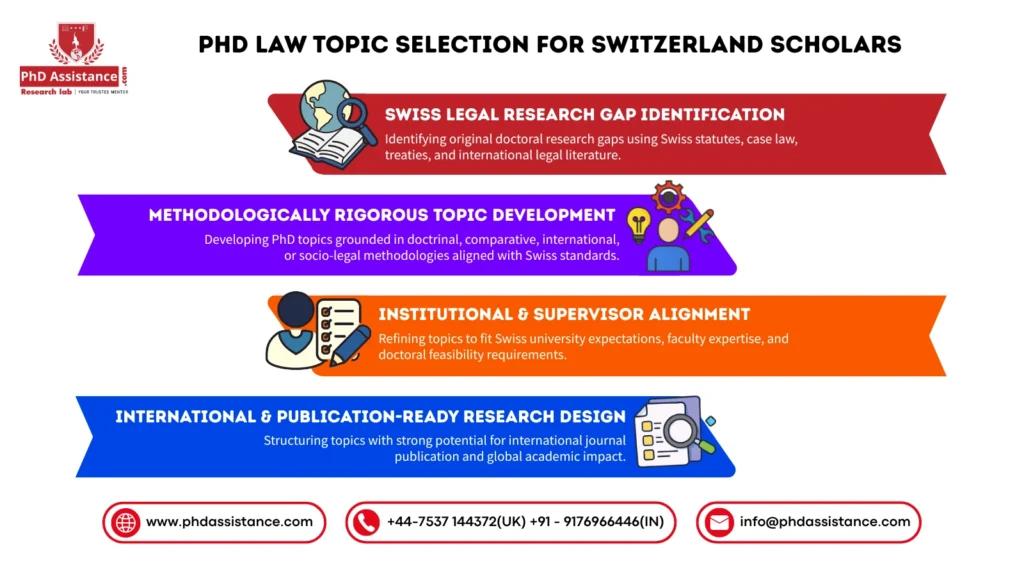
Doctrinal Legal Research: Establishing Analytical Precision
In Switzerland, doctrinal legal research is still mainly recognised as a pillar of research methodology for PhD candidates, especially in the areas of constitutional law, financial regulation, banking law, private international law, and commercial law. The method consists of a systematic and critical scrutiny of the law through analysis of statutes, court decisions, treaties, and legal theories to expose legal inconsistencies, ambiguities, or voids.
A PhD topic based on doctrine will be Switzerland-oriented if it includes, besides the descriptive elements, a critical evaluation of judicial arguments, analysis of the historical development of the doctrine, and presentation of the legal concepts that are to be clarified and reformed as a result of the research. Assistance with choosing a PhD law topic selection in Switzerland ensures that the doctrinal subjects are narrow enough to allow for the depth of a PhD while at the same time being original and relevant.
International and Financial Law Research in Switzerland
Switzerland, being an international organisation and a global finance centre, is a perfect place for doctoral research in international and financial law. Financial law PhD research topics Switzerland often look at banking regulation, financial markets’ supervision, anti-money laundering frameworks, international taxation, and cross-border financial compliance.
Swiss PhD programs motivate students to examine the case law and do a comparison of regulations in different countries at the same time. The researcher has to adhere to the legal standards, like Basel accords, OECD frameworks, and international arbitration norms, while integrating the research in Swiss legal doctrine.
Professional PhD Topic Selection in Switzerland service is there to help researchers discover the problems of legal and financial complexities that are not only academically viable but also relevant to policies and fit for international publishing.
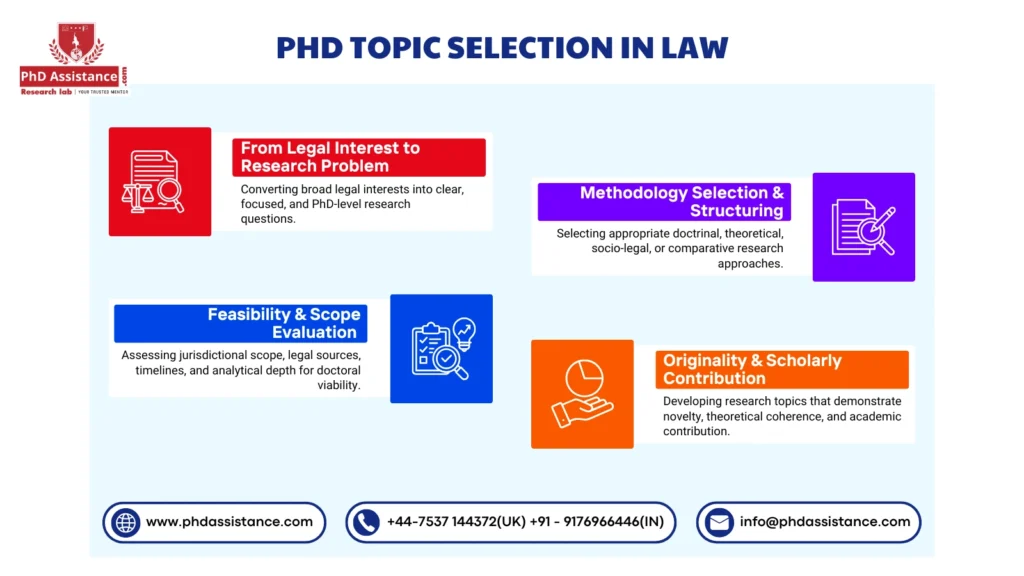
Theoretical and Socio-Legal Approaches in Swiss Doctoral Research
Theoretical engagement is a determinant of doctoral originality that Swiss law faculties mark very highly. Topics for a PhD that solely depend on the description of doctrines and lack theoretical support are likely to be perceived as having little contribution. Therefore, many Switzerland PhD dissertation topics in law attach jurisprudential theories, regulatory theory, or socio-legal perspectives to their works. Socio-legal research looks at the operation of legal rules in reality, as well as their impacts on institutions, markets, and people.
Switzerland is a perfect place for such approaches in the case of financial regulation, access to justice, corporate governance, and regulatory compliance. Legal realism, institutional theory, and comparative jurisprudence, among others, are theoretical frameworks that cannot only deepen analysis but also enhance academic contribution. PhD Assistance guarantees that theoretical and socio-legal methods are coherent and in line with Swiss doctoral evaluation standards.
Example:
Journal: International Journal for Court Administration
Lienhard and Kettiger (2024), in their research titled Twenty Years of Research on the Swiss Justice System offer a thorough critique of judicial research in Switzerland.
The paper, which has been published in the International Journal for Court Administration, outlines the transformation of Swiss legal scholarship from the focus on procedural doctrine to the adoption of innovative interdisciplinary and institutional analyses.
The research shows the potential of empirical and socio-legal methods to influence Kemparryh, M. & J. G. Wimmer’s (2023) doctoral research on judicial administration, institutional reform, and legal system performance in Switzerland.
Comparative Legal Research: Strengthening Scholarly Contribution
One of the main characteristics of doctoral legal studies in Switzerland is comparative legal research. The interaction of the country with the EU law and international treaties, as well as regulatory systems worldwide, makes the use of comparative approaches in these studies really valuable.
In Switzerland, many PhD law research topics involve a comparison of Swiss law with EU jurisdictions, common law systems, or international regulatory frameworks in order to point out both best practices and opportunities for reform.
Comparative research is ultimately a matter of selecting the right jurisdictions, clarifying the concepts, and being rigorous with the methodology. In the absence of adequate support, such topics might turn out to be nothing more than informative.
The law PhD thesis topic guidance Switzerland offers helps researchers present manageable comparative scopes that are still strongly analytical, creative, and original.
Example:
Journal: European Business Organisation Law Review
The Swiss Legislation on Business and Human Rights: A Reform Needed Towards Harmonisation with EU Law (2024) is one of the remarkable comparative legal studies from Switzerland. The article that appeared in the European Business Organisation Law Review brings to light the discrepancies existing between the regulatory frameworks of Switzerland and the EU concerning business and human rights, while the latter is still in the process of changing.
Utilising doctrinal and comparative approaches, the study pinpoints the regions where the laws need to be made uniform and shows how PhD students can mix up statutory interpretation with international regulatory comparison in the Swiss law setting.
Overcoming Common PhD Topic Selection Challenges
A candidate for a PhD in law at a Swiss university experiences the same issues repeatedly and very often, such as the topics being overly wide, the research gaps being vague, or the methods not being compatible with each other. These kinds of issues can cause either the rejection of the proposal, the postponement of admission, or the prolongation of the time of completion.
Professional service for law PhD topic selection in Switzerland tackles these issues effectively by:
- Making a very exhaustive legal literature review
- Studying statutes and court cases
- Evaluating the methodological approach
- Considering the publication in the long run
Conclusion
In the Swiss academic environment, selecting a law PhD research topic is quite a decision, both intellectually and strategically. No matter if it is doctrinal, international, financial, socio-legal, or comparative research, the members of the Scholarship must ensure that their topics are rooted in theory, methodologically sound, and fitting with the institution.
With the Best PhD Topic Selection support from PhD Assistance, the researchers can create PhD topics that meet the Swiss academic standards and also make a strong impact on the global legal scholarship.
Contact us to select a PhD research topic that aligns with your research idea, clearly addresses the legal research gap, and meets the academic standards in Switzerland.
References
- Lienhard, A., & Kettiger, D. (2024). Twenty years of research into the Swiss justice system. International Journal for Court Administration.
- Neri-Castracane, A., Canapa, M., & Brander, S. (2024). The Swiss legislation on business and human rights: A reform needed towards harmonisation with EU law. European Business Organisation Law Review.
