
Introduction
PhD research in India requires advanced data analysis methods that produce precise results, significant research findings, and high-quality academic outputs. The universities require doctoral scholars to use appropriate analytical techniques while they must explain their statistical selections, assess results, and create evidence-based conclusions that advance both theoretical knowledge and practical application.
Doctoral researchers face challenges with model selection and data cleaning and output validation, result interpretation and AI tool integration during their thesis writing process. Students who possess a deep understanding of their subjects need support to convert their unprocessed data into research findings that can be published.
The blog presents a systematic framework that shows how AI-based data science methods can be applied to conduct PhD research in India through predictive modelling and smart insights. PhD Assistance Research Lab provides expert PhD data analysis services in India to help scholars meet university standards while they conduct research.
What you will learn from this blog?
- How AI improves PhD data analysis quality and speed
- Key data science techniques for doctoral research success
- Common mistakes in research analytics and reporting
- How to generate smart insights for thesis completion
- Best practices for accurate and ethical AI-based analysis
Step-by-Step Guide and Data Science PhD Data Analysis Help in India
1. Defining Research Objectives and Data Needs
Researchers need to establish their testing, comparison, prediction, classification, and explanation requirements before they begin their research work. Researchers use research objectives to control their entire research process, which includes data collection, software selection and model selection.
You should:
- Identify dependent and independent variables
- Define hypotheses or research questions clearly
- Determine data type, which includes numeric, categorical, text, image and time-series elements.
- Match objectives with analytical methods
- Ensure measurable and researchable outcomes
2. Data Collection and Preparation with PhD Data Analysis Support in India
The effectiveness of AI models requires access to trustworthy, complete and properly structured datasets. The use of bad data will produce problems that end with incorrect results.
You need to:
- Collect reliable datasets from surveys, experiments, databases, or official sources
- Remove duplicates, errors, and missing values
- Standardise coding, labels, and formats
- Detect outliers and anomalies
- Transform variables for model compatibility
3. Predictive modelling for insights
Predictive modelling enables researchers to make forecasts about future outcomes through analysis of how different variables interact and through the discovery of undetected patterns in past data.
Common models include:
- Linear regression
- Logistic regression
- Decision trees
- Random forests
- Neural networks
- Time-series forecasting models
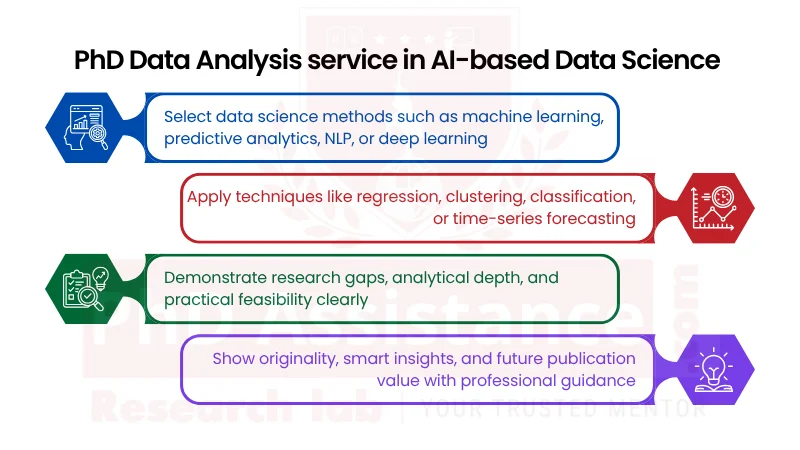
4. Applying Machine Learning for Classification
Machine learning enables automatic pattern discovery and decision-making processes because it can handle extensive data collections. The technology provides its best advantages when human analysis becomes too complex to execute.
You can use:
- Support Vector Machines
- K-Means clustering
- Naive Bayes
- Gradient boosting
- Deep learning methods
- Ensemble learning models.
The tools assist in response classification, population segmentation, behavioural pattern identification and detection of advanced patterns.
Get the pricing details for the PhD data analysis service at PhD Assistance Research Lab, designed to assist data scientists in meeting university standards
5. Natural Language Processing for Text-Based Research
PhD projects require researchers to conduct interviews, perform open-ended survey research and access literature archives, policy documents and social media platforms. The content needs natural language processing to enable effective analysis.
Use NLP for:
- Sentiment analysis
- Topic modelling
- Keyword extraction
- Text summarisation
- Language pattern analysis
- Content categorisation
6. Data Visualisation for Smart Interpretation
The visual outputs of the study provide clearer results to supervisors and examiners, and to journal readers and conference audiences. Effective visual materials enable better information comprehension, and they assist with successful communication.
Use charts such as:
- Bar graphs
- Heat maps
- Scatter plots
- Dashboards
- Trend lines
- Network diagrams
Clear visualisation improves thesis presentation and evidence-based decision-making.
7. Validating Models and Ensuring Accuracy
The material needs to undergo a full evaluation process before researchers in the doctoral research study can use it. The validation process establishes measurement reliability, which demonstrates that the test produces consistent outcomes while proving its academic validity.
Check for:
- Accuracy
- Precision
- Recall
- F1-score
- RMSE
- Cross-validation
- Confusion matrix results
8. Ethical Use of AI in PhD Research
Researchers must continue to use artificial intelligence in a responsible and ethical manner. The universities now show their requirements for ethical artificial intelligence use.
Ensure:
- Data privacy protection
- Fairness in algorithms
- Proper citations and transparency
- No fabricated outputs
- Human interpretation of AI results
- Responsible use of automated tools
Mistakes to be avoided:
- Using AI tools without clear research objectives
- Poor-quality or biased datasets
- Selecting the wrong models for the data type
- Ignoring validation metrics
- Over-relying on automated outputs
- Weak interpretation of findings
- No link between analysis and research questions
- Poor presentation of tables and charts
- Lack of ethical transparency.
Researchers can avoid these common mistakes with guidance from an expert Statistical Analysis Services for PhD in India while enhancing the quality of their proposal.
Example:
- All PhD data analysis studies require researchers to establish research objectives and validate their analysis methods and assessment methods to produce trustworthy study outcomes. Rajkomar, Alvin et al. conducted a peer-reviewed study that demonstrated that machine learning models achieve effective performance when they use high-quality datasets along with proper validation procedures.
- Research by Jordan, Michael I. and Mitchell, Tom M. showed that AI systems achieve better performance when humans work together with advanced research methods and ethical data analysis practices. The research demonstrates that PhD researchers need to select proper research techniques and reliable data sources to achieve correct research outcomes.
Conclusion
The data science techniques that use AI technology enable PhD analysis in India to be processed faster while producing better predictions, discovering hidden patterns and generating advanced insights. Researchers can improve their thesis work through strong research methods and current AI technologies, which result in academic publications that have lasting scholarly value.
The current competitive environment of doctoral programs benefits researchers who possess the ability to gather high-quality data while utilising suitable models, together with their capability to verify research outcomes and their complete understanding of research results.
Experts at PhD Assistance provide comprehensive PhD Data Science Analysis Support in India, by conducting accurate and efficient analysis that meets university requirements for approval.
Book a Free Expert Consultation with PhD Assistance to conduct an effective data analysis that supports your doctoral success.
References
- Rajkomar, A., Dean, J., & Kohane, I. (2019). Machine learning in medicine. New England Journal of Medicine, 380(14), 1347–1358.
- Jordan, M. I., & Mitchell, T. M. (2015). Machine learning: Trends, perspectives, and prospects. Science, 349(6245), 255–260.