

Applying Advanced Data Analytics Techniques in Doctoral Research: Expert PhD Guidance for Scholars in the UK
January 5, 2026
Utilising Professional Academic Editing Techniques to Enhance Research Excellence: Expert Guidance for Scholars in the UK
January 6, 2026Designing Data-Driven Research Models Using Advanced Analytics: Professional PhD Support in the UAE
- January 05, 2026
- Data Analytics
Introduction
The argument of having data in the research, which can be considered as a basis for the impact of the study as well as its credibility, is totally in line with the scenarios in one’s research area. The rapid growth of digital technologies has made its way to theorists to take the chance to produce not only theoretically elaborate but also data-driven studies. Just based on such large datasets handling, practically advanced statistical techniques application and many more such demands in the contemporary research field, the whole thing is very complex and technically difficult. Therefore, it becomes one of the reasons why most of the PhD aspirants are taking PhD data analysis help in UAE so that they can keep their research accurate, reliable and rigorous in terms of methods.
The UAE’s universities and research institutes place a high value on data integrity, analytical precision, and reproducibility. Researchers are expected to follow the globally accepted standards when conducting statistical analyses and conclusions. Today, to maintain those professional standards, the PhD statistical analysis services have become an indispensable part of the successful completion of the doctoral research process, thereby allowing scholars to produce works that are of high quality and have the potential for publication.
The Growing Importance of Data-Driven Research
Over the past few years, the research process has become far noisier by data in different disciplines. The dependence on data has been so extensive that researchers have not only performed their tests but also turned their decision-making processes and theories upside down through validation employing the evidence provided by data. On the other hand, the data coming in heaps and of multiple kinds have put many researchers in the situation where they would like to have the analysis done but are not able to do it themselves due to the hefty amount of work involved.
Postgraduate researchers mostly have to deal with large datasets collected through surveys, experiments, simulations, or secondary data sources. If the researchers involved do not have good analytical skills, it will be hard to extract any meaningful conclusions from the data. This situation has brought about the rise in demand for PhD data analysis services in UAE that offer professional dissertation data analysis help in data cleaning, model choosing, statistical checking, and comprehension of outcomes.
Quantitative Data Analysis for Research Excellence
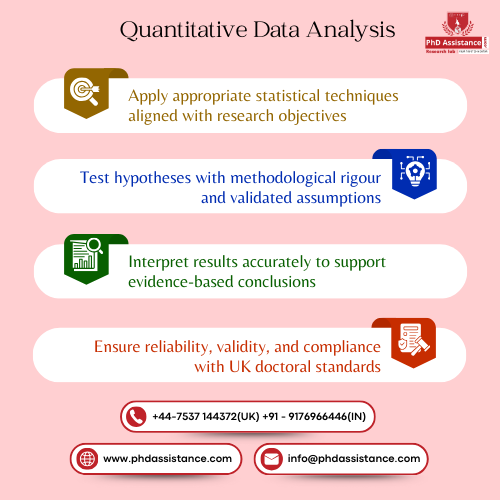
Quantitative analysis is still the foundation of many doctoral studies across various disciplines. It provides the opportunity for researchers to test their hypotheses, uncover the connections between different variables, and ultimately draw conclusions that are well-grounded in evidence. On the other hand, Statistical techniques demand thorough understanding and considerable experience.
PhD scholars can count on a professional PhD Quantitative Data Analysis Service that provide the support of skilled individuals in different areas, including descriptive statistics, regression analysis, multivariate analysis, hypothesis testing, and structural equation modelling. The advanced statistical software has been used, among others, SPSS, R, Python, and STATA, the most reliable and accurate way to do it. The researchers, with the help of experts, will not doubt interpreting their findings and will be able to present the results that correspond to the academic standards.
Example:
A systematic review and meta-analysis done by Panizzutti et al. (2023), which emphasised the use of minocycline for psychiatric and neurological disorders, is one of the clearest examples of quantitative data analysis. The study team decided to work with already existing datasets rather than create new ones, and in this way, they used second-hand quantitative data that originated from published clinical trials.
After identifying relevant studies, extracting numerical outcome measures (which consisted of symptom severity scores, treatment response rates, and standardized effect sizes), and applying statistical techniques of meta-analysis, they finally presented one combined result from all the studies. The researchers were able to conclude the therapeutic effect of minocycline from studies that were statistically determined by using the quantitative methods of effect size estimation, confidence interval calculation, and heterogeneity testing.
Big Data Analytics and Advanced Research Applications
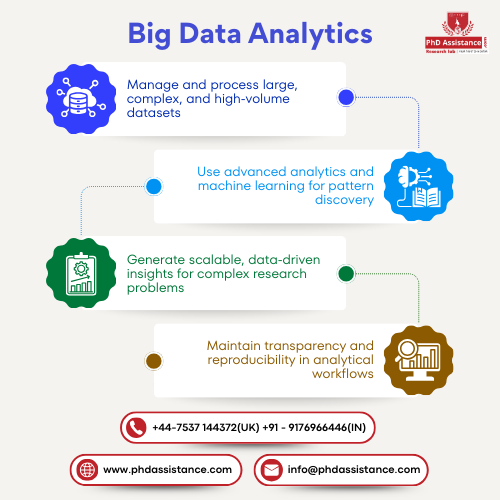
PhD Big Data Analytics Service for research encompasses coding, algorithm planning, data representation, and automating the whole process of analysis assistance, among others.
This support guarantees that the research is conducted in a manner that is efficient, reproducible, and technically qualified. Therefore, the researchers’ capability to reach conclusions, formulate theories, and eventually contribute to academia is then indirectly facilitated through the reduction of the technical burden.
Example:
Gulshan et al. (2016) in their study in JAMA, where the application of a deep learning model for diabetic retinopathy detection was successful. A total of over 128,000 retinal fundus images were studied, which already marked a substantial data volume that could not be analysed by traditional analytical techniques.
Advanced machine learning methodologies facilitated the researchers in making a huge processing of unstructured image data and also in evaluating the model performance quantitatively with the measures of sensitivity, specificity, and area under curve (AUC). This study exemplifies big data analytics to become an active force in data processing, accurate pattern recognition, and decision-making scalability in modern research.
Role of Programming and Computational Support in Research
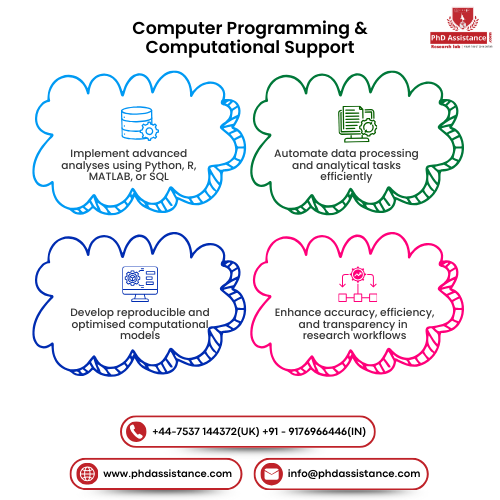
In modern research, advanced programming skills are frequently the primary requirement needed to handle data, apply algorithms, and carry out simulations. At the same time, many researchers lack in-depth knowledge of programming languages such as Python, R, or MATLAB. In such cases, a PhD Computer Programming Service plays a crucial role in bridging the technical gap and supporting researchers throughout the analytical process.
Professional PhD coding and programming support encompasses coding, algorithm planning, data representation, and automating the whole process of analysis assistance, among others. This support guarantees that the research is conducted in a manner that is efficient, reproducible, and technically qualified. Therefore, the researchers’ capability to reach conclusions, formulate theories, and eventually contribute to academia is then indirectly facilitated through the reduction of the technical burden.
Data-Driven Research Through Professional PhD Data Analysis Support
The academic world is challenged by the increasing intricacy of doctoral research, and one of the main avenues that researchers take to ensure that their work is methodologically sound and in compliance with international standards is through the use of specialised support. In this respect, PhD Data Analysis Help in Dubai has turned out to be a great asset for those researchers who find themselves in need of a skilled hand while working with the difficult data sets, making their way through the range of analytical models to choose from, and giving that expert-like interpretation of the results that they have gotten. Such help is especially required by those who work under short deadlines or use advanced quantitative and computational methods.
In addition, expert PhD thesis statistics help in Dubai provides researchers with the possibility to conform their analytical methods to the university and journal standards by making transparency, reproducibility, and statistical rigour their top concerns. The professional analysts and state-of-the-art analytical tools give PhD scholars the opportunity to spend more time on theories and academic writing while being sure the data analysis is strong and defensible because they have expert support.
Conclusion
In the current research scenario, which is heavily dependent on data, it is quite difficult, and extracting the data in a skilful manner is the main factor for success. Experts being present at every step of the research process will do the computational work, handle big data, and use advanced computer modelling, which will impact the quality of the research significantly. In the UAE, computer science dissertation help is a pathway for researchers to obtain specialised skills, robust methods, and reliable help with data analysis for dissertation, which not only improves their research but also enhances its credibility it.
To put it another way, the upgrading of functions through PhD Data Analysis Help in Dubai means that, besides being able to transform the data into knowledge, the researchers can also make their contributions in scholarly discourse and, even more so, the attainment of excellence in the academic journey.
References
- Panizzutti, B., Skvarc, D., Lin, S., Croce, S., Meehan, A., Bortolasci, C. C., Marx, W., Walker, A. J., Hasebe, K., Kavanagh, B. E., Morris, M. J., Mohebbi, M., Turner, A., Gray, L., Berk, L., Walder, K., Berk, M., & Dean, O. M. (2023). Minocycline as treatment for psychiatric and neurological conditions: A systematic review and meta-analysis. International Journal of Molecular Sciences, 24(6), Article 5250. https://doi.org/10.3390/ijms24065250
- Gulshan, V., Peng, L., Coram, M., Stumpe, M. C., Wu, D., Narayanaswamy, A., Venugopalan, S., Widner, K., Madams, T., Cuadros, J., Kim, R., Raman, R., Nelson, P. C., Mega, J. L., & Webster, D. R. (2016). Development and validation of a deep learning algorithm for detection of diabetic retinopathy in retinal fundus photographs. JAMA, 316(22), 2402–2410. https://doi.org/10.1001/jama.2016.17216
