

Designing Data-Driven Research Models Using Advanced Analytics: Professional PhD Support in the UAE
January 5, 2026
Elevating Research Standards with Professional Academic Editing Techniques: Tailored Guidance for Scholars in the UAE
January 7, 2026Utilising Professional Academic Editing Techniques to Enhance Research Excellence: Expert Guidance for Scholars in the UK
- January 06, 2026
- Editing Service
Introduction
The quality of a doctoral thesis is determined not only by the novelty of ideas or the strength of research design but also by the way the ideas are communicated, their clarity, accuracy, and professionalism. In modern academia, especially in the case of the UK and UAE institutions with international recognition, PhD dissertations and research publications are subjected to rigorous criteria of language, structure, originality, and formatting. This way, structured PhD editing and proofreading services in UK are seen more and more as a necessary step in the research process instead of a last-minute fix.
The present guide demonstrates that professional editing support for doctoral students mainly focuses on three important processes: academic translation, plagiarism removal, and formatting and referencing. All of these very crucial aspects contribute to making sure that the research is clear, ethically correct, and likewise meets the requirements of the institution and the journal in both UK and international academic contexts.
The Role of Academic Editing in Doctoral Research
Doctoral research should bring in new knowledge to a particular field, yet the communication of that research is, nevertheless, important to be accepted. Not only the arguments of the thesis but also the proper structuring, articulation, and support of those arguments are the points of the examiners and the reviewers’ analysis. The use of poor language, inconsistent terminology or the lack of compliance with the technical standards might hide strong research and cause extensive revisions or delays.
With academic editing, these problems are tackled by the processing of clarity, coherence, and consistency, but the researcher still retains the intellectual ownership of the work. Editing does not change content or interpretation; it merely refines the expression and presentation of the work in such a way that the research findings are evaluated solely based on scholarly merit. This matter holds especially true for the researchers using wider editing Services for PhD scholars in general, particularly in the institutions that follow the international assessment frameworks and publication standards.
Academic Translation as a Foundation for Research Clarity
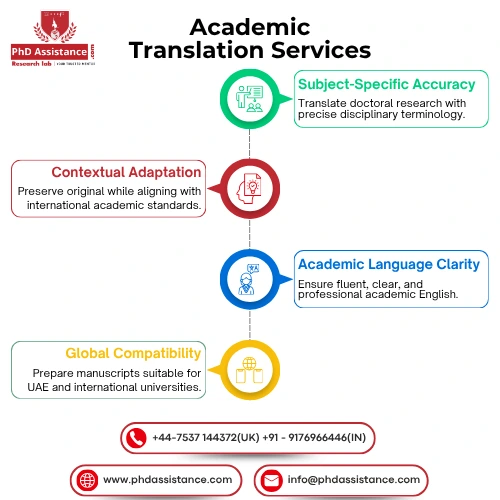
The translation of academic texts is a key factor in the process of researchers’ communication through which the research meaning is preserved while the content is adapted to the needs of non-native English speakers who have different linguistic and stylistic expectations. It is a very difficult operation that involves not only replacing words but also knowing the subject-specific terms very well, the conventions of the particular type of research, and the tone of academia. In the case of difficult academic workflows, such support is usually provided through a PhD Translation Support Service, allowing research arguments to be clear and persuasive without any misunderstanding arising from language transfer.
For doctoral students, especially those who are not proficient in English and are taking advantage of PhD editing and proofreading services, academic translation acts as a guarantee that the limitations imposed by the language will not negatively affect the quality of their work as perceived by others. It not only aids in the process of unifying theses and manuscripts with the international academic standards but also makes it possible for the examiners and reviewers to get totally involved in the core of the research instead of being distracted by linguistic inconsistencies.
Example:
Epstein et al. (2015) made an extensive review of various guidelines for the process of cross-cultural adjustment of research questionnaires and concluded that the lack of proper consistency in translation practices sometimes leads to the opposite of the intended conceptual equivalence among different languages. This situation is quite complementary, where a PhD student is facing an academic translation issue; it is a gradual process of understanding, rather than a mechanical one. Where there is a need to adapt surveys, interview protocols, or theoretical frameworks from one language to another, doctoral researchers have to make sure that meanings, constructs, and contextual nuances remain the same.
Plagiarism Correction and Ethical Writing in Research
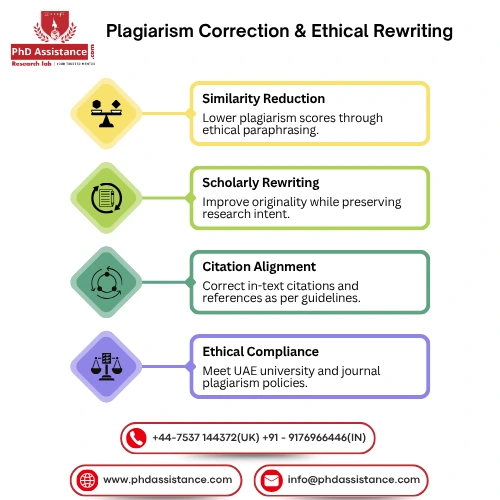
Academic editing with plagiarism correction takes the ethical rewriting and citation alignment methods instead of content alteration. The main goal is to support the researchers in voicing their ideas in a scholarly manner while remaining loyal to the sources. The idea is usually implemented formally with a PhD Plagiarism Correction Support Service, which not only enhances writing skills but also maintains conformity with institutional plagiarism policies and journal ethics.
By means of plagiarism correction support, the researchers get a better comprehension of the acceptable paraphrasing techniques, source integration, and referencing practices. This practice not only leads to a decrease in similarity scores but also to an enhancement of the quality and independence of the academic writing, thus backing the ethical research practices that are expected within PhD Dissertation Editing Services in UK and thesis-level submissions.
Formatting and Referencing as Technical Requirements
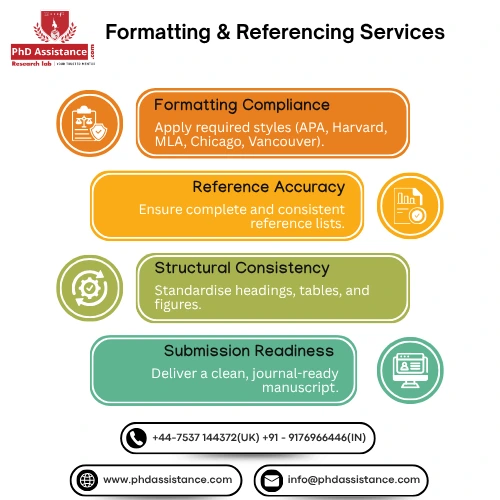
The formatting and referencing support guarantee that doctoral documents meet the required styling standards, such as APA, Harvard, MLA, Chicago, or Vancouver, with absolute precision. There will be uniform headings, tables, and figures in the right format, in-text citations that are accurate, and complete reference lists. Requirements of these types are usually catered for by a PhD Formatting and Referencing Support Service that is structured, which not only indicates academic professionalism but also gives respect to the institutional standards.
For PhD students who are dealing with a lot of complex documents, maintaining consistency in formatting across the different chapters can be really difficult. However, it is the structured formatting support that will be able to help keep the entire thesis or manuscript consistent, and that would mean that the reviewers can concentrate on the content instead of the technical discrepancies, which is an important consideration in PhD thesis editing services in UK.
Example:
Paltridge and Starfield (2020) researched the writing of doctoral theses in second-language contexts and found that following the rules of formatting and referencing has a strong impact on how the examiners consider the research to be of good quality. Thus, this work provides a model to PhD students that considers consistency in formatting, styles of citation being right, and all the structured presentation as basic parts of communication in the academic world. The study helps the future doctoral holders to consider the formatting and referencing as non-administrative but rather as inseparable parts that boost the clarity, coherence, and acceptance of thesis evaluation.
Supporting Editing and Proofreading in the Research Process
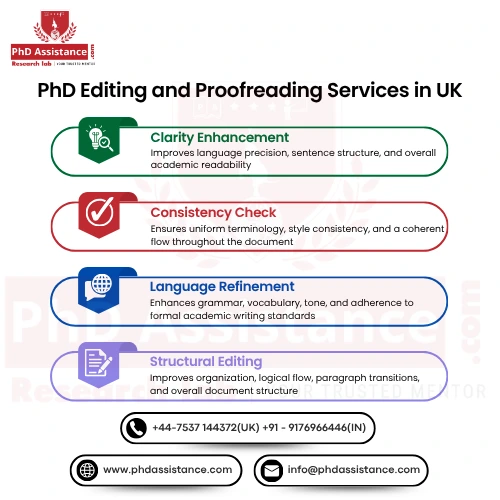
The academic editing typically involves making the language up to the standards of the journal and correcting the text, besides translating, spotting and correcting plagiarism, and formatting. Language editing makes the sentences comprehensible, raises the academic tone, and ties up the ideas, whereas proofreading eliminates typographical errors, incorrect punctuation, and slight inconsistencies. These works are very crucial in the last stages of research preparation and are often included in more extensive editing services for researchers.
Despite the fact that each step of the process helps the other, these editing actions have a significant influence on the paper’s readability and professionalism. They enable the writer to communicate complex ideas simply and to present the entire research in a coherent and easy-to-follow way for the examiners and reviewers.
Academic Editing and Research Outcomes
Overcoming linguistic, ethical, and technical challenges, academic editing has the effect it letting the researchers concentrate more on the intellectual dimensions of their work. It assists the clearer argumentation, the more precise interpretation of findings, and the better engagement with existing literature. It is also worth mentioning that editing does not supplant scholarly effort but instead enhances its presentation, particularly in the context of structured PhD editing support services in the UK models.
In doctoral research, where evaluation standards are high and competition is strong, the quality of writing and presentation might influence the examiners’ decision, the acceptance of the publication, and the researcher’s academic reputation. Structured academic editing plays a significant role in consistently meeting these high-quality standards.
Conclusion
Editing academic papers is one of the most important factors that contribute to the excellence of doctoral research, and it is mostly done in environments that emphasise international standards and readiness for publication. Translation accuracy, ethical writing (through plagiarism correction), and precise formatting and referencing are the aspects that directly affect the evaluation, understanding, and acceptance of research.
The PhD scholars who are using the services of PhD editing and proofreading in UK would be able to bring out the clarity, integrity, and professionalism of their work. This practice would again increase the influence of their research contributions and, at the same time, support successful advancement through the doctoral journey.
References
- Epstein, J., Santo, R. M., & Guillemin, F. (2015). A review of guidelines for cross-cultural adaptation of questionnaires could not bring out a consensus. Journal of Clinical Epidemiology, 68(4), 435–441. https://doi.org/10.1016/j.jclinepi.2014.11.02
