

Natural Language Processing of Clinical Notes for Automated ICD-10 Coding Accuracy
August 17, 2026
Call for Papers: Artificial Intelligence Approaches in Research and Intervention for Developmental Disabilities
August 18, 2026Why Biomedical PhD Manuscripts Get Rejected During Peer Review in France?
- August 18, 2026
- PhD Manuscript Peer Reviewing
Summary:
In this blog, we explore the reasons for the rejection of Biomedical PhD manuscripts during peer review in France. Areas that are covered include the research question, research method, statistics, originality, reproducibility, and scientific writing. We will also examine how the priorities of French biomedical research influence doctoral research programs.
Introduction
Publication of research articles is one of the essential elements of biomedical doctoral research. Nevertheless, the completion of a PhD experiment does not mean the publication of an article. A researcher should show a clear research question, method, analysis, presentation, and contribution to biomedical science.
There is an advanced biomedical research network in France which includes universities, hospitals, Inserm labs, CNRS research departments and interdisciplinary research programs. There are some institutions like Sorbonne Université, Université Paris-Saclay, and Université Claude Bernard Lyon 1 that provide doctoral research facilities in molecular biology, cancer, neurosciences, clinical research, genetics, bioinformatics and therapeutics.
For PhD scholars who are experiencing difficulties in writing, conducting research, analysing data, peer reviewing, and publishing their Biomedical PhD Manuscript in France, the PhD Assistance Research Lab provides customised PhD Manuscript Peer Review Services in France.
What will you learn from this blog?
- Why biomedical manuscripts may be rejected during peer review.
- What research and publication expectations are relevant to biomedical PhD researchers in France.
- How to improve methodology, statistical analysis, and reporting.
- How to demonstrate novelty and address an identifiable research gap.
Importance of PhD Journal Manuscript Peer Review Assistance in France:
Before submitting a biomedical manuscript, researchers should have clearly determined their research question, the right design, methods, statistics, and an interpretation of results.
Doctoral training in France is based on independent research in identified research units and doctoral schools. “Sorbonne Université considers that doctoral training is personal and independent research conducted in an identified research unit and doctoral school.”
A researcher should focus on:
- Clear research questions and hypotheses.
- Appropriate biomedical study design.
- Robust statistical and analytical methods.
- Transparent reporting of methods and results.
- Reproducibility, research integrity, and responsible publication.
PhD students can seek professional PhD Journal Manuscript Peer Review Assistance when evaluating their manuscript before submitting it to the journal. This will be useful in addressing any issues that the reviewers may raise about the manuscript.
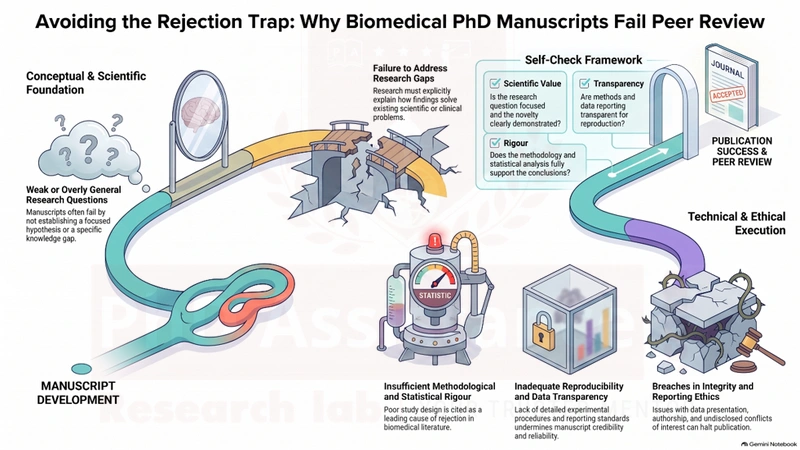
What Makes Biomedical PhD Manuscripts Difficult to Publish in France?
1. Weak or Poorly Defined Research Questions
A biomedical PhD dissertation may be rejected at the beginning because the research question is too general or because the manuscript fails to demonstrate how the work contributes to science. A good study must demonstrate knowledge, unknowns, and the importance of the research question.
Researchers should:
- Define a focused biomedical research question.
- Establish the specific knowledge gap.
- Develop a clear research hypothesis.
- Connect the objectives with the findings.
This requirement is relevant for French biomedical PhD programs. For instance, the Life Sciences and Health PhD program at Université Paris-Saclay involves research that ranges from molecular biology to clinical and therapeutic applications, where students must frame their research based on a scientific question (Université Paris-Saclay, n.d.)
2. Insufficient Methodological and Statistical Rigour
Biomedical manuscripts can be rejected because the study design, methodology, sample, and statistical analysis do not sufficiently support the results. Recently, poor study design was found to be one of the most common causes of rejection among biomedical manuscripts through a systematic review (Faggion, 2024).
Researchers should:
- Select an appropriate study design.
- Justify the sample and methodology.
- Apply suitable statistical methods.
- Report controls and limitations clearly.
This is especially crucial for programs like Sorbonne Université’s Pierre Louis Doctoral School, which specialises in epidemiology and biomedical information sciences, and its Physiology, Physiopathology and Therapeutics doctoral school (Sorbonne Université, n.d.).
3. Limited Novelty or Unclear Research Contribution
This may happen when a manuscript largely corroborates the results that already exist, without explaining how it adds anything to the body of knowledge. PhD students must show how and why their results differ from existing research.
Researchers should:
- Identify what is already known.
- Explain what remains unresolved.
- State the original contribution.
- Link the findings to the research gap.
An analysis of rejected biomedical manuscripts shows that lack of novelty is one of the most common reasons for rejection (Faggion, 2024).
This is significant for Université Paris Cité, as Université Paris Cité, together with Institut Pasteur and Sorbonne Université, is a participant in the doctoral program Pasteur-Paris University for life and medical sciences (Institut Pasteur, n.d.).
4. Inadequate Reproducibility and Data Transparency
Research conducted in the biomedical field requires adequate methodological and reporting details so that other researchers can comprehend and appraise the research results. Inadequate methodological descriptions or weaknesses in the analysis can reduce the clarity and reliability of a Biomedical PhD Manuscript peer review.
Researchers should:
- Provide detailed methodological information.
- Document experimental procedures clearly.
- Report analytical decisions transparently.
- Follow relevant reporting standards.
This is particularly important in France’s research environment, where doctoral training is centred on original research conducted within recognised research units and doctoral schools. Sorbonne Université, for example, describes doctoral research as personal and original research carried out within a research unit and doctoral school (Sorbonne Université, n.d.).
Explore the services at PhD Assistance Research Lab to get PhD Manuscript Review Support in France.
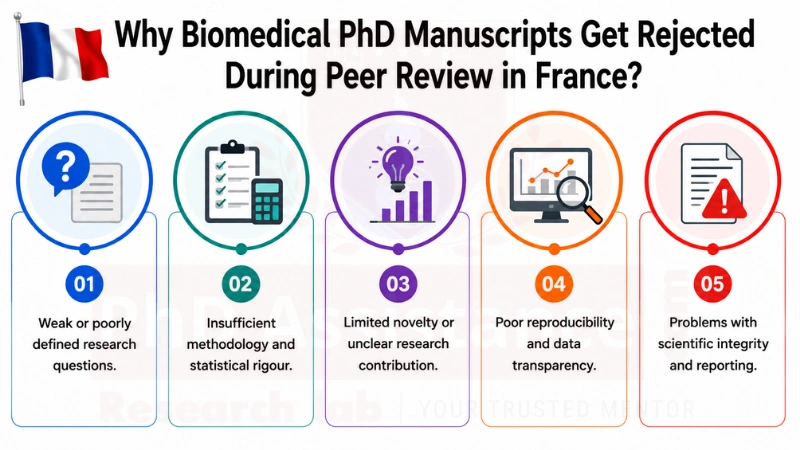
5. Problems With Scientific Integrity, Authorship, and Reporting before Biomedical PhD Manuscript Peer Review
Problems may arise in the preparation of biomedical research articles where there is an issue with data presentation, authorship, conflict of interest, or scientific conduct. Such issues can affect the integrity of both the article and the underlying research.
Researchers should:
- Report findings accurately and completely.
- Clarify authorship and contributions.
- Declare relevant conflicts of interest.
- Maintain appropriate research records.
French biomedical PhD students study in an environment where universities, hospitals, and research institutes are combined. The Pasteur-Paris University PhD program is an example of such a research environment where the Institut Pasteur, Université Paris Cité, Sorbonne Université, and Université Paris-Saclay are involved (Institut Pasteur, n.d.).
6. Failure to Address Current Biomedical Research Gaps
A good biomedical research article must be able to explain how the findings contribute to solving any existing scientific or biomedical problems. It can be quite difficult for researchers to demonstrate how their findings have added to or answered any biomedical issues.
Researchers should:
- Identify an unresolved research problem.
- Relate findings to current evidence.
- Explain scientific or clinical significance.
- Show how the study advances existing knowledge.
Current PhD research in biomedical studies emphasises an increasingly close connection between fundamental science and clinical and therapeutic applications. The Université Paris-Saclay offers PhD research in genetics, genomics, bioinformatics, disease biology, and therapeutic research (Université Paris-Saclay, n.d.).
Quick Self-Check for Saudi PhD Researchers
- Is my biomedical research question clearly defined?
- Does my methodology adequately support my conclusions?
- Have I clearly demonstrated the novelty and research gap?
- Are my data, analysis, and methods sufficiently transparent and reproducible?
- Have I addressed scientific integrity, authorship, ethics, and conflicts of interest?
Conclusion
A biomedical manuscript can be rejected by peer reviewers in France due to problems including a lack of clarity in the research question(s), poor methodology, low originality, poor statistics, or poor reporting of results. It is also important to show how your results fill the research gap.
Strong methodology, transparent reporting, reproducibility, originality, and clinical relevance can strengthen a manuscript’s scientific contribution and improve its readiness for peer review.
Struggling with biomedical manuscript preparation in France? Connect with our experts for professional guidance on manuscript writing, research methodology, data analysis, peer review, reproducibility, and publication support.
Book a Free Expert Consultation and receive structured PhD dissertation peer reviewing services help with biomedical research.
FAQs:
1. Why do PhD manuscripts get rejected in peer review?
PhD manuscripts may be rejected due to weak methodology, unclear research questions, limited originality, poor data analysis, or inadequate reporting. A lack of clear research contribution or alignment with the journal’s scope can also lead to rejection.
2. What causes manuscript rejection?
Common causes include methodological weaknesses, insufficient statistical analysis, poor presentation of findings, and lack of research novelty. Incomplete reporting, ethical concerns, and unsupported conclusions may also influence reviewers’ decisions.
3. How can I improve my PhD manuscript?
Strengthen the research question, methodology, statistical analysis, literature support, and interpretation of findings. Ensure that the manuscript clearly presents its originality, research gap, contribution, and limitations.
4. What do peer reviewers look for?
Peer reviewers generally assess the study’s originality, methodological rigour, validity of analysis, clarity, and significance. They also examine whether the conclusions are supported by the evidence and whether the manuscript is clearly reported.
5. How can I prepare a manuscript for peer review?
Check the methodology, data analysis, references, reporting standards, ethics, and overall structure before submission. A pre-submission review can help identify weaknesses and address potential reviewer concerns.
References
- Faggion, C. M., Jr., & Menne, M. C. (2024). The fate of rejected manuscripts in different biomedical disciplines. Journal of Evidence-Based Medicine, 17, 259–262. https://doi.org/10.1111/jebm.12617
- Institut Pasteur. (n.d.). Pasteur-Paris University International doctoral program (PPU). Pasteur-Paris University International doctoral program
- Sorbonne Université. (n.d.). The doctorate. Sorbonne Université – The doctorate
- Université Paris-Saclay. (n.d.). PhD program Life Sciences and Health – Graduate School Life Sciences and Health. Université Paris-Saclay – PhD Program Life Sciences and Health
