
Call for Papers: Artificial Intelligence Approaches in Research and Intervention for Developmental Disabilities
Introduction
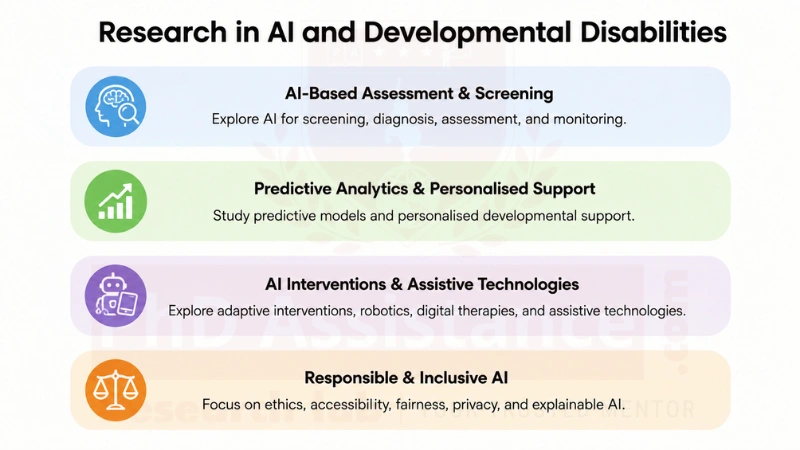
Artificial Intelligence (AI) is providing novel ways of assessing, predicting, monitoring, and intervening in cases of developmental disabilities. The development of machine learning, predictive analytics, intelligent personalised systems, and assistive technologies is paving the way to provide more personalised and accessible care through a data-driven approach.
AI in Developmental Disabilities Research Special Issue invites scholars to study the development, applications, and evaluation of Artificial Intelligence technologies among people with developmental disabilities. Research dealing with methodological, ethical, cultural, accessibility, and translational problems of using artificial intelligence technologies is especially welcome. We also encourage interdisciplinary research that bridges developmental sciences, clinical practice, education, engineering, data science, and ethics.
Why publish in this issue?
The present Special Issue offers researchers, practitioners, educators, engineers, data scientists, and bioethicists a platform to present their innovative work in relation to AI in developmental disorders. Through the issue, they can illustrate their technological inventions, methodologies, and solutions that may potentially help with the evaluation, intervention, and management of such disorders.
Key advantages:
Scope
Manuscripts are sought for this Special Issue on Artificial Intelligence and developmental disabilities. Contributions must reflect methodological rigour as well as a focus on current issues in relation to assessment, prediction, intervention, accessibility, ethics, and implementation associated with AI approaches.
Contact PhD Assistance Research Lab today to publish your research papers in Scopus and PubMed-indexed journals!
Know More About This Issue
The rapid emergence of Artificial Intelligence is generating possibilities for enhancing the evaluation, monitoring, prediction and support for people with developmental disabilities. The fields of machine learning, predictive analysis, intelligent systems, robotics and assistive technologies can offer ways of personalisation in aiding people with developmental disabilities.
The purpose of this Special Issue is to serve as an outlet for scholarly contributions focused on research concerning the design, use and validation of AI approaches within developmental disabilities. The focus will be on advances in methodology, ethics, cultural competency, accessibility, transparency, and the practical application of AI technologies.
Submissions that concern AI-based assessment and prediction, personalised interventions, digital therapies, assistive devices, and ethical use of AI will be particularly appreciated.
Key factors
How We Support Your Submission
The PhD Assistance Research Lab helps researchers develop high-quality manuscripts for publication in international journals and Special Issues. The Publication team works on improving the scientific quality, clarity, methodology, originality, and presentation of the research according to the requirements of the journal.
Our services include:
The publication experts at our organisation can help researchers make their manuscript fit for the Special Issue titled “Artificial Intelligence Approaches in Research and Intervention for Developmental Disabilities”.
Journal Guidelines:
If you are a researcher interested in publishing research papers in the journal titled “Artificial Intelligence Approaches in Research and Intervention for Developmental Disabilities,” get help from the PhD Assistance Research Lab to publish your manuscript.
Free Guide: How to Write the Journal Manuscript
Book a free consultation to get guidance from the PhD Assistance Research Lab for writing a credible research manuscript and submitting it to a high-quality journal.
FAQs:
- What is AI’s role in developmental disability research?
AI supports the assessment, prediction, monitoring, and analysis of developmental disabilities.
It can also enable personalised and data-driven approaches to research and care. - How can AI support developmental disability interventions?
AI can provide adaptive interventions, personalised learning, digital therapies, and intelligent support systems.
These technologies can help improve independence, functioning, and overall well-being. - What AI approaches can researchers use?
Researchers can use machine learning, predictive analytics, multimodal AI, robotics, and intelligent systems.
These approaches can support assessment, intervention, monitoring, and outcome prediction. - What are AI applications in developmental disabilities?
AI can be applied to screening, diagnosis, assessment, prediction, intervention, and continuous monitoring.
It can also support assistive technologies and personalised developmental care. - How can AI improve developmental disability research?
AI can improve data analysis, early identification, prediction of outcomes, and personalised support.
It can also help researchers integrate complex and longitudinal data more effectively.
Reference
Elsevier. (2026). Call for Papers: Artificial Intelligence Approaches in Research and Intervention for Developmental Disabilities. Research in Developmental Disabilities | ScienceDirect.com by Elsevier – Research in Developmental Disabilities | ScienceDirect.com by Elsevier