
The paper and its question
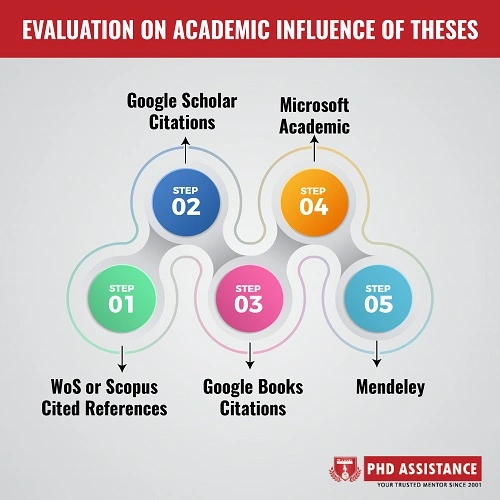
Kousha and Thelwall (2020) start from a gap. A research doctorate ends in a dissertation that reports a substantial body of original work, yet no citation index covers dissertations well, so their scholarly influence is rarely assessed. The authors asked whether four alternative sources, Google Books, Scopus, Microsoft Academic and Mendeley, could support impact assessment at scale, and how the answer differs by subject and year.
The study followed an earlier paper by the same authors on Google Scholar and Mendeley for dissertations (Kousha & Thelwall, 2019), and it sits in a longer line of work on the scientific contribution of doctoral students and the declining citation of theses as separate documents (Larivière et al., 2008; Larivière, 2012).
How the study was done
The authors downloaded metadata for 172,576 UK doctoral dissertations from 2009 to 2018 from ProQuest Dissertations & Theses, and removed 21,836 without subject classifications, leaving 150,740. They explain that the British Library's EThOS service did not support large-scale metadata collection or subject classification, so it was used only for a later Google Scholar comparison (Kousha & Thelwall, 2020).
Each source needed its own matching rules, because a thesis title can also belong to an article by the same author:
- Google Books: queries combined the author's surname, an exact title phrase, the year and the awarding university, which removed citations to same-titled articles.
- Scopus: titles were searched in cited references, and a match required title, surname and university.
- Microsoft Academic: title searches were filtered by author and year, and records that looked like articles (with a DOI or journal identifier) were removed.
- Mendeley: searches by title and surname were restricted to records typed as theses or dissertations.
Manual checks were used throughout, and the authors acknowledge that some matching errors remain.
Google Scholar could not be queried at this scale, so it was tested separately. The authors searched for theses through their EThOS records and matched 36,354 dissertations, about a quarter of the main dataset, which allowed a like-for-like comparison of counts for those theses only (Kousha & Thelwall, 2020). This design choice is worth noticing: when a source cannot be sampled in the same way as the others, a separate, clearly bounded comparison is more honest than forcing it into the main analysis.
What they found
Most theses had no trace in any source. The shares with at least one citation or reader were small and differed sharply by field.
| Source | All theses (n = 150,740) | Where it was strongest | Where it was weakest |
|---|---|---|---|
| Scopus | 12% | Engineering (24%) | Medical sciences (6%) |
| Microsoft Academic | 11% | Close to Scopus in most fields; ahead for older social science, business and education theses | Medical sciences (6%) |
| Google Books | 9% | Arts and humanities (18%); social sciences (13%) | Medical sciences (3%) |
| Mendeley readers | 5% | Social sciences (8%) | Sciences (3%) |
Scopus and Microsoft Academic counts correlated most strongly with each other. Google Books correlated only weakly with them, most weakly in history, which suggests that book citations capture a different kind of influence. Mendeley counts correlated very weakly with citations, and about 71% of thesis readers in Mendeley were students. For a sample matched through EThOS, Google Scholar found up to six times as many citations as Scopus, much of it from books, eprints, working papers and other theses, but it could not be searched at the scale needed (Kousha & Thelwall, 2020).
The authors conclude that even one citation signals above-average impact for a UK thesis, that Google Books suits the humanities and Scopus or Microsoft Academic the sciences and engineering, that Mendeley can show early interest in education and the social sciences, and that comparisons should be made only within fields.
Strengths
- Scale and coverage. A decade of theses across all subjects gives a far broader picture than earlier single-field studies.
- Careful matching. Requiring the university name in matches tackles the main source of false positives.
- Field sensitivity. Reporting by subject and year, rather than one overall figure, avoids misleading comparisons and fits the principle that indicators must be read in context (Hicks et al., 2015).
- Candour. The authors list their own limitations, which makes the paper a good model for doctoral writing.
Limitations and what has changed since 2020
Several limits come from the authors themselves: ProQuest coverage of UK theses is incomplete, especially for the final years; university-name matching misses abbreviations and misspellings; merging narrow subjects into broad fields may hide differences; and citations to journal articles derived from a thesis are not counted. That last point matters most. In many sciences, the thesis's ideas travel through papers, so a low thesis citation count understates its influence (Larivière, 2012).
A wider caution applies to any citation count. Citations are made for many reasons, not all of them signals of quality or use (Bornmann & Daniel, 2008), and database coverage differs by field and language (Mongeon & Paul-Hus, 2016).
The landscape has also changed. Microsoft Academic, one of the four sources tested, was retired at the end of 2021, so its results are now historical rather than practical guidance. Its role has passed to other open or freemium indexes such as OpenAlex and Dimensions; OpenAlex in particular is now being benchmarked against Web of Science and Scopus, with broader coverage but its own gaps (Culbert et al., 2025). Google Scholar remains the most inclusive source, as earlier comparisons across 252 subject categories also found (Martín-Martín et al., 2018), and it is the simplest place to check a single thesis (Harzing & van der Wal, 2008).
Worked example (illustrative): tracking the reach of one thesis
Imagine a history thesis completed four years ago and a chemistry thesis completed in the same year. For the history thesis, the paper suggests looking first at Google Books and Google Scholar, because monographs and edited books are where it is likely to be cited. For the chemistry thesis, Scopus or OpenAlex cited-reference searches are more useful, but the researcher should also count citations to the journal articles drawn from the thesis, because that is where most of its influence will appear.
In both cases, a count of zero says little on its own. Most theses in the study had no citations in any single source, so one or two citations already place a thesis above the norm for its field (Kousha & Thelwall, 2020). Report counts with the source, the search date and the field, and pair them with qualitative evidence such as reuse of data, invitations or policy mentions.
What the study means for a doctoral researcher
The findings have practical consequences for anyone finishing a thesis. A thesis is most likely to be found and cited when it is easy to identify as a distinct work. The matching rules in the study depended on a stable title, the author's surname and the awarding university (Kousha & Thelwall, 2020), and the same details help human readers and search engines. Deposit the final thesis in your institutional repository with complete metadata, use the same form of your name across the thesis and later papers, and link the thesis to your researcher identifier.
Because so much influence travels through derived articles, plan those articles early and cite the thesis in them where your field allows. A reader who meets the article can then reach the fuller account, including methods, data and negative results that rarely fit in a journal paper. In the humanities, where book citations matter most, the route from thesis to monograph or book chapter is the equivalent step.
Finally, decide in advance what evidence of reach you will collect and how you will report it. The table below sets out a minimal, honest record.
| Element | What to record |
|---|---|
| Source | Google Scholar, Google Books, Scopus, OpenAlex or another index, named exactly |
| Search | Query used and date searched, because counts change over time |
| Unit | The thesis itself, or the thesis plus articles derived from it, stated separately |
| Field context | How the count compares with typical theses or papers in the same field and year |
| Other evidence | Reuse of data or code, invitations, policy or practice mentions, with sources |
Common mistakes when measuring thesis impact
- Comparing citation counts across fields as if they meant the same thing (Hicks et al., 2015).
- Relying on a single source when coverage differs by discipline (Mongeon & Paul-Hus, 2016).
- Treating Mendeley readers as citations rather than as early, mostly student interest.
- Citing results for Microsoft Academic as if the service were still available.
- Ignoring citations to articles derived from the thesis.
For related guidance, see how to select a journal, how to convert a thesis into a journal manuscript and why citation matters.
Key takeaways
- Fewer than one in eight UK theses had a citation or reader in Scopus, Microsoft Academic, Google Books or Mendeley (Kousha & Thelwall, 2020).
- The best source depends on the field: Google Books for the humanities, Scopus for engineering and the sciences (Kousha & Thelwall, 2020).
- Microsoft Academic has been retired; open indexes such as OpenAlex now fill part of its role (Culbert et al., 2025).
- Thesis influence often travels through derived articles, which thesis-level counts miss (Larivière, 2012).
- Read any count within its field and alongside expert judgement (Hicks et al., 2015; Bornmann & Daniel, 2008).