
Critical Review of Living Rhythms: Investigating Networks and Relational Sensorial Island Rhythms Through Artistic Research
Introduction
A critical review in artistic research requires scholars to evaluate theoretical systems and their associated research methods, sensory evaluations, and interdisciplinary work. Researchers face difficulties when they evaluate artistic research, as the studies combine philosophical concepts and aesthetic principles with ethnographic research.
The article Living Rhythms: Investigating Networks and Relational Sensorial Island Rhythms Through Artistic Research presents an experimental investigation into virtual reality (VR), rhythmanalysis, sensory mapping, and relational artistic practice during the COVID-19 pandemic. The study investigates how artists create immersive virtual reality environments through socially engaged research, which transforms islanders’ sensory experiences and environmental rhythms into artistic experiences. The Living Rhythms Artistic Research Critical Review assesses the article’s conceptual development, methods, theoretical foundation and interdisciplinary value.
The research combines Lefebvre’s Rhythmanalysis with Deleuze and Guattari’s rhizome theory and Glissant’s archipelagic thought and Deligny’s sensory mapping techniques to study how humans and non-human entities build their relationships. The article advances artistic research by examining sensory rhythms together with environmental interaction and digital immersion, which establish novel methods of social connection during periods of isolation.
Summary of the article
The article examines the Rhythmanalysis+ project, which involves virtual reality research about social engagement through artistic research work with four Sherkin Island residents. The study investigates how people perceive their daily sensory rhythms together with environmental sounds, body movements and island activities through virtual reality environment development.
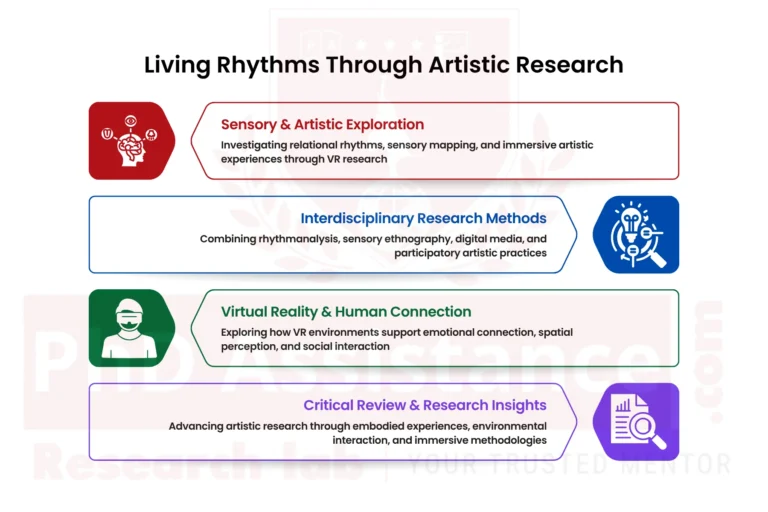
The study integrates rhythmanalysis and cyclical rhythms, archipelagic and relational thinking, VR immersive environments, Ethnographic sensory mapping, Soundscape construction, and Non-linear network theory.
The author creates visual and audio representations of island life through his research, which includes participant interviews, drawings, recordings and VR-based spatial mapping. The article presents VR to the audience as more than a technological instrument that enables users to experience their surroundings through spatial relationships.
The research demonstrates its living rhythms artistic research analysis because it studies how people experience social isolation and connect with others through sensory experiences and emotional bonds created by immersive technologies.
Critique
Significance and contribution of the field
The article establishes connections between modern artistic research domains through its unified framework, which combines sensory ethnography, virtual reality technology and environmental humanities and relational aesthetics research methods.
Burns develops rhythmanalysis by studying digital immersive environments, which include multisensory artistic experiences, while Lefebvre examined how urban environments and social spaces create rhythm patterns. Deleuze and Guattari’s rhizomatic theory exists only as a theoretical concept until it is implemented through spatial VR mapping.
The research relates to Sarah Pink’s sensory ethnography study because it examines environmental spaces and human social interactions through physical bodily sensory experiences. The virtual reality system developed by Burns enables users to experience complete environments that prove this concept. It demonstrates human-nonhuman relationships through its visual and auditory components, which create an interactive artistic space. The study empowers relational sensorial rhythms island study review by using sensory perception to establish research boundaries while creating artistic content.
Key contributions include expanding rhythmanalysis into VR artistic environments, combining sensory ethnography with immersive digital media, demonstrating relational artistic methodologies during isolation, integrating multispecies and environmental perception, and developing embodied forms of artistic knowledge production. The article provides substantial research value to academic scholars who study artistic research, media studies, digital humanities, sensory ethnography, and VR-based art practice.
Methodology and research design
The research study uses artistic research methods, which require researchers to perform artistic work and study human behaviour through ethnographic methods, gather sensory data from participants, record environmental sounds, and create virtual reality demonstrations.
The research methodology employs an interdisciplinary framework that combines six different academic disciplines through its study of Artistic research, Sensory ethnography, Rhythmanalysis, VR experimentation, Participatory research, and Cartographic visual mapping. The author uses participatory experiences to create audiovisual virtual reality compositions, which he describes in his research. The research uses Zoom interviews together with sensory diaries, sound recordings, and visual sketches to establish a research framework.
Burns demonstrates his knowledge of artistic practice according to Henk Borgdorff’s research framework, which states that artistic work produces knowledge. The article combines academic research with artistic practice through Natalie Loveless’ study of hybrid artistic research methods.
However, some methodological limitations are noticeable, including that the participant sample remains very limited, Longitudinal sensory observation was absent, audience-response analysis lacked formal qualitative evaluation, and the study relies heavily on interpretive artistic perception.
Argumentation and Use of Evidence
This demonstrates how virtual reality technology enables users to experience physical movements and sensory connections with other people during periods when they cannot make direct contact. The author supports this argument through participant narratives, environmental recordings, sensory mapping, and theoretical interpretation.
The study shows that emotional ties, together with sensory memory retrieval, represent more significant research fields than Oliver Grau’s VR art theory, which investigates digital environments that create authentic experiences and visual illusions. The article applies Merleau-Ponty’s embodied perception theory to study how people utilise their bodies for spatial navigation and various sensory experiences.
It also reflects themes found in Tim Ingold’s environmental anthropology, where movement, pathways, and environmental interaction are treated as forms of lived knowledge. This strengthens the networks and rhythms in artistic research critique because the article demonstrates how rhythm and movement operate simultaneously as social, ecological, and artistic systems.
Ethical considerations and omissions
The research shows its ethical commitment through three specific aspects, which include participant consent, non-extractive engagement and collaborative artistic development work.
The article’s strongest ethical contribution involves its discussion of “opacity” through Glissant’s philosophy, which protects participants from excessive exposure and exploitation of their personal experiences. The pandemic context establishes this matter as especially significant. Burns uses participatory and relational methods, which contrast with traditional ethnographic research methods that require researchers to observe their study subjects. The research connects with modern sensory ethnography methods.
The study contains multiple conceptual flaws that include three specific issues that need to be addressed, but the technical VR section fails to provide sufficient information about accessibility and scalability, while the article maintains an excessive focus on abstract concepts, which affects its ability to deliver clear analytical results. The complex nature of the island rhythms artistic research paper review is necessary to demonstrate how island ecosystems function as relational art environments.
Writing Style and Structure
The article demonstrates a highly reflective and poetic academic writing style. The text includes three distinct sections, which contain theoretical discussion, artistic reflection, sensory description, and methodological explanation. The writing successfully mirrors the rhythmic and relational themes discussed throughout the article. The content humanises the reading experience through its combination of visual figures, sensory descriptions, and immersive narrative explanations.
The article aims to dismantle traditional academic texts by demonstrating their rigid structure through their actual reading pattern. The article provides space for two types of reflection, which include rhizomatic and archipelagic thinking. However, some sections are overly descriptive, and theoretical repetition makes. It is hard to understand the text, and people who do not know artistic research terms will find it difficult to interpret the content.
Despite these limitations, the article successfully delivers its message about embodied artistic research experiences. It provides important contributions to the discussion about sensory networks in art research through its critical examination.
Conclusion
The article Living Rhythms: Investigating Networks and Relational Sensorial Island Rhythms Through Artistic Research makes an important contribution to artistic research, VR studies, and sensory ethnography. The study shows that users are able to learn through sensory experiences and develop social relationships while they create art when they use VR environments, which operate at their highest level of immersion.
The research outcomes demonstrate how it combines rhythmanalysis and sensory ethnography and digital immersive practice into one artistic system. It also supports sensorial networks in art research critical analysis by studying how virtual environments support relational interactions. The research study presents methodological limitations but still provides important insights for current artistic research and immersive sensory investigation.
It shows that VR technology functions as a sensory medium through which users can establish social connections. The study presents a novel research methodology that uses artistic creations to connect environmental patterns with participant experiences and immersive audio environments for studying human spatial perception.
“Are you facing challenges in writing a high-quality critical review for your research? The PhD Assistance Research Lab offers specialised guidance tailored to doctoral scholars and early-career researchers.”
Reference
- Burns, A. (2026). Living rhythms: Investigating networks and relational sensorial island rhythms through artistic research. Arts, 15(2), 31 https://www.mdpi.com/2076-0752/15/2/31
- Borgdorff, H. (2009). Artistic research within the fields of science. Kunst und Forschung: Can Artists Research?, 60–73. https://www.ahk.nl/fileadmin/download/ahk
- Clark, A., & Chalmers, D. (1998). The extended mind. Analysis, 58(1), 7–19. https://www.alice.id.tue.nl/references/clark
- Deligny, F. (2015). The arachnean and other texts. Univocal Publishing. https://logischerevolten.wordpress.com/wp-content/uploads/2019/03/webpage-1.pdf