

Call for Papers: Biomaterial Interactions at Cell–Tissue–Material Interfaces: From Fundamental Mechanisms to Biomedical Applications
May 8, 2026
Critical Review of Living Rhythms: Investigating Networks and Relational Sensorial Island Rhythms Through Artistic Research
May 11, 2026PhD Data Analysis Guidance for Economics Students in Qatar: A Clear Step-by-Step Approach
- May 8, 2026
- PhD Data Analysis
Introduction
Qatar has developed its economy through its natural gas export revenues, diversifying its economy, sovereign wealth fund investments, and its digital economic transformation initiatives. Students in Qatar’s economics doctoral programs must demonstrate expertise in advanced econometric methods to resolve actual macroeconomic and development challenges by implementing economic models that combine both theoretical and observational elements.
The data examination phase presents difficulties for many doctoral researchers because economics research requires them to possess strong econometric skills, access high-quality macroeconomic datasets, and develop computational models and correctly understand policy-related economic relationships. Researchers face various challenges when they try to investigate inflation dynamics together with energy price fluctuations and labour market participation.
The blog shows how economics PhD students in Qatar face analytical and methodological challenges while executing their research through advanced econometric techniques and empirical research methods. The PhD Assistance Research Lab provides expert PhD statistical analysis service in Qatar to researchers to enhance their economic research standards.
What you will learn from this blog?
- Key reasons economics PhD students struggle during data analysis
- Advanced econometric modelling techniques in economics research
- Best practices for macroeconomic and panel data analysis
- Common statistical and economic data interpretation problems
- Strategies to improve empirical economics research quality
Understanding Challenges in Economics PhD Research
Doctoral researchers in economics face difficulties because they need to combine economic theory with their advanced empirical and econometric methods. Theoretical economic frameworks prove difficult for PhD students to connect with actual macroeconomic indicators, which they need to measure.
Researchers studying inflation persistence, oil price shocks, labour productivity, fiscal policy transmission, and economic diversification in Qatar face research problems because of incorrect econometric model specifications and researchers’ weak understanding of stationarity and cointegration and their difficulties with large macroeconomic datasets and their inability to correctly interpret causal economic relationships
Example: Researchers Lutz Kilian and Cheolbeom Park proved that oil price shocks create significant impacts on economic development and its forecasting abilities. The research showed that energy-dependent economies, which include Qatar, experienced policy misinterpretation because researchers used incorrect structural VAR model specifications.
Structured PhD Data Analysis Help in Qatar for Economics Students
1. Developing a Technically Strong Economics Research Framework
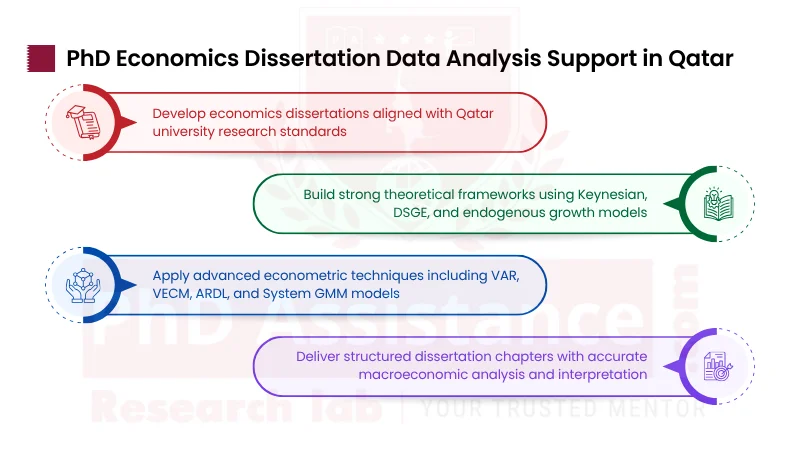
PhD students in economics begin their research process by choosing various research areas, which include inflation, unemployment, economic diversification, and monetary policy. A strong economics dissertation requires researchers to define macroeconomic variables to demonstrate their theoretical foundations through Keynesian, DSGE, and endogenous growth theories, and select appropriate econometric methods to measure actual policy outcomes.
Researchers must create connections between economic theories and the datasets that they will acquire from the IMF, World Bank, Qatar Central Bank and OECD databases.
Example: Acemoglu et al. (2014) found that endogenous growth models show human capital investment, institutional quality and technological development as their essential components, which drive long-term economic growth. The researchers demonstrated that economic models need researchers to find appropriate macroeconomic data, which they can use for testing models and assessing government programs.
Researchers face challenges as they cannot establish a connection between the theoretical economic frameworks, literature reviews and empirical econometric models. Professional PhD Data Analysis Help in Qatar provides expert guidance in econometric modelling, statistical validation and empirical data interpretation to support high-quality economics research.
2. Econometric Modelling Challenges in Economics Research
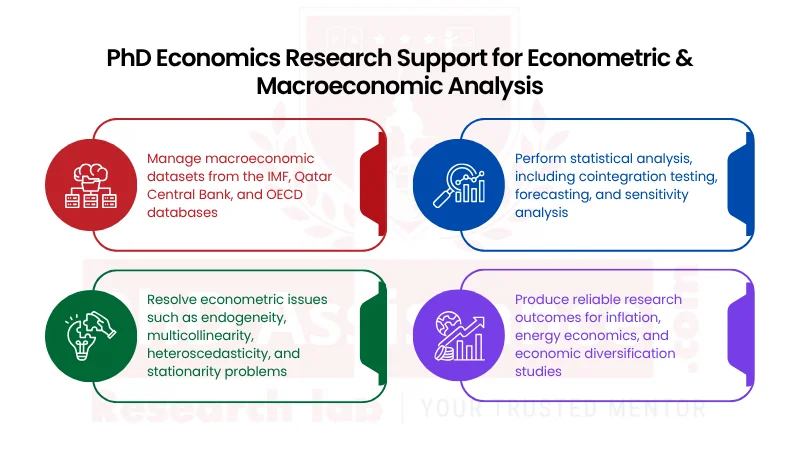
The foundation of doctoral research in economics depends on econometric precision. Researchers face various challenges, which include unit root problems, stationarity issues, multicollinearity, endogeneity bias, heteroscedasticity, and autocorrelation, weak instrumental variables and improper use of VAR, VECM, ARDL, and DSGE models.
Researchers studying inflation dynamics in Qatar use Phillips Curve frameworks as their main research tool without testing long-run equilibrium links between inflation, unemployment, and exchange rates. The correct interpretation of impulse response functions, variance decompositions, and forecasting outputs requires advanced econometric knowledge.
Example: David Roodman demonstrated that researchers produce wrong macroeconomic results when they fail to handle endogeneity and lag structures appropriately. The study established the importance of System GMM estimation for dynamic panel data analysis in economics research.
3. Handling Macroeconomic Data and Empirical Analysis with PhD Economics Statistical Analysis Help in Qatar
Researchers need to use international financial databases, which provide macroeconomic and financial data through their systems that include the International Monetary Fund, World Bank, Qatar Planning and Statistics Authority and Qatar Central Bank. Researchers face difficulties because they must address missing data points and structural breaks caused by financial crises, inflation adjustment errors, exchange rate conversion issues, and non-linear economic relationships.
Researchers conducting energy economics analysis need to use Augmented Dickey-Fuller testing together with Phillips-Perron unit root tests and Johansen cointegration analysis. The PhD Economics Statistical Analysis Help in Qa tar provides support to scholars to acquire advanced econometric skills for analysing complex macroeconomic systems.
Example: The study conducted by Paresh Kumar Narayan and his research team discovered that inflation, oil prices, and economic growth maintain permanent equilibrium relations that undergo brief temporary changes. The research study demonstrated that macroeconomic forecasting and policy analysis require cointegration testing as essential instruments together with Vector Error Correction Models.
Get the pricing details for the PhD data analysis service at PhD Assistance Research Lab, designed to assist researchers in constructing a dissertation.
4. Interpreting Economic Results and Policy Implications
Many economics PhD students create regression results that show statistical significance, yet they cannot explain their results in terms of economic importance. Economists need to connect their research findings with the development of public policies and the implementation of macroeconomic decision-making systems. Qatar researchers need to research three distinct areas, which include studying how exchange rate systems affect inflation transmission, researching the connection between monetary policy and hydrocarbon revenue and evaluating which fiscal expansion models achieve their intended policy results.
The discussion chapter of an effective economics dissertation needs to include economic interpretation of coefficients with theoretical consistency checks and policy relevance.
Overcoming Mid-Research Data Analysis Challenges
Economics doctoral research requires technical expertise because researchers need considerable time to debug econometric codes, manage datasets, analyse statistical results and incorporate supervisor feedback. Researchers experience multiple difficulties when they attempt to validate econometric models, execute software, interpret forecasts, explain economic policies, and produce empirical research for academic journals.
Students who study STATA, EViews, MATLAB and Python econometric libraries need PhD Statistical Analysis Help in Qatar because it helps them create reliable research results. The three methods which researchers use to overcome dissertation progress limits include incremental econometric testing, reproducible coding frameworks, continuous robustness analysis and structured analytical writing.
Example: Athey (2018) demonstrated that machine learning algorithms deliver superior macroeconomic forecasting results through their improved forecasting abilities, which exceed the performance of traditional linear econometric models when researchers use data to study both inflation and financial market volatility.
Conclusion
The data analysis work of Economics PhD students in Qatar encounters obstacles from three specific econometric challenges, which include limited macroeconomic data access and their difficulties in understanding policy and a lack of economic theory and empirical modelling connections.
The researchers use systematic econometric planning as well as robust macroeconomic data management, advanced statistical validation, and policy-oriented empirical interpretation to solve dissertation challenges. The PhD Economics Data Analysis Help in Qatar provides reliable academic assistance, which enables researchers to develop their analytical skills and econometric abilities.
Book a Free Expert Consultation with PhD Assistance Research Lab to avoid these challenges and develop an accurate data analysis.
References
- Athey, S. (2018). The impact of machine learning on economics. In A. Agrawal, J. Gans, & A. Goldfarb (Eds.), The economics of artificial intelligence: An agenda (pp. 507–547). University of Chicago Press.
- Acemoglu, D., Gallego, F. A., & Robinson, J. A. (2014). Institutions, human capital, and development. Annual Review of Economics, 6, 875–912.
- Hvidt, M. (2013). Economic diversification in GCC countries: Past record and future trends. Kuwait Programme on Development, Governance and Globalisation in the Gulf States, 27, 1–31.
- Kilian, L., & Park, C. (2009). The impact of oil price shocks on the U.S. stock market. International Economic Review, 50(4), 1267–1287.
- Narayan, P. K., Narayan, S., & Sharma, S. S. (2011). Do oil prices predict economic growth? New global evidence. Energy Economics, 33(5), 1019–1028.
- Roodman, D. (2009). How to do xtabond2: An introduction to difference and system GMM in Stata. The Stata Journal, 9(1), 86–136.
