
In brief: two spider-inspired metaheuristics
Metaheuristics are general search strategies for optimisation problems that are too large or irregular for exact methods, such as engineering design, scheduling and parameter tuning. Swarm intelligence methods, a family dating back to the 1990s, coordinate many simple agents that share information. Two of them take their inspiration from social spiders, a small minority of spider species that live in colonies on a shared web.
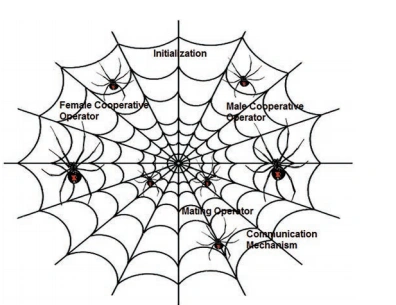
The names cause confusion. Social spider optimisation (SSO) was proposed by Cuevas et al. (2013). The social spider algorithm (SSA) was proposed separately by Yu and Li (2015a), who state that the two differ in all aspects of their design. It then explains how SSA searches, how to choose between the two, and how to benchmark and report either method so that examiners can trust the results.
SSO and SSA compared
| Feature | Social spider optimisation (SSO) | Social spider algorithm (SSA) |
|---|---|---|
| Authors | Cuevas et al. (2013) | Yu and Li (2015a) |
| Behaviour modelled | Mating and cooperation in the colony | Foraging through vibrations on the web |
| Population | Spiders classified by gender, with different roles | All spiders identical, same operation |
| Search operators | Several movement operators | One random-walk operator guided by a target vibration |
| Implementation effort | Higher, more operators to code and tune | Lower, as its authors note |
When you cite either method, name it precisely and cite its founding paper. Many later variants modify one parent or the other, so state which parent your variant builds on. If a paper you rely on calls SSO "the social spider algorithm", say so in a footnote rather than repeating the confusion.
How the social spider algorithm searches
In SSA the search space is treated as a web and each spider's position as a candidate solution (Yu & Li, 2015a). The method can be described without the metaphor:
- Evaluate. Each spider evaluates the objective function at its position.
- Broadcast. Each spider generates a vibration whose intensity increases with solution quality.
- Attenuate. Vibrations weaken with distance between spiders, scaled by the spread of the population and an attenuation parameter ra; this sets how local or global information sharing is.
- Choose a target. Each spider keeps the strongest vibration it has received as its target, replacing it when a stronger one arrives.
- Mask dimensions. A binary mask decides, dimension by dimension, whether to follow the target or a randomly chosen spider; the mask changes with a probability governed by pc, and pm sets how many dimensions are masked.
- Move. Each spider performs a random walk combining momentum from its previous move with a step towards its following position, and is reflected back if it leaves the bounds.
Yu and Li report a sensitivity analysis and suggest ra = 1, pc = 0.7 and pm = 0.1 as starting values, warning against very large pc (Yu & Li, 2015a; Yu & Li, 2015b). They tested SSA on 25 functions built from the CEC 2013 and CEC 2014 benchmark bases in 10, 30 and 50 dimensions, with 51 runs each, against CMA-ES, JADE, SaDE and GL-25, and reported favourable results. These are the authors' results; treat them as a starting point to check, not as settled.
Choosing between SSO, SSA and other methods
Both methods have been adapted to many problems since they appeared, including binary versions for feature selection, multi-objective versions for image analysis and versions for power system scheduling. These variants are where most dissertation ideas come from, but an application paper is not evidence that the parent method suits your problem. Choose by asking four questions.
- What kind of problem is it? Continuous, binary, combinatorial, constrained or multi-objective problems need different operators and constraint handling, and the original papers were written for continuous global optimisation (Yu & Li, 2015a; Cuevas et al., 2013).
- How expensive is each evaluation? If one evaluation takes minutes, a method that needs tens of thousands of evaluations may be impractical, whatever its benchmark ranking.
- What are the strongest existing baselines? Established methods such as CMA-ES and differential evolution variants, which Yu and Li themselves used as comparators, set the bar to beat (Yu & Li, 2015a).
- What is your contribution? A thesis contributes more by explaining why an operator helps on a class of problems than by adding a new metaphor (Aranha et al., 2022).
If SSA and SSO perform similarly on your problem, prefer the simpler one to implement and explain. If neither beats a well-tuned standard method, that is a legitimate and useful finding to report.
Reading metaphor-based algorithms critically
Two general results should frame any dissertation that uses SSO, SSA or a similar method. First, the no free lunch theorems show that, averaged over all problems, no optimisation algorithm outperforms any other (Wolpert & Macready, 1997). Claims of superiority are only meaningful for a stated class of problems. Second, researchers have shown that several "novel" nature-inspired algorithms are close variants of existing methods presented in new vocabulary (Camacho Villalón et al., 2019; Piotrowski et al., 2014; Tzanetos & Dounias, 2021), and leading researchers have called for metaphor-based methods to be described in standard optimisation terms and tested rigorously (Aranha et al., 2022).
Benchmarking has its own traps. Kudela (2022) showed that many methods perform well on common test functions partly because they are biased towards the centre of the search space, where many benchmark optima lie; shifting the optimum exposes the bias. Your thesis should show that you know these debates.
Worked example (illustrative)
A hypothetical engineering dissertation proposes an SSA variant for a constrained mechanical design problem. A defensible plan would: describe the variant in plain optimisation terms; compare it with the original SSA (Yu & Li, 2015a), with SSO (Cuevas et al., 2013) and with strong general baselines such as CMA-ES; use a documented benchmark platform (Hansen et al., 2016) plus shifted versions of functions to detect centre bias (Kudela, 2022); run each algorithm many times with equal evaluation budgets; and compare results with non-parametric tests such as the Friedman test with post hoc procedures (Derrac et al., 2011).
The number of algorithms, problems and runs affects the conclusions of such comparisons, so the plan should justify them (Veček et al., 2017). A short parameter sensitivity study, reported in an appendix, shows the results are not an artefact of tuning. Finally, code, seeds and raw results are archived so that others can reproduce the tables (Sandve et al., 2013).
What to report
| Element | What to state |
|---|---|
| Algorithm identity | SSO or SSA, founding paper, and the parent of any variant |
| Operators | Each operator in plain terms, with pseudocode |
| Parameters | Values, how they were chosen and a sensitivity check |
| Baselines | Strong, current competitors, not only other metaphor-based methods |
| Benchmarks | Suite, dimensions, shifted or rotated versions, evaluation budget |
| Statistics | Number of runs, non-parametric tests, effect sizes |
| Reproducibility | Code, seeds, software versions and raw results |
Common mistakes
- Citing SSO when describing SSA, or the reverse.
- Describing the method only through the metaphor.
- Comparing only with older or weaker metaheuristics.
- Using default parameters for your method while leaving baselines untuned, or the reverse.
- Reporting best runs instead of distributions over many runs.
- Claiming general superiority from results on one benchmark suite.
For the same critical approach applied to another nature-inspired method, see elephant herding optimisation and how to benchmark a metaheuristic; for statistical comparison of algorithms, see using ANOVA to compare algorithms.
Key takeaways
- SSO and SSA are different algorithms: SSO models mating with gender classes, SSA models foraging with identical spiders (Cuevas et al., 2013; Yu & Li, 2015a).
- SSA shares information through distance-attenuated vibrations and moves spiders by a masked random walk (Yu & Li, 2015a).
- Report and test SSA parameters rather than assuming the published defaults suit your problem (Yu & Li, 2015b).
- No algorithm is best on all problems, and metaphor-based novelty needs scrutiny (Wolpert & Macready, 1997; Aranha et al., 2022).
- Benchmark against strong baselines on shifted functions with non-parametric statistics (Kudela, 2022; Derrac et al., 2011).