
Overview
Summary:
This guide explains how to prepare and defend a finance dissertation in Qatar by aligning research with Qatar National Vision 2030 and the Third National Development Strategy 2024–2030. It explores how to identify research gaps, establish an original research contribution, select an appropriate methodology, and interpret findings accurately. Key research areas include banking resilience, sustainable finance, ESG disclosure, financial-sector diversification, and digital payments. The guide highlights the importance of reliable data, causal inference, robustness testing, and evidence-based policy recommendations. It also provides practical guidance for preparing dissertation defence presentations, answering examiners’ questions, acknowledging research limitations, and demonstrating how the study advances finance knowledge while addressing Qatar’s financial and economic priorities.
Defending a finance dissertation in Qatar requires candidates to explain the research question, justify the method, interpret the evidence, and demonstrate an original contribution. Qatar National Vision 2030 sets a long-term direction for economic, social, human, and environmental development (National Planning Council, n.d.). The Third National Development Strategy 2024–2030 translates this direction into priorities including sustainable economic growth, fiscal sustainability, environmental sustainability, and stronger institutions (Government of Qatar, 2024).
1. Connect Research to National Priorities Without Overclaiming
Start with a national or sector priority and narrow it to a question that can be answered with accessible evidence. For example, a sustainable-finance dissertation could test whether ESG disclosure is associated with financing costs among Qatar-listed firms. A fintech study could examine factors associated with digital-payment adoption, while a banking-risk study could investigate whether liquidity, capital adequacy, or loan quality is associated with bank resilience. These bounded questions are more defensible than claiming that one dissertation will deliver national sustainability or economic diversification.
Qatar’s financial-sector ESG and Sustainability Strategy identifies climate, environmental, and social risk management, sustainable investment, and ESG integration as important directions (Qatar News Agency, 2024b). This policy context can justify the relevance of an ESG research question, but it does not prove that a particular firm’s ESG score improves financial performance. That claim must be tested using suitable data, a transparent method, and careful treatment of uncertainty.
Table 1. Compare Qatar finance research topics, evidence sources, and methods.
| Qatar-specific research context | Illustrative research question | Evidence and analysis plan |
|---|---|---|
| Banking resilience | How did Qatar banks’ capital adequacy and non-performing loan ratios change over 2016–2023 Q2? | IMF country report reproducing Qatar Central Bank financial soundness indicators; compare trends and explain period limits. |
| Sustainable finance / ESG | Is ESG disclosure associated with financing costs among Qatar-listed firms? | Qatar Stock Exchange disclosures and annual reports; define a reproducible ESG-disclosure measure and debt-cost outcome. |
| Financial-sector diversification | Are financing constraints associated with investment by non-hydrocarbon firms? | Firm annual reports, sector classifications, investment and financing variables; use firm and year controls where justified. |
| Digital payments | Which factors are associated with digital-payment adoption? | Survey or published QCB data, clearly defined adoption measures, sampling strategy and demographic controls. |
Worked example using published Qatar evidence. The IMF’s 2024 Qatar Article IV report reproduces financial soundness indicators sourced from Qatar Central Bank and Haver Analytics. In that series, regulatory capital to risk-weighted assets was 19.3% in 2022 and 19.0% in 2023 Q2, while non-performing loans to total loans were 3.6% in 2022 and 3.8% in 2023 Q2 (International Monetary Fund, 2024). A dissertation could examine the trend alongside liquidity, profitability, and macroeconomic controls. These descriptive figures provide a starting point; they do not, by themselves, establish the cause of a change in banking risk.
2.Define an Original Research Contribution
An original research contribution is the specific value a dissertation adds beyond summarising existing knowledge. It may provide new Qatar-specific evidence, test a relationship that has received limited attention, compare sectors or institutions, refine a theoretical explanation, or show the conditions under which an established relationship does or does not hold. Applying a known framework in Qatar is a contextual contribution, but it is not automatically a theoretical contribution; the candidate must explain what the setting reveals that prior research has not established.
State the contribution in one or two precise sentences and connect it to the gap identified in the literature review. For example: “This study examines whether ESG disclosure is associated with the cost of debt among Qatar-listed firms and tests whether firm size moderates that relationship.” This identifies the population, relationship, outcome, and potential boundary condition without assuming the result in advance. The argument should follow a traceable chain: literature gap, research question, hypotheses or propositions, data and method, findings, and contribution.
If the study uses an established theory, explain whether the findings support, refine, or challenge its predictions. Mixed or statistically insignificant findings can still contribute when they are interpreted carefully and the study is adequately designed. Originality does not require claiming that a topic has never been studied; it depends on the value of the question, the quality of the evidence, and the reasoning used to interpret the results.
3.Choose and Defend an Appropriate Methodology
The methodology should follow the research question, data structure, and assumptions. Quantitative finance studies may use regression, panel-data models, time-series analysis, event studies, or forecasting. Qualitative research can examine governance decisions, risk-management processes, or how institutions implement financial products. Mixed methods can combine numerical patterns with interviews or institutional evidence when each component has a clear purpose and the integration is explained.
For econometric modelling, define the variables, justify the sample, identify data sources, explain missing-data treatment, and specify the model and diagnostic checks. Consider endogeneity, omitted-variable bias, reverse causality, selection effects, and measurement error. Correlation alone does not establish causation. Where causal claims are central, explain the identification strategy and its assumptions, such as those required by a natural experiment or difference-in-differences design (Henningsen et al., 2026; Keele & Grieve, 2025).
Robustness tests should address plausible threats to the main conclusion rather than simply add alternative models. Depending on the design, they may include alternative variable definitions, different sample windows, suitable fixed effects, sensitivity analyses, or out-of-sample validation. Explain why each test matters and whether it changes the interpretation. For interviews or case studies, describe participant selection, recruitment, coding, confidentiality, and how interpretations were checked against the evidence (Creswell & Poth, 2018).
4. Interpret Results and Explain Policy Relevance
Distinguish statistical significance from economic and practical significance. A small p-value does not necessarily indicate a large or important effect, while a statistically non-significant estimate does not prove that no relationship exists. Report effect sizes, confidence intervals, relevant model-fit measures, and assumptions, then explain the meaning of the results in plain language.
Policy implications must remain proportionate to the evidence. A small or non-representative sample cannot automatically support conclusions about all organisations in Qatar or establish the impact of a national policy. State the sample period, institutional setting, data limitations, and groups covered. Qatar’s development strategy can frame the relevance of findings, but empirical results must remain distinct from broader policy ambitions (Government of Qatar, 2024).
5. Prepare for the Dissertation Defence
Use a small number of clear visuals: a conceptual framework, a data or sample-flow diagram, a model summary, and one or two results charts. Avoid dense literature slides and unreadable regression tables. For each key result, prepare a plain-language interpretation, a technical explanation, and a limitation. If an examiner identifies a genuine weakness, acknowledge it and explain its likely effect. Credibility comes from reasoned answers, not from claiming the study has no limitations.
Prepare a concise opening that covers the problem, research question, contribution, method, main finding, and principal limitation. These points should form a short, coherent summary—not a single overloaded sentence. Rehearse likely questions: Why does the question matter in Qatar? What is original? Why was this method selected? Which assumptions are vulnerable? What alternative explanation could fit the results? What would change the conclusion? What should future research test?
Use a small number of legible visuals: a conceptual framework, a data or sample-flow diagram, a model summary, and one or two results charts. Avoid dense literature slides and unreadable regression tables. For each key result, prepare a plain-language interpretation, a technical explanation, and a limitation. If an examiner identifies a genuine weakness, acknowledge it and explain its likely effect; credibility comes from reasoned answers, not from claiming the study has no limitations.
Before the viva or oral defence, confirm the institution’s format, time limit, presentation rules, revision process, and final-deposit requirements. Procedures vary by university and programme, so consult the doctoral handbook and supervisor rather than assuming a single Qatar-wide process.
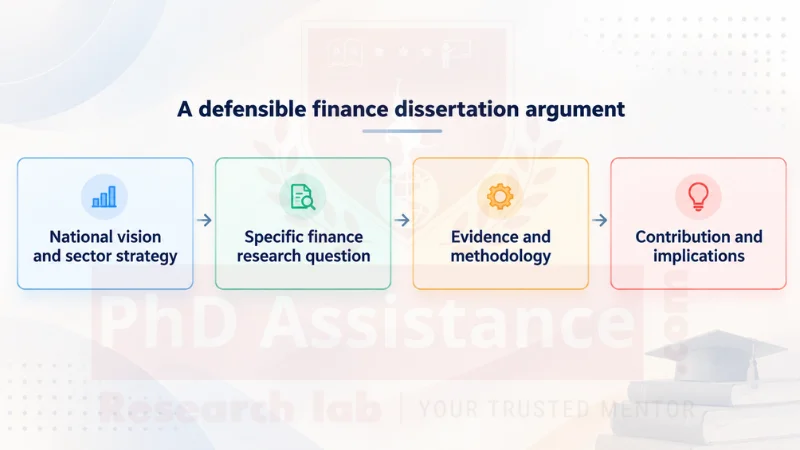
Figure 1. A defensible finance dissertation argument: linking national and sector strategies to a specific research question, appropriate evidence, and a clearly bounded contribution.
Conclusion
A defensible finance dissertation in Qatar links national context to a bounded research problem and uses transparent methods to produce evidence-based conclusions. Qatar National Vision 2030 and the Third National Development Strategy can frame research on resilience, sustainable finance, digital transformation, and diversification. They do not replace a clear research gap, methodological rigour, critical interpretation, or an explicit original contribution. Candidates should explain what they found, why the method supports the claim, where the evidence stops, and how the study advances understanding.
Planning your finance dissertation in Qatar? Get expert guidance with research methodology, data analysis, academic writing, and dissertation structuring.Align your research with Qatar National Vision 2030 and strengthen your academic contribution.
Connect with PhD Assistance today to move your dissertation forward with confidence!
Frequently Asked Question
1. How can a finance dissertation link to Qatar National Vision 2030?
Identify a relevant national priority, translate it into a measurable finance question, and test it with appropriate evidence. Explain the connection without claiming that the study directly delivers a national outcome.
2. Which finance topics may be relevant in Qatar?
Possible topics include banking resilience, sustainable finance, ESG disclosure, fintech adoption, financial inclusion, Islamic finance, and corporate investment, provided the topic has a clear research gap and accessible data.
3. What makes a finance dissertation contribution original?
A contribution may add new evidence, test a relationship in a relevant setting, refine theory, compare methods, or identify when an established result does not hold. The analysis must support the claim.
4. What should candidates prepare for the defence?
Prepare the research question, literature gap, methods, findings, robustness checks, limitations, and contribution, supported by concise visuals and answers to likely examiner questions.