
Overview
A prevalence-only study of thalassaemia in the UAE offers a narrower methodological contribution than a study focused on an unresolved diagnostic problem, and the same applies to a survey of awareness of premarital screening. Neither names a diagnostic gap, a technology or an accuracy design, which is why both tend to struggle at the proposal stage. This blueprint sets out a different question: which α-globin variants does conventional screening miss, can long-read nanopore sequencing resolve them, and how would a doctoral study prove it against a proper reference standard?
Who this is for: PhD scholars in molecular diagnostics, haematology, medical laboratory science, medical genetics and biomedical sciences; laboratory scientists pursuing doctorates; and clinician-researchers in the UAE and wider GCC.
Scope and separation of content. This article distinguishes three things throughout: published evidence, cited to source; research hypotheses, which a thesis would test and which are labelled as such; and design guidance from PhD Assistance. It is research-methodology guidance only — not clinical, diagnostic or genetic-counselling advice — and it does not interpret anyone’s test result or inform anyone’s reproductive decisions. Those belong with the treating clinician and genetic counselling service. Regulatory and data-access requirements change; confirm them with your research ethics committee and the relevant health regulator before submission.
1. Why α-thalassaemia is still a diagnostic research gap in the UAE
The screening infrastructure is mature, which raises the bar for what counts as a contribution. Since January 2025, genetic testing covering 570 genes and more than 840 conditions has been a mandatory part of premarital screening for Emiratis [1], alongside the longstanding premarital haemoglobinopathy screening programme. Arguing that screening matters is no longer a research contribution.
The detection problem is documented, not speculative. A 2026 narrative review from the HELIOS action states that individuals with single α-globin gene deletions “may present with borderline or even normal red cell indices, significantly reducing detection sensitivity”, that “reliance solely on haematological cut-offs may lead to underdiagnosis of α-thalassaemia carriers”, and that “the diagnosis of α-thalassaemia heterozygosity almost always requires DNA-based testing, as CBC and haemoglobin analysis alone are insufficient” [2].
The regional variant spectrum is not what a deletion-focused design would assume. In 400 characterised samples from Kuwait, the dominant α-thalassaemia allele was the non-deletional polyadenylation-1 variant, at an allele frequency of 0.59, with the α⁰ −−MED allele at only 0.017 [3]. That matters for design: a study framed solely around large deletions would miss most of the regional burden in at least one Gulf population. A method that resolves deletional and non-deletional variants in one assay is therefore the stronger proposition. This supports evaluating a method capable of characterising both deletional and non-deletional variants within a predefined study design.
Long-read feasibility is established; local accuracy is not. A 2026 Thai validation study used nanopore sequencing with multiplex long-amplicon PCR across HBA1, HBA2, HBB and G6PD in 63 previously characterised samples, identified 39 distinct variants including −−SEA, −−THAI, −−FIL, −α3.7 and −α4.2, and reported 100% concordance with conventional PCR and Sanger sequencing [4]. That demonstrates feasibility and concordance in the studied cohort; it does not establish diagnostic performance in an Emirati or Gulf screening population, on a locally representative variant spectrum, against a locally used reference standard.
Three study concepts that have to be connected explicitly. This blueprint moves between variants that routine screening does not detect, a sampling frame of adults with unexplained microcytosis, and a prospective diagnostic-accuracy design. They can be combined, but the protocol has to join them rather than assume they are the same thing. The formulation used throughout is laboratory-based: participants are identified from the participating laboratory’s own caseload by prespecified haematological criteria, and the comparator is that laboratory’s documented workflow. If access to the national premarital screening pathway is secured and its α-globin workflow can be documented, the same design can be restated as “adults undergoing the defined UAE premarital screening pathway who meet prespecified criteria for unexplained microcytosis” — which supports stronger claims about that pathway specifically, and requires the corresponding approvals. State which version you are running, and do not claim findings about the national programme from a laboratory-based frame.
The research gap, stated narrowly. A defensible 2026 gap is not “α-thalassaemia is under-detected”. It is closer to this: our documented search did not identify a published study that has prospectively evaluated long-read nanopore sequencing as an index test against the reference standard actually used in a UAE diagnostic or screening pathway, in a defined sampling frame enriched for unexplained microcytosis, with prespecified discordant resolution and STARD-compliant reporting of sensitivity, specificity and predictive values. A claim of this kind is only defensible as the output of a documented search, not as an assertion. Record in the proposal the databases queried (for example MEDLINE/PubMed, Embase, Scopus and Web of Science, plus a preprint server and a trials register), the full search strings for each, the date the search was run, the language and date limits applied, and the inclusion and exclusion criteria used to screen results — and re-run the search before submission, because the field is moving quickly.
2. The α-globin cluster: why duplicated, homologous genes are hard to test
The testing difficulty is a direct consequence of how the alpha globin cluster is organised, and a methods chapter that explains this is already ahead of most.
HBA1 and HBA2 sit on chromosome 16p13.3 within a cluster that also contains HBZ and, roughly 40 kb upstream, the regulatory element MCS-R2 — previously known as HS-40 — which is required for α-globin expression [5]. Three consequences follow.
The genes are duplicated and highly homologous, which is why short-read sequencing struggles: reads from one gene can map equally well to the other, so unique placement fails precisely where the answer lies. The HELIOS review notes that long-read approaches address “the usual limitations posed by highly homologous regions such as the HBA2 and HBA1 genes” [2].
The common deletions arise from that homology. The −α3.7 and −α4.2 deletions are generated by unequal crossover between homologous segments, so their breakpoints sit inside repeated sequence — the hardest place to resolve with short reads or to amplify cleanly.
Regulatory deletions leave the genes intact. MCS-R2 deletions impair α-globin expression while HBA1 and HBA2 remain physically present [5]. An assay that interrogates the genes alone can therefore return a normal result in a genuinely affected individual.
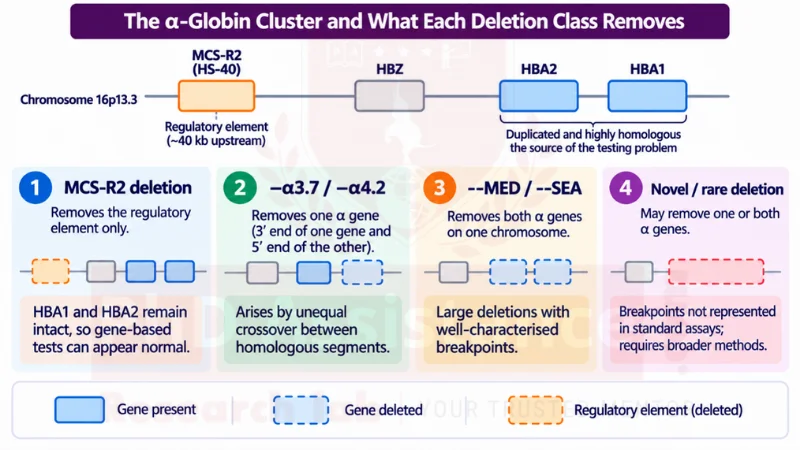
The α-globin cluster on chromosome 16p13.3 showing MCS-R2/HS-40, HBZ, HBA2 and HBA1, with bars indicating what each deletion class removes: single-gene deletions, α-zero deletions, regulatory element deletions and novel or rare deletions
3. Common, rare and novel α-globin variants: what screening programmes expect to find
Screening assays are built around an expected variant list. The research question is what sits outside it.
| Variant class | Examples | Why it matters for assay design |
|---|---|---|
| Single-gene deletions (α⁺) | −α3.7, −α4.2 | Common; breakpoints known and well covered by targeted assays |
| Two-gene deletions (α⁰) | −−MED, −−SEA, −−FIL, −−THAI [5] | Can be particularly important for reproductive risk assessment when inherited with other pathogenic α-globin variants; breakpoints characterised |
| Regulatory element deletions | MCS-R2 / HS-40 deletions [5] | Genes intact, so gene-targeted assays can read as normal |
| Non-deletional variants | Polyadenylation variants, Hb Constant Spring [3, 5] | Dominant in at least one Gulf population [3]; invisible to deletion-only assays |
| Triplications | anti-3.7 | Modifies phenotype, particularly alongside β-thalassaemia trait |
| Novel or uncharacterised rearrangements | Breakpoints not previously described | The explicit target of this research; undetectable by design in targeted assays |
The design implication. State in the proposal which classes your reference standard can detect and which it cannot. That determines what your study can honestly claim — and it is the difference between a diagnostic-accuracy study and a variant-discovery study, which are different designs with different reporting requirements.
4. Why CBC indices and HPLC under-detect α-thalassaemia carriers
Three distinct mechanisms operate here, and conflating them weakens a literature review.
HbA2 does not rise. In β-thalassaemia trait, raised HbA2 provides a usable screening marker. α-thalassaemia carriers typically show no equivalent signal on HPLC or capillary electrophoresis, so the most informative discriminator in β-thalassaemia screening is simply unavailable.
Red cell indices overlap with normal. Single-gene deletion carriers “may present with borderline or even normal red cell indices” [2]. A programme using index thresholds alone will therefore classify a proportion of genuine carriers as unaffected.
Iron deficiency mimics the picture. Microcytosis and hypochromia arise from both iron deficiency and α-thalassaemia, and the two coexist. The HELIOS review states that “excluding iron-deficiency anaemia is essential, particularly in high-prevalence regions”, recommending ferritin measurement before relying on red cell indices [2].
Why this creates a tractable PhD. These three facts together define a specific, identifiable population — people with microcytosis, normal HbA2 and adequate iron stores, in whom conventional screening has not produced an explanation. That group is where the missed variants concentrate, and Section 9 uses it as the sampling frame.
5. Where gap-PCR, MLPA and short-read sequencing reach their limits
Each method has a designed scope, and each fails outside it in a predictable way.
Gap-PCR amplifies across a known deletion junction. It is efficient for characterised deletions and is the workhorse of most α-thalassaemia molecular workflows. Its limitation is structural: it is “limited for deletions with known breakpoint sequences” [2], so a novel breakpoint produces a negative result indistinguishable from true absence — a limitation demonstrated directly where a 14.9-kb α-globin deletion went undetected by a conventional PCR-based panel covering the commonest variants [8]. Amplification of GC-rich regions is also technically difficult [2].
MLPA measures copy number across multiple probes and therefore detects deletions and duplications without prior breakpoint knowledge. Its limitations are that it “cannot detect balanced rearrangements” and suffers from “breakpoint ambiguity” [2] — it tells you dosage has changed, not exactly where or how, which is why breakpoint-level characterisation has required a separate long-read step in published case series [7].
Short-read sequencing resolves point variants well but maps poorly across the duplicated α-globin genes, where reads cannot be uniquely placed.
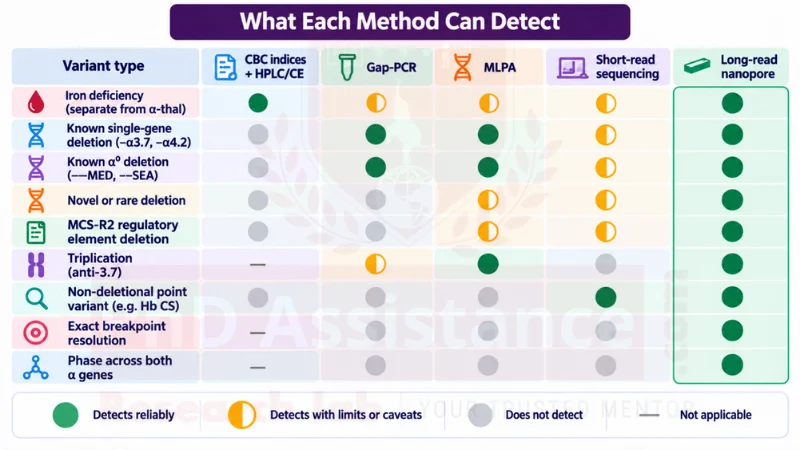
What each method can see: a matrix comparing CBC indices with HPLC, gap-PCR, MLPA, short-read sequencing and long-read nanopore across nine variant classes and capabilities
Illustrative capability comparison; performance is workflow-, enrichment-, coverage- and caller-dependent and requires validation for the study population.
How to use this comparison in a proposal. It defines the hypothesis, and it should be labelled as one. The claim that long-read sequencing detects variants the current workflow misses is a hypothesis to be tested, not an established local finding. The comparison shows why the hypothesis is plausible; the study in Section 8 is what would test it.
6. How long-read nanopore sequencing resolves complex deletions and rearrangements
The mechanism is straightforward, and stating it precisely matters more than enthusiasm about the technology.
Sufficiently long reads can span repetitive or homologous sequence and provide additional mapping context that short reads cannot. A read long enough to cross an entire deletion carries both breakpoints and the intervening sequence on one molecule, so the rearrangement can be observed directly rather than inferred from dosage or from a PCR product’s presence or absence. In one series, single-molecule long-read sequencing resolved four previously unreported α-globin deletions of 23.1–81.1 kb to exact genomic coordinates, where MLPA could show that dosage had changed but not where, and gap-PCR could only interrogate breakpoints already described [7]. The HELIOS review notes that third-generation sequencing “sequences long DNA molecules without amplification or fragmentation, allowing simultaneous and accurate detection of SNVs, and simple and complex SVs” [2].
Four capabilities to claim, and no more:
- High-resolution breakpoint characterisation, including for potentially novel rearrangements [7, 8] — subject to read length, coverage, alignment and orthogonal confirmation.
- Detection across variant classes in one assay — deletional and non-deletional together [4], which matters given the regional spectrum [3].
- Phasing across both α genes, establishing whether two variants are in cis or trans — the distinction that can materially affect genotype interpretation and reproductive risk assessment. In a carrier-screening series of 2,926 individuals, long-read sequencing resolved structural configurations that short-read screening misassigned, including ten functionally normal HKαα alleles reported as −α3.7 [9].
- Coverage of selected regulatory regions outside HBA1 and HBA2, if those regions are included in the predefined enrichment or panel design. This is a design choice, not an inherent property of the platform; deletions removing the HS-40/MCS-R2 element while leaving both structural genes intact are documented [10], so whether the assay interrogates that region has to be stated explicitly.
Four limitations to state in the same breath:
- Per-base accuracy and performance in homopolymer regions depend on the chemistry and basecalling model used; specify versions, because results are not comparable across them.
- Input DNA quality and fragment length constrain read length, and so constrain the whole argument.
- Structural-variant calling in repetitive regions remains caller-dependent, and callers disagree.
- Amplicon-based approaches [4] reintroduce some of the amplification bias that the untargeted method avoids, so the enrichment choice is itself a design decision.
The honest framing for a supervisor: the technology’s capability is established in the literature. What is unknown is its accuracy in this population, on this variant spectrum, in this workflow, which makes the local diagnostic-performance question testable rather than reducing the project to a technology-selection exercise.
7. Designing the wet-lab and bioinformatics workflow
The methods chapter must specify each of these, because each changes the result.
| Step | Decision to prespecify | Why it matters |
|---|---|---|
| DNA extraction | Method and expected fragment length distribution | High-molecular-weight input is what makes long reads possible |
| Sample QC | Purity ratios, quantification method, minimum fragment length | Degraded input silently caps read length |
| Enrichment | Long-amplicon PCR [4], adaptive sampling, or capture | Amplicon methods are cheaper and more robust but reintroduce PCR bias; adaptive sampling avoids amplification but yields lower depth |
| Library preparation | Kit, barcoding strategy, multiplexing level | Multiplexing drives cost per sample but reduces depth per sample |
| Sequencing | Flow-cell chemistry, target depth per sample, run length | Depth requirements differ for SNV calling versus SV calling |
| Basecalling | Model and version, recorded explicitly | Accuracy differs materially between models; results are not comparable across versions |
| Alignment | Reference build and aligner | Alignment behaviour across the duplicated genes is the crux |
| Variant calling | Separate SNV and SV callers, with thresholds fixed in advance | SV callers disagree in repetitive regions; post-hoc threshold choice is a form of analytic flexibility |
| Interpretation | Variant classification framework and databases with versions and access dates | Determines what counts as a positive index-test result |
A central methodological requirement. Freeze this pipeline before the accuracy study begins, and report every version. A common design weakness is allowing the workflow to evolve during the study, which makes the accuracy estimate uninterpretable because it does not correspond to any single, reproducible test.
8. Diagnostic-accuracy design: index test, reference standard and STARD reporting
Diagnostic accuracy study design is what converts a technology project into an examinable thesis.
The four elements that must be named explicitly:
- Index test: the long-read nanopore workflow, frozen as specified in Section 7.
- Reference standard: the locally documented comparator workflow used by the participating laboratory, with orthogonal confirmation of prespecified discordant results where required.
- Target condition: what exactly you are detecting. “α-thalassaemia” is too vague; specify whether the target is any pathogenic α-globin variant, α⁰ genotypes only, or a defined variant list.
- Sampling frame: who is tested and how they were selected (Section 9).
Defining the reference standard from documented local practice. The reference standard must be defined from the documented workflow used by the participating UAE laboratory rather than assumed from international practice. The protocol should specify which molecular methods are routinely applied, to which participants, and which α-globin variant classes they can detect. Where the reference standard and the index test disagree, an independent orthogonal method should be prespecified for discordant resolution. UAE policy on mandatory premarital genetic testing is published [1]; the specific α-globin molecular workflow in use at any given laboratory is not established by that policy, and treating an assumed workflow as the comparator is the single most likely point of challenge at viva.
Diagnostic-accuracy study flow in STARD style, from eligible participants through exclusions, index test, reference standard and cross-tabulation, with a prespecified discordant-resolution branch
The imperfect reference standard problem, which this topic cannot avoid. The reference standard here is the very workflow hypothesised to miss variants. If the index test detects a variant the reference standard missed, that is counted as a false positive under naive analysis — penalising the index test for being right. Three ways to handle it, all legitimate if prespecified:
- Composite reference standard: define the reference as the combination of methods, with prespecified rules for combining them.
- Discrepant resolution by an independent third method — for example orthogonal confirmation of every discordant result — with the protocol fixed before any results are seen.
- Latent class analysis, treating true status as unobserved, which is statistically more demanding but avoids incorporation bias.
State which you are using and why, and acknowledge the residual bias; the trade-offs between these approaches are set out in the methodological literature [12]. Reporting should follow the STARD 2015 checklist [6], and the reporting requirements should be written into the protocol rather than retrofitted at write-up.
Metrics to prespecify: sensitivity and specificity with confidence intervals; positive and negative predictive values, with the caveat that these depend on the prevalence in your sampling frame and so do not transfer directly to the general screening population; and how indeterminate or failed results are handled — excluded, counted as negative, or reported separately, with the choice fixed in advance.
9. Sample selection and size: making the study feasible within a PhD
Enrichment is what makes this study possible. Screening an unselected population for a condition detectable in a small percentage requires a sample size beyond a doctoral project. Restricting recruitment to people with unexplained microcytosis — low MCV or MCH, normal HbA2, iron deficiency excluded by ferritin [2] — concentrates the variants of interest and makes the study tractable.
The trade-off to state plainly. Enrichment raises the prevalence of the target condition in the study sample, which improves feasibility but means predictive values do not generalise to the unselected screening population. Sensitivity and specificity are less affected by prevalence but can still shift with spectrum: a sample enriched for clearer cases may overstate sensitivity relative to routine practice. Report this as a limitation rather than allowing a reviewer to raise it.
Sample size. Calculate it from the expected sensitivity and specificity, the desired confidence-interval width, and the anticipated prevalence of the target condition in the enriched frame, using a method that incorporates prevalence explicitly rather than sizing on total participants alone [11] — noting that the number of positives drives the precision of sensitivity, while the number of negatives drives specificity. Underpowering for sensitivity while over-recruiting negatives is the most common error in these designs. Obtain a realistic prevalence estimate from local laboratory records before fixing the aims.
A feasibility step to do first. Request a retrospective count from a participating laboratory: how many samples per month meet the enrichment criteria. That single number determines whether the recruitment target is achievable within the timeline, and it should be in the proposal.
10. Cost, turnaround and implementation in UAE screening laboratories
An accuracy result alone does not answer the question a laboratory director asks, which is whether to adopt the method. Including an implementation dimension materially strengthens the thesis.
| Dimension | What to measure | How to report it |
|---|---|---|
| Consumable cost per sample | Extraction, library preparation, flow cell, at a stated multiplexing level | Cost per sample at several multiplexing levels, since this dominates |
| Equipment and setup | Capital, service contracts, compute and storage | Stated as assumptions, separately from per-sample cost |
| Staff time | Hands-on wet-lab time and bioinformatics analysis time | Hours per batch, and the skill level required |
| Turnaround time | Sample receipt to reported result | Median and range, separating batching delay from run time |
| Incremental yield | Additional variants detected per 100 samples over the current workflow | The numerator for any cost-per-additional-detection figure |
| Failure and repeat rate | Proportion needing repeat testing | Affects both real cost and real turnaround |
Frame this as a cost-consequence description, not a health-economic evaluation. A full cost-effectiveness analysis with outcome modelling is a separate project requiring different expertise. What a diagnostics PhD can credibly report is cost per sample, cost per additional variant detected, and turnaround — leaving formal economic evaluation as stated further work. Claiming more invites a challenge the thesis cannot meet.
11. PhD Assistance Diagnostic-Accuracy Study Design Checklist
Work through these before writing the aims. Each item that cannot be answered is a gap a reviewer will find.
| # | Item | Decision to record |
|---|---|---|
| 1 | Index test | The exact workflow, with every version frozen and documented |
| 2 | Reference standard | Which methods, applied to whom, documented from the participating laboratory’s own workflow, and its known limitations |
| 3 | Target condition | Precisely what counts as a positive — which variant classes |
| 4 | Sampling frame | Who is eligible, recruited where, and selected how |
| 5 | Recruitment | Consecutive, random or convenience — stated honestly |
| 6 | Blinding | Whether index-test operators are blinded to reference results, and vice versa |
| 7 | Sample size | Calculated from expected sensitivity, specificity, prevalence and CI width [11] |
| 8 | Positives available | The expected number of true positives, which drives sensitivity precision |
| 9 | Indeterminate results | How failed or uncertain results are counted, fixed in advance |
| 10 | Discordant resolution | The protocol, and the independent method used, prespecified |
| 11 | Imperfect reference | Which approach — composite, discrepant resolution or latent class — and why [12] |
| 12 | Analysis plan | Metrics, CI method, subgroup analyses, all prespecified |
| 13 | STARD items | Mapped against the checklist [6] at protocol stage, not at write-up |
| 14 | Cost and turnaround | What is measured and what is assumed |
| 15 | Incidental findings | What is returned, through what pathway, with what counselling |
| 16 | Ethics and governance | Approvals, consent scope, data handling and sample storage |
How to use it. Any item you cannot complete is either a design decision still to be made or a limitation to declare. Both are acceptable in a proposal; neither is acceptable left unstated.
12. How to turn this blueprint into an approvable PhD proposal
A PhD research proposal on this topic must state the research questions, one primary aim with a measurable endpoint, the evidence gap, the expected limitations and the contribution, and pair every data dependency with a documented fallback.
Evidence gap map
| Existing evidence | Population and design | Main contribution | Remaining gap |
|---|---|---|---|
| Rujirachaivej et al. 2026 [4] | 63 previously characterised Thai samples; nanopore with long-amplicon PCR | 39 variants across four genes; 100% concordance with conventional methods | Pre-characterised samples, not a prospective screening frame; Thai variant spectrum; not an accuracy study in a screening pathway |
| Li et al. 2025 [9] | 2,926 individuals; targeted long-read carrier screening across five conditions | Short-read NGS identified 56.4% (133/236) of the variants detected by long-read sequencing; 49 α-triplications and one quadruplication detected only by long read; ten HKαα alleles miscalled as −α3.7 by NGS | A carrier-screening comparison, not a diagnostic-accuracy study against a documented clinical reference standard; Chinese population and variant spectrum |
| Bao et al. 2023 [7]; Yuan et al. 2023 [8] | Case series and family study, China; single-molecule long-read sequencing | Four previously unreported α-globin deletions of 23.1–81.1 kb resolved to exact coordinates; a novel 14.9-kb deletion missed by a conventional PCR panel | Demonstrates breakpoint-level capability on selected cases, not detection rates in a consecutive series |
| Mohd Yasin et al. 2026 [2] | Narrative review, HELIOS action | Documents limits of CBC, HPLC, gap-PCR and MLPA; positions long-read sequencing | A review, not primary local accuracy data |
| Adekile et al. 2020 [3] | 400 samples, 283 families, Kuwait | Regional genotype spectrum; non-deletional PA-1 dominant at allele frequency 0.59 | Kuwaiti not Emirati; selection bias toward moderate-to-severe phenotypes acknowledged by the authors |
| GeneReviews, α-thalassaemia [5] | International reference | Cluster structure, deletion classes, MCS-R2, non-deletional variants | Reference material, not local diagnostic performance data |
| MoHAP 2025 screening policy [1] | National programme | 570-gene mandatory premarital panel | Published evidence on residual α-globin detection gaps in the current workflow is not established |
Novelty matrix
| Component | What is already known | What remains unknown | What this PhD would add |
|---|---|---|---|
| Method capability | Long-read sequencing resolves α-globin variants with high concordance on characterised samples [4] and outperforms short-read screening for structural classes in carrier cohorts elsewhere [9] | Performance in a prospective screening frame with an unselected variant spectrum | Prospective accuracy estimates in a defined UAE sampling frame |
| Detection gap | Conventional methods have documented class-specific limits [2] | The size of the residual gap in the current UAE workflow | A quantified incremental yield per 100 samples |
| Variant spectrum | Regional spectrum includes substantial non-deletional burden [3] | The Emirati α-globin spectrum defined by a method able to detect novel rearrangements | A spectrum description not constrained by the assay’s prior expectations |
| Implementation | Not addressed in the cited literature | Cost per sample, turnaround and failure rate in a UAE laboratory setting | A cost-consequence description alongside accuracy |
Research questions to adapt:
- RQ1 (primary): What are the sensitivity and specificity of a frozen long-read nanopore workflow for detecting pathogenic α-globin variants, against the current reference standard, in adults with unexplained microcytosis?
- RQ2: What is the incremental yield — additional variants detected per 100 samples — over the current workflow, and which variant classes account for it?
- RQ3: What α-globin variant spectrum is observed when the detection method is not restricted to previously characterised breakpoints?
- RQ4: What are the consumable cost per sample, turnaround time and assay failure rate at a stated multiplexing level?
- RQ5 (exploratory): Among discordant results, what proportion are resolved in favour of the index test by independent confirmation?
Expected limitations to state in the proposal:
- The reference standard is imperfect and is the method under scrutiny, so accuracy estimates carry residual bias however discordance is handled.
- Enrichment for unexplained microcytosis means predictive values do not generalise to unselected screening.
- Single-centre recruitment limits spectrum generalisability.
- Basecalling and variant-caller versions constrain comparability with other studies.
- Amplicon-based enrichment reintroduces amplification bias [4].
- Cost figures are consumable-level and setting-specific, not a health-economic evaluation.
- The study measures analytical and diagnostic performance, not clinical or reproductive outcomes.
- Access, consent scope and laboratory approvals may constrain recruitment and reporting.
Contribution statement. A completed thesis on this design would contribute (1) prospective diagnostic-accuracy estimates for long-read nanopore sequencing against the documented comparator workflow of a participating UAE laboratory, reported to STARD [6]; (2) a quantified incremental detection yield with the variant classes responsible; (3) an α-globin variant spectrum characterised without prior breakpoint assumptions; and (4) a cost-consequence and turnaround description to inform laboratory implementation decisions, transferable to Gulf population genetics more broadly.
Design weaknesses that get diagnostics proposals sent back: no reference standard named, or one applied only to index-positives; target condition left vague; a workflow that changes during the study; discordant resolution decided after seeing results; sample size calculated on total participants rather than expected positives; enrichment used without acknowledging its effect on predictive values; technology novelty offered in place of a research question; and no implementation or incidental-findings plan.
Frequently asked questions
Why is alpha thalassaemia deletion detection harder than for β-thalassaemia?
Three reasons compound. Raised HbA2 gives β-thalassaemia trait a usable screening marker, and α-thalassaemia has no equivalent. Carriers can show borderline or normal red cell indices [2]. And iron deficiency produces a similar picture, so microcytosis alone does not discriminate without ferritin [2].
Is a new sequencing technology enough for a PhD?
No. A technology is a method, not a research question. The examinable question is how accurately it performs against a defined reference standard, in a defined population, for a defined target condition. Without those four elements, a proposal reads as a purchase justification rather than a study.
What if my reference standard is itself imperfect?
Say so, and choose a prespecified strategy: a composite reference standard, discrepant resolution by an independent third method, or latent class analysis. The problem is unavoidable when the index test is hypothesised to outperform the comparator; what matters is that the approach is fixed before results are seen and its residual bias acknowledged.
Should I enrich my sample for microcytosis?
Enrichment can be justified when an unselected screening population would make the required sample size infeasible. Enrichment raises prevalence and makes the study tractable, but predictive values then reflect the enriched frame rather than routine screening. Report both the rationale and the limitation.
How many samples do I need?
There is no single answer. Calculate from expected sensitivity and specificity, desired confidence-interval width and anticipated prevalence in your enriched frame — remembering that the number of true positives drives the precision of sensitivity. Obtain a local monthly count of eligible samples before fixing recruitment targets.
Do I need to include a cost analysis?
It substantially strengthens the thesis, because it answers the question a laboratory actually asks. Keep it to a cost-consequence description — consumable cost per sample, cost per additional variant detected, turnaround, failure rate — and leave formal cost-effectiveness modelling as stated further work.
Can my thesis recommend changing the national screening workflow?
No. It can report accuracy, incremental yield and cost consequences, and discuss what those would imply if confirmed. Decisions about screening programmes rest with health authorities and laboratory services, and would require prospective evaluation, health-economic assessment and regulatory review beyond a doctoral study.
What if laboratory or ethics approvals are delayed?
Name a fallback. A systematic review and diagnostic meta-analysis of published long-read performance in haemoglobinopathy diagnosis is publishable independently and establishes your comparison baseline. A retrospective analytical validation on previously characterised archived samples — the design used in the Thai study [4] — is a lower-risk alternative, with its narrower claim stated.
Request a molecular-diagnostics topic and methodology review
Request a molecular-diagnostics topic and methodology review — PhD Assistance’s research-methodology team can review your proposed topic, diagnostic-accuracy design and feasibility against this framework. You receive:
- Novelty assessment: your question mapped against published long-read haemoglobinopathy work and the regional variant literature
- Diagnostic-accuracy design check: index test, reference standard, target condition and sampling frame, against the 16-item checklist
- Reference-standard strategy: how to handle an imperfect comparator, and which discordant-resolution approach suits your setting
- Sample-size and feasibility plan: calculation from expected accuracy and prevalence, plus the eligible-sample feasibility count to request
- Workflow specification review: the decisions to freeze before the accuracy study begins
- STARD mapping: reporting items built into the protocol rather than retrofitted
- Fallback design: a documented lower-risk alternative if laboratory access is delayed
To start, share: your draft topic or research questions, your target university and programme, and what you currently know about laboratory access and sample availability. The review supports your own proposal writing; it does not replace it, and it does not provide clinical, diagnostic or reproductive guidance.
Related support: research proposal development · bioinformatics and biostatistics analysis · systematic review and meta-analysis