
Overview
SUMMARY:
A PhD in management in Germany may be completed through a monograph or a cumulative dissertation, depending on the applicable university and faculty regulations. A monograph presents a sustained research study in one integrated thesis, whereas a cumulative dissertation brings together several related research papers within an overarching framework. Research on doctoral dissertations in selected German social science disciplines has found an association between cumulative dissertations and higher publication and citation outcomes, but this does not guarantee easier publication for every candidate. Before choosing a format, candidates should check their doctoral regulations, including paper-count requirements, publication or submission criteria, co-authorship rules, and expectations for integrating the papers.
In Germany, management PhD candidates may be able to submit either a monograph or a cumulative dissertation, depending on their faculty’s doctoral regulations. A monograph presents the research as one integrated scholarly work. A cumulative dissertation brings together related research papers and a synthesis that explains their shared research question, methods, and overall contribution. The doctoral regulations of Universität Hamburg provide one example of requirements for a publication-based dissertation (Universität Hamburg, 2018). The formatting choice might influence research preparation, manuscript submission, co-authoring, and effort required for linking results. One study done on German social sciences doctoral theses found a relationship between cumulative formatting and success in publication. However, it does not mean that one format is superior to another or that similar results can be guaranteed in the case of management doctorate students (Asanov et al., 2024).
1. Cumulative Dissertation vs. Monograph
A monograph is a self-contained scholarly work. Its chapters commonly move from the research problem and literature review to theory, methods, findings, discussion, and conclusions. The main writing challenge is to sustain a clear line of reasoning throughout the manuscript. This is a general description, not a fixed chapter structure; candidates should follow their programme’s requirements.
A cumulative dissertation is organised around several related research papers and a synthesis text. The papers should address a shared research question, while the synthesis explains how they relate to one another and what the dissertation contributes overall. Candidates should consult the doctoral regulations applicable to their faculty or programme to confirm the required number of papers and any publication-status requirements. These rules vary across German universities and faculties. Universität Hamburg offers one institutional example: its regulations address an overarching title, an introduction, and a synthesis that discusses the included papers. Requirements vary across faculties and institutions (Universität Hamburg, 2018).
Table 1. Key writing differences between monograph and cumulative dissertations.
| Writing dimension | Monograph | Cumulative dissertation |
|---|---|---|
| Overall logic | One continuous argument across chapters | One overarching argument linking separate papers |
| Drafting rhythm | Chapters can be revised as an integrated whole | Paper-level drafting alongside synthesis writing |
| Publication planning | Publication can occur before, during, or after thesis completion | Journal submission and review timelines may shape the plan |
| Authorship | Usually centred on the candidate’s integrated manuscript | Co-authored papers may require contribution statements |
| Main risk | The argument may become repetitive or diffuse | Papers may feel disconnected without a strong framework text |
2. Why Publication-Based PhDs Change Academic Writing
Cumulative structure puts more focus on articles as a writing style. The main requirements for every article include clear purpose, proper research methodology, and contribution. Topics such as leadership, innovation, entrepreneurship, and strategy may support several related studies, provided that the papers form a coherent research project rather than dividing one topic into unnecessary fragments.
Literature review and synthesis work also require careful planning. Rather than repeating the same review in every paper, candidates can use the synthesis text to explain the research gap, show how the papers relate to one another, and present the dissertation’s overall contribution. The regulations of Universität Hamburg provide one example of a synthesis requirement for publication-based dissertations; candidates must check the rules that apply to their own faculty (Universität Hamburg, 2018).
Publication timelines also affect project planning because submitted papers may require revision or may not be accepted. Candidates should therefore confirm their university’s requirements for publication status and co-authorship early in the process. In a study of German social-science dissertations, cumulative theses were associated with roughly three times as many publications and citations as monographs in the sample examined. This finding is an association, not a guarantee of similar outcomes for management PhDs (Asanov et al., 2024).
4. Cumulative Dissertation Synthesis Text: Why It Matters
One risk in a cumulative dissertation is that the individual papers may be stronger than the synthesis that connects them. To reduce this risk, candidates should prepare an initial synthesis outline early and revise it as each study develops.
In the synthesis, it is important to state not only the connections between the two articles, but also the significant differences. There should be a clear explanation of how the research answers the broad research question. Universität Hamburg’s regulations provide one example of a synthesis text that discusses the papers as parts of a connected dissertation.
5. A Practical Decision Framework for Management Scholars
The most appropriate format depends on the research methodology, publication conventions in the discipline, the supervisor’s advice, data accessibility, and the applicable doctoral regulations.
Before choosing a format, candidates should:
- Study the existing doctoral rules and any specific requirements regarding each subject.
- Confirm with the supervisor or doctoral committee the rules for preparing the articles, the required components, and the expectations for authorship.
- Establish a structure for every proposed paper or chapter in relation to the anticipated research question and its contribution.
- Discuss early how co-authorship and individual contributions will be acknowledged.
- Check journal copyright and repository conditions before reproducing published articles in the thesis.
Candidates should check whether journal articles can be included in the dissertation and which versions may be deposited in the university repository. It is important to consult both the publisher’s copyright policy and the institution’s own policy, since the doctoral regulations do not provide automatic rights to reprint published articles.
A practical approach is to confirm eligibility, verify publication and authorship requirements, plan the research design, and agree on a writing and submission schedule with the supervisor. Since requirements vary across German universities, candidates should follow their own doctoral regulations and programme guidance (Universität Hamburg, 2018).
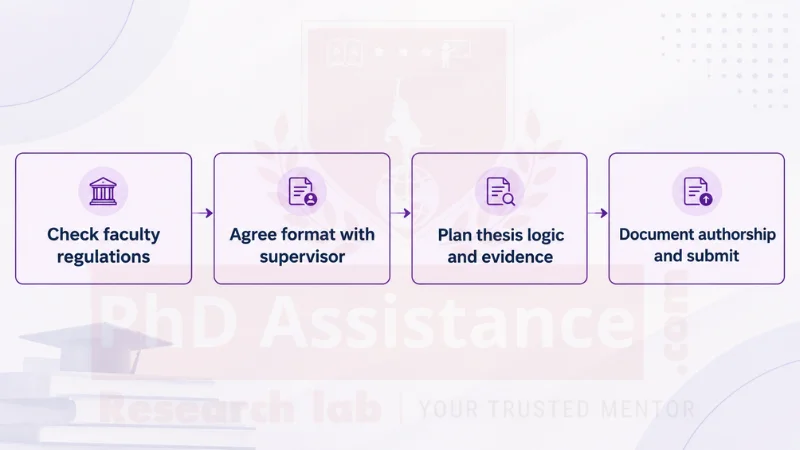
Figure 1. A practical decision and planning sequence for choosing and preparing a German doctoral dissertation format.
Institutional comparison: cumulative dissertation rules are faculty specific. The examples below illustrate why candidates must consult the applicable regulations rather than assume one national paper-count rule.
Table 2. Compare key dissertation requirements across German universities.
| Institution | Cumulative format / paper count | Publication status | Co-authorship / candidate contribution |
|---|---|---|---|
| WHU – Otto Beisheim School of Management | At least three scholarly contributions, as specified in § 20(5) of the 15 June 2026 Doctoral Program Regulations. . | Contributions may be published or accepted for publication. Contributions not yet accepted must be sufficiently developed for timely submission to a peer-reviewed scholarly journal. | Co-authored contributions require a declaration specifying the candidate’s individual contribution, as set out in Appendix 2.. |
| University of Cologne (WiSo) | Regulations describe a cumulative work consisting of several essays; specific provisions are in the regulations’ appendix. | The applicable regulation and programme guidance determine eligibility and status. | Candidate contribution and supporting declarations should be checked in the current faculty rules. |
| University of Mannheim | Requirements differ by department or school; no single university-wide paper count is stated on the overview page. | Consult the relevant department’s doctoral regulations and procedures. | The university highlights doctoral regulations, good research practice, and department-specific guidance on co-authored papers. |
| Universität Hamburg (WiSo) | The faculty provides a cumulative-dissertation route; use the currently applicable Promotionsordnung for the exact requirements. | Requirements depend on the applicable regulation and admission cohort. | The applicable regulations and guidance address co-authorship and the synthesis text. |
Conclusion
German publication-based PhDs require management scholars to produce publishable papers while maintaining one coherent doctoral argument. Compared with a monograph, a cumulative dissertation demands greater attention to publication planning, authorship transparency, and synthesis. Candidates should verify faculty regulations, document their contributions, and develop the synthesis text throughout the project. Ultimately, the dissertation must demonstrate an original, coherent, and defensible research contribution.
Struggling to structure your PhD dissertation or refine your research methodology?
Get tailored support with literature reviews, research design, data analysis, academic writing, and APA referencing.
Partner with PhD Assistants to develop a clear, coherent, and academically rigorous dissertation.
Frequently Asked Question
1. What is the difference between a cumulative dissertation and a monograph?
A cumulative dissertation combines related research papers with a synthesis text, while a monograph presents research as one integrated academic document.
2. How does a cumulative dissertation change academic writing?
Each paper requires a focused research question, sound methods, and a distinct contribution, connected through an overall synthesis.
3. Which management topics suit a cumulative dissertation?
Leadership, innovation, entrepreneurship, organisational change, and strategy are suitable when each study contributes to a shared research problem.
4. Does a cumulative dissertation guarantee better publication outcomes?
No. One study found an association with higher subsequent publication and citation outcomes in its German social-science sample, but this does not guarantee similar results for management PhDs (Asanov et al., 2024).