
Overview
Summary:
Transforming a finance chapter into a Scopus Q1 manuscript requires a focused research contribution, rigorous methodology, and clear responses to reviewer comments. Endogeneity in empirical finance can arise from omitted variables, reverse causality, simultaneity, or measurement errors, potentially affecting the reliability of findings. Researchers must identify the underlying concern and select appropriate methods, such as instrumental variables, fixed-effects models, or difference-in-differences, based on their research design. Robustness checks, transparent reporting, and justified causal claims strengthen methodological credibility. A structured reviewer response letter should document revisions and acknowledge limitations. PhD Assistance supports manuscript preparation through methodological refinement, statistical analysis, and editorial guidance for journal submission.
Transforming a finance thesis chapter into a journal manuscript requires more than reducing its length or rearranging sections. A chapter may document extensive analyses, yet a publishable article must establish a focused contribution, explain why its identification strategy is credible, and show how the evidence supports the claims. Reviewer comments on endogeneity often expose a gap between statistical association and causal interpretation. They may question whether managerial choices, financing decisions, governance arrangements, or firm performance are jointly determined, or whether omitted characteristics and measurement error distort the estimated relationship. In empirical corporate finance, these concerns are substantive because conventional regression estimates do not automatically identify causal effects (Roberts & Whited, 2013). This article addresses Endogeneity in Empirical Finance by connecting reviewer concerns to defensible identification strategies and transparent reporting.
1. Diagnose the reviewer’s concern before changing the model
The first task is to translate each reviewer’s comment into a precise econometric question. A request to address endogeneity is not itself a method recommendation. It may refer to omitted-variable bias, reverse causality, simultaneity, sample selection, or noisy measurement. Each mechanism implies different assumptions and remedies (Hill et al., 2021). For example, a positive association between board independence and firm value may reflect governance effects, but high-value firms may also be better able to recruit independent directors. Firm fixed effects can absorb time-invariant unobserved heterogeneity, but they do not by themselves resolve time-varying confounding or reverse causality.
Authors should revisit the theory, timing of variables, sample construction, and original chapter before selecting a test. Identify the endogenous regressor, the outcome, plausible confounders, and the direction of possible feedback. Then state whether the manuscript’s claim is descriptive, predictive, or causal. This distinction matters: a study can make a valuable contribution without claiming causality, provided the language matches the design. A concise response to reviewers should acknowledge the concern, explain the mechanism considered, specify the analysis added or revised, and report how the interpretation changes.
2. Match the identification strategy to the source of endogeneity
Instrumental-variable (IV) estimation and two-stage least squares (2SLS) can be appropriate when a defensible instrument predicts the endogenous regressor but affects the outcome only through that regressor, conditional on the model’s controls. Relevance can be assessed using first stage estimates and suitable weak-instrument diagnostics. The exclusion restriction, however, is primarily a substantive argument: it cannot be proven by a single statistical test. Researchers should explain the institutional or economic mechanism that makes the instrument plausibly exogenous, discuss alternative pathways, and report diagnostics transparently (Angrist & Krueger, 2001). When a suitable instrument is available, Instrumental Variables methods should be justified by the economic mechanism and the assumptions required for identification, not selected simply because they are familiar.
Where a policy change, regulatory threshold, or other external event creates plausibly exogenous variation, a natural experiment may offer a stronger design. Difference-in-differences requires a credible counterfactual, including a defensible parallel-trends assumption; regression discontinuity depends on the assignment threshold and the absence of precise manipulation around it. Matching can improve comparability on observed covariates but cannot, by itself, eliminate bias from unobserved confounders. Dynamic panel estimators, including difference and system generalized method of moments (GMM), may be useful for suitable panel structures, but instrument proliferation, serial correlation, and instrument validity require careful attention. No estimator is a universal fix (Gippel et al., 2015; Roberts & Whited, 2013).
Table 1. Connecting reviewer concerns with methodological responses
| Reviewer concern | Potential response | Key limitation to disclose |
|---|---|---|
| Omitted, time-invariant firm traits | Firm fixed effects; theory-led controls | Does not remove time-varying omitted factors |
| Reverse causality or simultaneity | Credible IV/2SLS; natural experiment where justified | Requires identification assumptions and a clear causal mechanism |
| Policy or regulatory intervention | Difference-in-differences or regression discontinuity, if design fits | Counterfactual, timing, manipulation, and specification assumptions |
| Dynamic outcome with panel data | Difference/system GMM where appropriate | Instrument count, serial correlation, and moment-condition validity |
| Imprecise proxy or noisy measure | Alternative measures; validation and sensitivity analysis | Proxy changes may alter construct meaning |
3. Build a transparent empirical argument
A revised manuscript should make the empirical logic visible in the methods and results sections. Define the estimating equation, explain fixed effects and standard errors, specify the sample and timing, and distinguish pre-specified tests from analyses added in response to review. For IV models, report the first stage, the instrument’s theoretical justification, relevant weak-instrument statistics, and overidentification tests when applicable. An overidentification test does not establish that every instrument is valid; it assesses a joint implication under the maintained assumptions. For panel GMM, report the relevant serial-correlation and instrument-validity diagnostics and explain instrument construction.
Robustness checks should test meaningful alternatives rather than accumulate specifications until a preferred coefficient appears. Think about alternative variable definitions, sample periods, fixed effect specifications, clustering approaches, placebo results or dates, and robustness to influential observations if appropriate. Report effect sizes and uncertainty, not only statistical significance. If estimates change materially across models, explain why and narrow the claim. Statistical support such as Manuscript Statistics may help verify the suitability and interpretation of analyses, while a structured Peer Reviewing perspective can help identify whether the revised argument answers the underlying methodological objection rather than merely adding another regression.
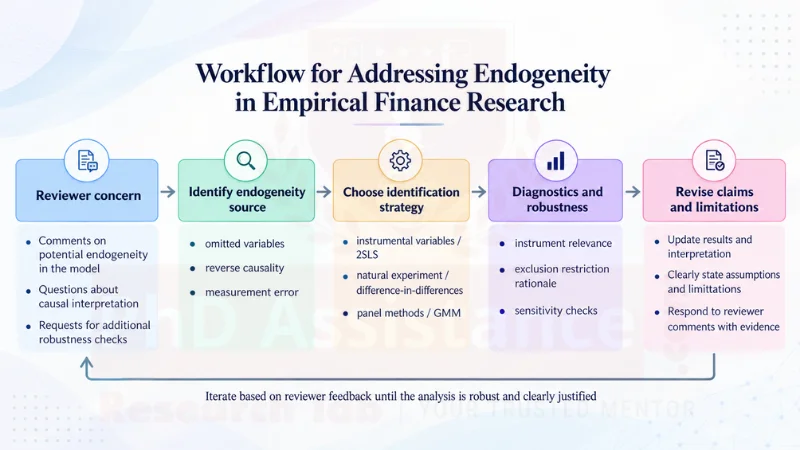
Note. The workflow is iterative: the chosen design must follow from the suspected source of endogeneity and the assumptions the available data can support.
Figure 1. Workflow for responding to endogeneity comments
4. Write the response letter as an evidence trail
An effective rebuttal letter is specific, respectful, and traceable. Reproduce each reviewer’s comment, respond directly, identify the changes made, and point to the revised section, table, or page. Avoid statements such as “endogeneity has been resolved” unless the design supports that strong conclusion. Prefer calibrated wording: “To address the concern about reverse causality, we added [specified analysis], report the results in Table X, and revised the discussion to reflect the remaining identification assumptions.” If the requested approach is infeasible, explain the data or design constraint, provide the strongest justified alternative, and acknowledge the limitation in the manuscript. A concise Reviewer Response Letter should make this evidence trail easy to verify by linking every concern to a specific analysis or manuscript change.
Table and text must be consistent. Check that the reported sample size, coefficient signs, standard errors, confidence intervals, significance notation, and variable definitions match across the results, appendix, and rebuttal. Revisit the introduction and conclusion after the analysis changes; a revised estimate may require a different contribution statement. Manuscript Copyediting and Manuscript Formatting and referencing are relevant final-stage considerations when polishing language and aligning citations, tables, and presentation with the target journal’s instructions, but neither substitutes for methodological validity.
Table 2. Reviewer-response structure and evidence required
| Response component | What to include | Quality check |
|---|---|---|
| Acknowledgement | Restate the concern accurately and neutrally | Does the response address the reviewer’s actual point? |
| Methodological rationale | Explain the suspected bias and why the chosen method fits | Are assumptions explicit and defensible? |
| Evidence | Identify new tests, diagnostics, tables, and estimates | Can the reviewer reproduce the path to the conclusion? |
| Manuscript change | Give section/page/table references and revised wording | Do manuscript and response letter agree? |
| Qualification | State remaining threats and calibrate causal claims | Are limitations acknowledged without overstating certainty? |
5. Shape the chapter into a journal contribution
A thesis chapter often contains extensive literature coverage, multiple research questions, and supplementary analyses. A journal article needs a sharper narrative: a specific research gap, a theoretically motivated hypothesis, a credible design, a small set of decisive results, and a contribution that follows from those results. Keep material that establishes the research question or supports identification; move secondary tests to an appendix when journal policy permits. Do not remove details necessary to assess sample selection, variable construction, or the validity of the design.
Targeting a Scopus Q1 journal should therefore mean meeting the standards of the relevant journal and field, not applying a formula that guarantees acceptance. Check the journal’s scope, recent methodological expectations, word limits, reporting conventions, and reference style. A manuscript can be strengthened through Manuscript Rewriting when the argument needs clearer sequencing, and editorial comments can help test whether the revised paper is coherent for a reader who has not seen the thesis. These are supporting steps: publication readiness ultimately depends on the originality of the question, the credibility of the identification strategy, transparent reporting, and the contribution to finance scholarship. A strong Scopus Q1 Manuscript therefore needs a clear contribution, credible methods, and appropriately qualified conclusions rather than keyword repetition or a claim of guaranteed acceptance.
Conclusion
Reviewer comments on endogeneity are best treated as a request to strengthen the logic linking theory, design, and inference. Authors should identify the specific bias mechanism, choose a method whose assumptions fit the research setting, report diagnostics and robustness evidence, and revise causal claims to match what the design can establish. A clear response letter then shows exactly how each concern changed the analysis or manuscript. This disciplined process turns a finance chapter into a more focused, transparent, and defensible journal submission without implying that any single test or editing step guarantees a Scopus Q1 outcome.
Strengthen your finance manuscript with expert guidance from PhD Assistance. Address endogeneity concerns and respond to reviewer comments with methodological clarity.
Prepare your research for journal publication with confidence!
Frequently Asked Question
1. What is endogeneity in finance research?
Endogeneity occurs when an explanatory variable is correlated with the error term, potentially biasing regression estimates and conclusions.
2. How can researchers address endogeneity in a finance manuscript?
Researchers may use instrumental variables, fixed-effects models, natural experiments, or other methods suited to the study design.
3. How should authors respond to reviewer comments on endogeneity?
Authors should explain the concern, justify their methodological approach, report relevant diagnostics, and revise claims where necessary.
4. How can a finance thesis chapter be converted into a Scopus Q1 manuscript?
Focus on a clear research contribution, rigorous methodology, concise results, and alignment with the target journal’s scope and requirements.
5. How can PhD Assistance support finance manuscript preparation?
PhD Assistance provides support with manuscript revision, statistical analysis, editorial feedback, formatting, and responses to reviewer comments.