
Why the proposal must be yours
A research proposal is a gatekeeping document. It is used to decide admission and, later, confirmation of candidature, and it must set out not only the topic and question but also the design that shows how the research will be done (Kivunja, 2016). Many applicants find this hard because advice on proposal writing is scattered and generic, which is one reason a market for commercial "proposal writing" has grown.
In the UAE the proposal is also an assessed document. The CAA Standards require every accredited doctoral programme to include a comprehensive examination that covers a defence of the doctoral research proposal as well as of the completed thesis (Commission for Academic Accreditation, 2019). At UAE University, the proposal must clearly define the research problem and objectives and outline the methodology, and the PhD Advisory Committee must approve it before the student advances to candidacy (United Arab Emirates University, 2018). A proposal written by someone else is therefore not only a breach of integrity; it is a document you will be asked to defend in person, in front of people who know the field.
The question it now answers is different: how to tell legitimate mentoring and editing from ghostwriting, and how to write the proposal yourself.
What UAE research shows about contract cheating
Contract cheating means submitting work that a third party has produced, whether paid or not. Research from the UAE shows that it is actively marketed to students in the country. Khan (2022) searched two search engines in two browsers for essay-writing, ghost-writing and assignment-writing services combined with "UAE" and identified 34 unique websites targeting students in UAE higher education. Twenty-nine appeared significantly often across searches, the most visible used .ae domains, and several used university names and logos to appear legitimate. The author called for awareness campaigns, staff training and legislation of the kind adopted in Australia and the United Kingdom.
Institutional responses are uneven. Aljanahi et al. (2024) interviewed eight faculty members from six UAE universities in five cities. Participants viewed contract cheating as a violation of fairness and of religious and professional ethics, but in the absence of explicit institutional policies they handled cases inconsistently, from reducing grades to confronting students without formal reports, and many felt unsupported in reporting. The authors recommended clear policies, standard procedures, staff training and administrative backing.
Global evidence suggests the problem is not small. In a systematic review of 71 samples from 65 studies, Newton (2018) found that 3.5% of students overall admitted paying someone to complete their work, rising to 15.7% in samples collected from 2014 onwards, while cautioning that most samples were convenience samples with low response rates and that self-report probably underestimates prevalence. None of these studies concerns doctoral proposals specifically, but they show the market a UAE applicant is likely to meet.
Where UAE rules draw the line
The CAA Standards require institutions to have provisions on student behaviour and academic integrity (Commission for Academic Accreditation, 2019), and each university defines misconduct in its own policy. UAE University's catalogue, for example, defines plagiarism as deliberately presenting another person's work as your own without acknowledgement, lists "fabricating, facilitating or aiding academic dishonesty" among acts of dishonesty, and sets penalties that range from a warning to dismissal or withdrawal of an awarded degree (United Arab Emirates University, n.d.-a). The University of Dubai requires the dissertation to be checked for similarity with Turnitin before the proposal defence and before the final defence, and advises students to check their own drafts (University of Dubai, 2024).
Supervisors are part of the line, not outside it. The CAA Standards limit principal supervision to qualified, experienced full-time faculty (Commission for Academic Accreditation, 2019), and the University of Dubai describes the supervisor's role as giving formal advice on the student's progress (University of Dubai, 2024). Supervisors differ in how they see that role, from managing the project to inducting the student into a discipline or developing critical thinking (Lee, 2008), but none of these conceptions includes writing the student's text. The same limit applies to anyone else who helps you.
The difficult cases are language editing and translation. In a study of faculty and international students at a US university, Kim and LaBianca (2018) found that students were far less certain than faculty about which kinds of writing help were ethical, and that faculty disagreed most about machine translation and paid editing. When Harwood (2018) asked 14 UK proofreaders to work on the same weak master's essay, the number of changes ranged from 113 to 472; some rewrote structure and argument, and some introduced new errors. The lesson is that "editing" is not a defined service: you need your university's rule and a written agreement on what the editor may change.
| Kind of support | Usually acceptable | Crosses the line |
|---|---|---|
| Supervision and mentoring | Questions, feedback on drafts, reading suggestions, discussion of design options | The mentor drafts sections or chooses the question and design for you |
| Methods training | Explaining methods, reviewing your justification, practising analysis on example data | Writing your methodology section |
| Language editing | Correcting grammar and spelling within an agreed scope permitted by your university | Rewriting argument, structure or content |
| Translation tools and AI | Uses your university permits, disclosed as required | Generating text you submit as your own without permission or disclosure |
| Paid "proposal writing" | Nothing in this category | Any proposal written for you, in whole or in part |
How to judge any proposal support
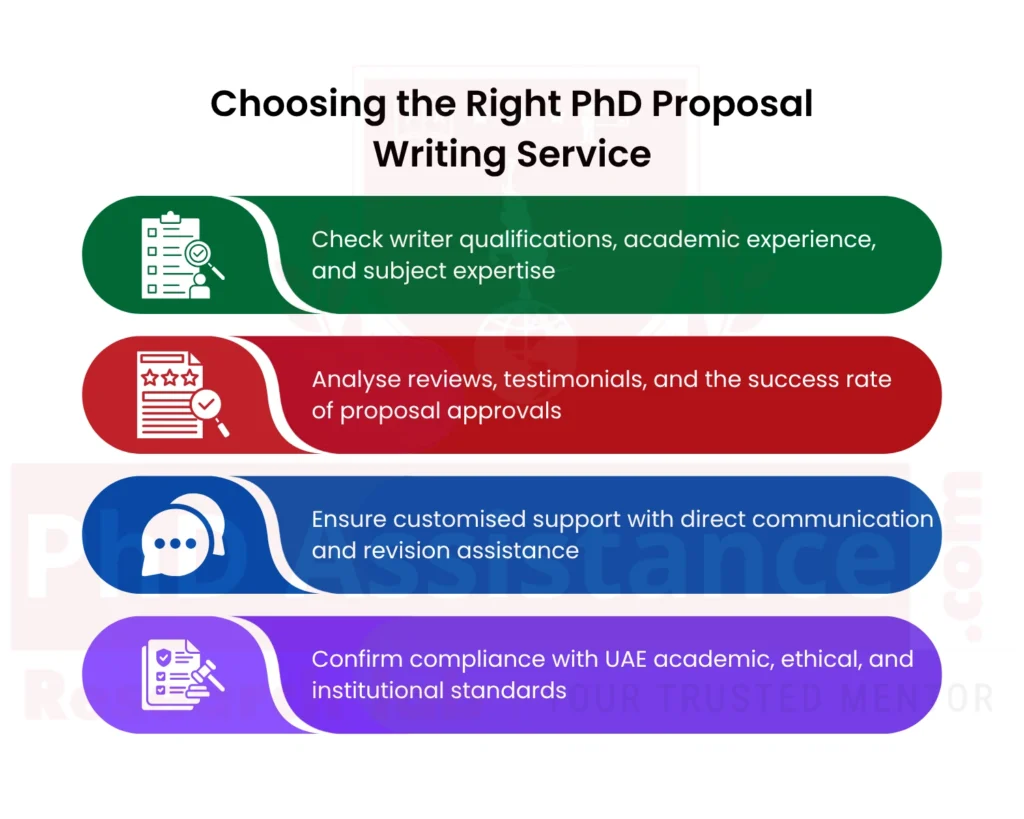
The criteria are kept below, but each is revised so that it tests whether support helps you learn and keeps the work yours, rather than whether someone else can produce a proposal for you.
| Criterion | Original check (summarised) | Revised check |
|---|---|---|
| Expertise | Cultural studies specialisation and interdisciplinary knowledge | The mentor knows the field well enough to question your theory and sources, not to supply them |
| Methodology | Clear, justified, research-aligned design | The mentor explains options and asks you to justify your choice in your own words |
| Originality | Content free of plagiarism with proper citations | Every idea and sentence originates with you; similarity reports cannot show authorship |
| Structure | Logical, coherent, academically sound | Feedback comments on your structure; it does not replace it |
| Experience | Qualified and experienced proposal writers | Qualified mentors with supervision or teaching experience, who state in writing that they do not write for clients |
| Compliance | Alignment with UAE academic standards | The support is compatible with your university's integrity and editing rules, and you can disclose it |
Two further signs help. Legitimate support never promises outcomes such as approval or admission, and it is comfortable being disclosed to your supervisor. If you would hesitate to tell your supervisor what a helper did, treat that as the answer.
Write a cultural studies proposal yourself
A cultural studies proposal follows the general shape of any doctoral proposal: a working title, background and problem, research questions, a literature review that establishes the gap, a theoretical framework, methodology, ethics, timeline and references (Kivunja, 2016). What distinguishes it is the weight given to theory and to the position of the researcher. Common lenses include postcolonial theory, identity theory and cultural globalisation for UAE topics; whichever you choose, explain what it lets you see that another lens would not.
Local studies show what a feasible design looks like. Hopkyns (2014), publishing in a UAE-based journal, examined how the spread of global English was perceived to affect culture and identity in the UAE, using open-response questionnaires with 35 female Emirati undergraduates and 12 female Emirati primary school teachers, and presented the effect as double-edged. The design is modest and clearly bounded: one question, two defined groups and a qualitative instrument suited to the aim. A doctoral proposal can be more ambitious, but it should be equally clear about who will take part and why.
Ethics belongs in the proposal, not after it. Research with human participants needs institutional approval before data collection; UAE University, for example, reviews such research through its research ethics process (United Arab Emirates University, n.d.-b). Identity, language and religion can be sensitive topics, so say how you will obtain consent, protect anonymity and handle translation.
Worked example (illustrative)
A hypothetical applicant wants to study how young Emirati content creators present national heritage on social media. Her first draft asks "How does globalisation affect Emirati identity?", which is too broad to answer. With her mentor's questions, she narrows it to "How do Emirati content creators aged 20 to 30 combine heritage symbols and global platform conventions in their videos, and how do they explain those choices?" She chooses cultural hybridity as her lens, proposes a qualitative design that combines analysis of a defined sample of videos with interviews, and drafts an ethics section on consent, public versus private content and anonymity. Every revision is hers; the mentor's role is to ask what each choice is for.
Common mistakes
Research on proposal writing identifies faults that recur whoever the writer is. In a study of 80 master's students and 20 lecturers in Zambia, Manchishi et al. (2015) reported overly broad or vague topics, missing problem statements, failure to establish a gap, inappropriate methods, confused terminology, poor citation and plagiarism. To these, the UAE evidence above adds integrity mistakes.
- Choosing support on price or speed instead of on whether it keeps the work yours.
- Treating a similarity report as proof of authorship.
- Accepting "editing" without a written agreement on what may be changed.
- Using templates or model proposals that you then adapt into your own text.
- Leaving out the theoretical framework or treating it as decoration.
- Postponing ethics planning until after the proposal is approved.
- Not telling your supervisor what help you have received.
Related guides: Dissertation proposal writing for UAE researchers, writing a management proposal in the UAE, research proposal mentoring and the UAE study hub.
Key takeaways
- UAE doctoral programmes require a defence of the research proposal, so the proposal must be your own (Commission for Academic Accreditation, 2019; United Arab Emirates University, 2018).
- Contract cheating services actively target UAE students, and institutional responses are uneven (Khan, 2022; Aljanahi et al., 2024).
- University policies treat presenting another person's work as your own, and aiding it, as misconduct with serious penalties (United Arab Emirates University, n.d.-a).
- Editing is a grey area: agree its scope in writing and follow your university's rules (Kim & LaBianca, 2018; Harwood, 2018).
- A strong cultural studies proposal has a narrow question, an explained theoretical lens, a bounded design and an ethics plan (Kivunja, 2016; Hopkyns, 2014).