
Overview
Summary:
This article explores CNIL/RGPD Rules in Organizational and HR Management Research in France, focusing on ethical approval, GDPR compliance, and employee data protection. It explains how researchers can establish a lawful basis for processing personal data, ensure voluntary participation, minimise data collection, and protect confidentiality through pseudonymisation and secure storage. The article also examines institutional ethics review, CNIL guidance, and Data Protection Impact Assessments (DPIAs). A practical compliance checklist outlines essential steps before, during, and after research. Overall, it highlights how responsible data management and ethical planning protect employees’ privacy while strengthening research credibility and regulatory compliance.
Organisational and human resource management research can reveal how people experience leadership, recruitment, performance reviews, workplace culture and employee wellbeing. Yet these studies often involve personal information shared in a setting where participants may worry about how their answers could affect their careers. Researchers working in France therefore need to plan for privacy and research ethics before collecting data. The CNIL/RGPD Rules in Organisational and HR Management Research are not simply a final compliance check: they influence study design, recruitment, data handling and publication from the outset.
Two frameworks must be distinguished. Research ethics review considers matters such as participant welfare, fairness, informed participation and conflicts of interest. Data protection laws govern the processing of personal data. Institutional approval does not automatically establish GDPR compliance, and GDPR compliance does not necessarily replace an institution’s ethics-review process. A defensible project addresses both.
1. Understanding CNIL and the RGPD
The Commission nationale de l’informatique et des libertés (CNIL) is France’s independent data protection authority. RGPD is the French abbreviation for the EU General Data Protection Regulation (GDPR), which applies alongside France’s national data-protection legislation. The Regulation requires personal data to be processed lawfully, fairly and transparently, for specified purposes, and only to the extent necessary. Researchers must also protect data and be able to demonstrate compliance (Abraha, 2022; Ebert et al., 2021).
For HR studies, personal data can include names, work email addresses, job titles, interview recordings, identifiable quotations, survey responses and performance information. Removing a name does not necessarily make a dataset anonymous: a rare job title, team description or detailed account may still identify someone. Employee data protection therefore requires considering the whole context, including what managers or colleagues might already know (Ebert et al., 2021; Abraha, 2022).
2. Choose the lawful basis before collecting data
Every project should document its purpose, the categories of data required, who will access them and the applicable lawful basis under Article 6 of the GDPR. Depending on the project, this may be a public task, legitimate interests or another basis available in the circumstances. Public universities, private research teams and employer-sponsored studies may not have the same legal position; the basis should be assessed with the institution’s data protection officer (DPO) or legal adviser.
Consent deserves particular care in workplaces. Employees may feel pressure to participate when a manager invites them, so consent may not always be freely given in the GDPR sense. Researchers should not assume that a signed consent form solves every data-protection issue. They should distinguish consent to take part in a study from the lawful basis for processing personal data, explain participation is voluntary where applicable, and make clear that declining will not affect employment. Research involving sensitive data such as health, political opinions, trade-union membership or other Article 9 categories needs both an Article 6 basis and a valid Article 9 condition. Additional national requirements may apply (Abraha, 2022; Enqvist & Litins’ka, 2022).
3. Build privacy into the research method
Good workplace research ethics begins with data minimisation: collect only information needed to answer the research question. If a study investigates perceptions of hybrid work, it may not need employees’ full dates of birth, home addresses or identifiable performance records. Use broad role categories where possible and avoid collecting sensitive details merely because they might be interesting later.
Researchers should provide a clear privacy notice covering the controller, purposes, lawful basis, recipients, retention period, participant rights and contact details for questions. Where data are obtained indirectly, for example, from HR records, the relevant transparency obligations still need to be considered. Describe any limitations to confidentiality, including those where disclosure is legally necessary.
Pseudonymisation may mitigate risks by coding names and keeping the key to deciphering such codes apart from the actual recordings and restricting access to the latter. Pseudonymisation is not equal to anonymisation because the coded data are still personal data if deciphering is feasible. Keep the recordings, transcripts and consent forms secure, control access rights, use authorised institutional systems, and establish a retention/deletion schedule. When reporting findings, remove or generalise details that could reveal an individual, particularly in small teams or senior roles (Ebert et al., 2021).
4. CNIL procedures, ethics review and impact assessment
A common misconception is that every non-medical HR study must receive advance authorisation from CNIL. The applicable steps depend on the nature of the research, the data involved, the organisation and any specific legal framework. CNIL’s guidance on public scientific research outside health explains that its opinion may be required in defined circumstances involving sensitive data when no other applicable exception is available. Researchers should check the current guidance and consult their DPO rather than assume either that approval is always required or that no formalities apply (Abraha, 2022; Abraha, 2023).
CNIL reference methodologies are not a universal shortcut for all management research. Some reference methodologies are designed for categories of health research, so they should not be applied automatically to employee surveys or organisational studies. Confirm that a methodology covers the project before relying on it. A Data Protection Impact Assessment (DPIA) may be necessary where processing is likely to result in a high risk to people’s rights and freedoms, for example, certain large-scale monitoring or sensitive-data projects. The DPO can help determine whether a DPIA is required and what safeguards are proportionate.
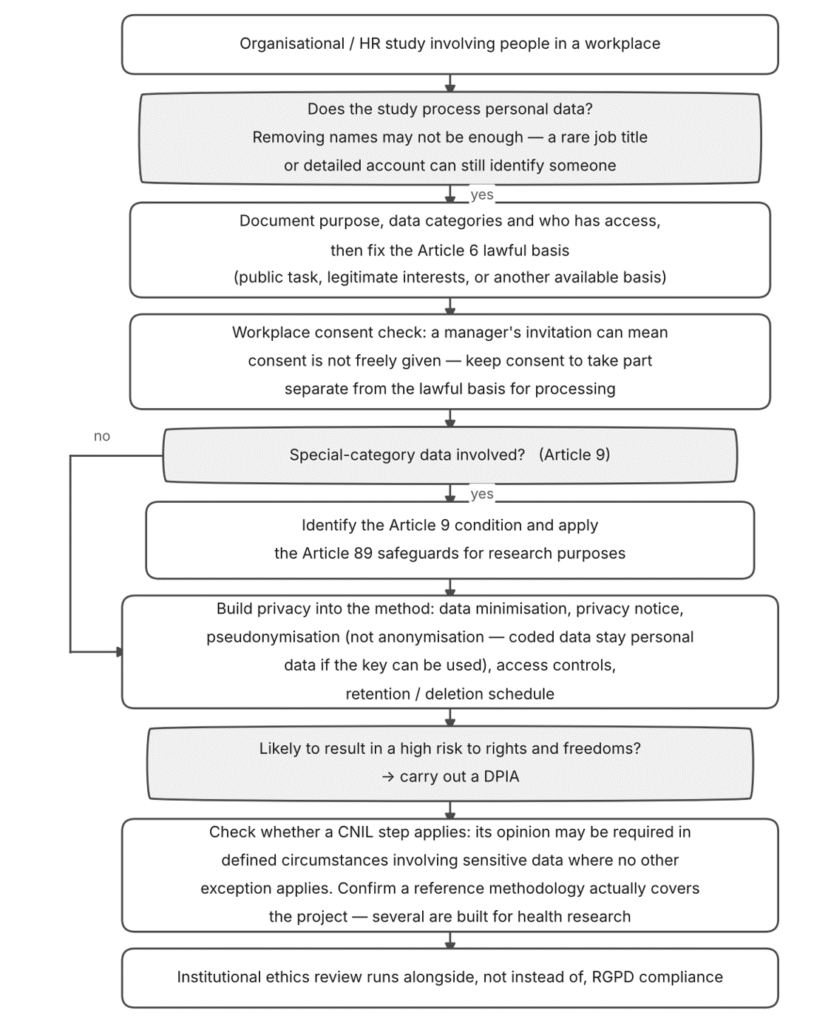
Figure 1. Sequence of data-protection decisions in a French organisational or HR study, from lawful basis through to CNIL formalities and institutional ethics review.
5. Practical compliance checklist
| Before fieldwork | During and after the study |
|---|---|
| Define the research purpose and lawful basis. | Limit access to authorised research-team members. |
| Seek the required institutional ethics review. | Keep the key linking codes separate from research data. |
| Seek guidance from the DPO in relation to sensitive data and DPIA evaluation. | Provide for safe storage and handling of approved methods of data transfer. |
| Prepare participant information and data retention plan. | Analyse the quotations and tables for potential re-identification risks. |
| Recruit without manager pressure or implied consequences. | Delete or archive data according to the documented schedule. |
Conclusion
Responsible HR research is not achieved by adding a privacy statement after the survey has been designed. It depends on early decisions about purpose, lawful basis, participant communication, data minimisation, access controls and safe reporting. Researchers should treat ethical approval and GDPR compliance as complementary responsibilities, involve their institution’s DPO when needed, and verify whether any CNIL procedure or reference methodology genuinely applies. This approach protects participants while preserving the credibility and usefulness of organisational research.
Strengthen your PhD research with expert guidance from PhD Assistance!
From research methodology to ethical compliance, get the support you need to make your research rigorous and publication-ready.
Turn your research challenges into academic success with PhD Assistance today!
Frequently Asked Question
1. What is the role of CNIL in HR research in France?
CNIL oversees data protection compliance under the GDPR and French data-protection legislation.
2. Is CNIL approval required for every HR research study in France?
No. Requirements depend on the research type, data involved and applicable legal framework.
3. Is employee consent sufficient for GDPR compliance?
No. Researchers must assess the appropriate lawful basis and ensure any consent obtained is freely given where applicable.
4. When is a Data Protection Impact Assessment (DPIA) required?
A DPIA is required when data processing is likely to result in a high risk to individuals’ rights and freedoms.
5. What is the difference between pseudonymisation and anonymisation?
Pseudonymised data may identify individuals using additional information, whereas properly anonymised data cannot reasonably identify them.