
The source and why it matters
This critique examines Mohan et al. (2025a), "Towards neuromorphic compression based neural sensing for next-generation wireless implantable brain machine interface". The article was published open access in Neuromorphic Computing and Engineering (volume 5, issue 1, article 014004) in January 2025.
The problem it tackles is one of scale. Implantable brain-machine interfaces (iBMIs) are growing from around a hundred electrodes to thousands. Laboratory acquisition systems such as the Neuropixels platform already handle more than 10,000 channels (Putzeys et al., 2019), but a fully implanted wireless device must push its data through the skin while staying within a strict power and heat budget. Mohan and colleagues set the permissible dissipation at roughly 80 mW per square centimetre, following Wolf (2008) on the thermal design of cortical implants. Because thousands of raw channels exceed what such a link can carry, the data have to be reduced inside the implant.
What the paper proposes
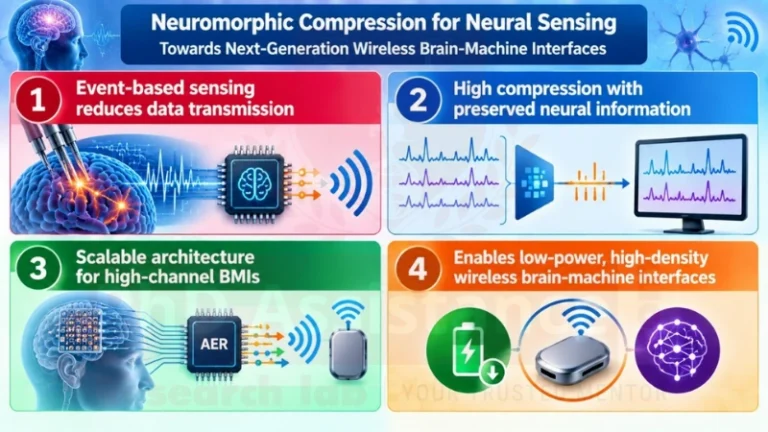
The design takes its cue from neuromorphic vision sensors, which signal changes in brightness as asynchronous events instead of transmitting whole frames (Lichtsteiner et al., 2008). Every recording channel gets an asynchronous delta modulator, an amplifier feeding comparators that issue an ON event when the signal climbs by a set threshold and an OFF event when it drops. Spikes are short and sparse, so a quiet channel emits few events. Corradi and Indiveri (2015) had already shown delta-modulated, event-based neural recording in silicon; what Mohan and colleagues add is a system architecture for very large channel counts (Mohan et al., 2023).
All channels share a single readout based on address-event representation (AER), in which each event travels as the address of the channel that produced it. When several channels fire together, a toggle-tree arbiter with request and acknowledge handshaking places them in a queue, so a collision costs nanoseconds of delay rather than a lost event. Two transmission modes are compared: an all pulse mode (APM) that forwards every event, and pulse count modes (PCM) that send the number of events per time bin of a chosen width. A third option forwards only the events that coincide with spikes (Mohan et al., 2023).
| Element | What the paper uses |
|---|---|
| Encoding | Asynchronous delta modulation; ON and OFF events at threshold crossings |
| Readout | AER with a toggle-tree arbiter and request and acknowledge handshaking |
| Transmission modes | All pulse mode; pulse count modes with bin widths of 1, 2 or 4; spike-related events only |
| Synthetic data | Simulated recordings with known spike times at four noise levels (Quiroga et al., 2004); replicated to 10,000 channels for a worst case |
| Real data | 100-channel non-human primate motor cortex recordings; 384-channel Neuropixels recordings from mouse visual cortex (Steinmetz et al., 2019) |
| Metrics | Compression ratio; root-mean-square error and correlation between original and recovered signals; spike-detection accuracy, sensitivity and false detection rate; collisions |
The preprint reports compression ratios of 50 to 100 when only spike-related events are sent, which the authors put at 5 to 18 times better than an earlier wired-OR compressive readout (Muratore et al., 2019). Signals rebuilt from the events correlated with the originals at about 0.9, and spike-detection accuracy stayed above 90% in the 10,000-channel worst case. On real recordings in all pulse mode, sensitivity reached 96.91% for the primate data and 89.45% for Neuropixels. The estimated front-end power density, about 4.4 mW per square centimetre, sat far below the thermal allowance (Mohan et al., 2023). Because the journal version extends this analysis, final figures should be taken from the published article (Mohan et al., 2025a).
Strengths, limitations and methodological issues
Strengths
- It targets the true bottleneck. The paper recognises that scaling iBMIs depends on taming the data rate and communication power that extra electrodes create, not only on adding electrodes.
- It models the whole pipeline. Encoding, arbitration, packetisation and transmission are analysed together, which reveals trade-offs that studies of a single block would miss.
- It uses varied data. Synthetic signals with known spike times sit alongside two real datasets from different species, brain regions and probe types.
- It keeps the modes separate. Reporting compression for all events and for spike-related events individually lets readers see that the largest ratios come from discarding information.
- It shares its materials. A dataset on Zenodo accompanies the journal article and supports replication.
Limitations
The main concern is the type of evidence. The architecture is assessed through simulation and circuit modelling, and its power figures are extrapolated from circuits measured in earlier work; no complete system has yet been fabricated and tested as an implant (Mohan et al., 2023).
- Copied channels. The 10,000-channel case repeats one synthetic signal on every channel. That makes a demanding test of the arbiter, since many channels fire at once, but it cannot reproduce the correlations, noise and firing statistics of a real large array.
- No ground truth in real data. For the primate and Neuropixels recordings, the reference spike times were themselves found by threshold detection, so accuracy is judged against an estimate.
- A perfect channel. Wireless transmission is treated as error-free, and noise, interference and packet loss are left unmodelled. Newer telemetry work, discussed below, shows what a measured channel looks like (Shi et al., 2026).
- Fidelity drops as compression rises. Wider pulse-count bins increase compression but blur the waveform, which matters for spike sorting even when detection still works.
- Downstream tasks postponed. The preprint leaves spike sorting and motor decoding for later. The group's follow-up preprint decodes straight from events and reaches R2 of up to about 0.73 (Mohan et al., 2025b), but that is a separate, unrefereed study.
The original Academy review collected these limitations in a table, reproduced here.
| Limitation | Why it matters | Improvement needed |
|---|---|---|
| Predominantly simulation-based | Limits evidence for deployment | Fabricated, end-to-end hardware |
| 10,000 channels from replicated synthetic data | No real large-scale recording tested | Larger experimental datasets |
| Ideal wireless channel assumed | Transmission errors untested | Realistic channel, noise and interference models |
| Limited ground truth in real datasets | Spike-detection figures uncertain | Validated spike annotations |
| Higher compression reduces waveform fidelity | Maximum compression unsuitable for some tasks | Task-specific, adaptive compression |
| Event filtering partly left to future work | Highest ratios depend on filtering | Real-time event filtering in hardware |
| Limited decoder investigation | Effect on BMI control unclear | Tests on several downstream tasks |
How the paper sits in the wider literature
The live Academy page compared the study with other work but supplied neither data nor references for most of its rows. The table below substitutes verified comparators. The numbers cannot be compared directly, because each study uses its own datasets, metrics and level of validation.
| Study | Approach | Reported result | Validation |
|---|---|---|---|
| Corradi and Indiveri (2015) | Event-based recording with delta modulator and spiking network | Amplifier noise 2.1 µV RMS at 90 µW | Fabricated chip |
| Muratore et al. (2019) | Data-compressive wired-OR readout | Baseline that Mohan et al. compare against | Circuit-level analysis |
| Mohan et al. (2025a) | Delta modulation, AER readout and compression | 50 to 100 times with spike-related events (preprint) | Simulation; real 100- and 384-channel data |
| Hwang et al. (2025) | Spiking neural network spike detector on events | 95.72% accuracy at high noise | Software evaluation, no multiplications needed (preprint) |
| Ke et al. (2025) | In-memory computing spike detector for event-based front ends | 1,024 channels at 23.9 nW per channel in 65 nm CMOS | Fabricated macro (preprint) |
Taken together, these studies trace a research programme moving from architecture towards hardware. Spike detection (Ke et al., 2025) and decoding (Hwang et al., 2025; Mohan et al., 2025b) are now designed to run on the events themselves, so that the implant never has to rebuild waveforms. Hwang and colleagues note that event-based sensing typically compresses by 15 to 20 times, a useful reminder that the headline ratios rely on selective transmission.
Overall appraisal
The original review closed with a judgement on each dimension of the work. It is reproduced below with one figure corrected (a correlation of about 0.9).
| Dimension | Finding | Judgement | Assessment |
|---|---|---|---|
| Compression efficiency | Very high compression achievable | Strong reduction in transmitted data | Strong |
| Spike preservation | Correlation about 0.9 | Good retention, but depends on compression level | Strong |
| Spike detection | Sensitivity varies by dataset and mode | Promising task-level preservation | Strong |
| Collision handling | AER arbitration handles simulated collisions | Important for scalability | Strong |
| Channel scalability | Up to 10,000 simulated channels | Biological validation limited | Moderate to strong |
| Power efficiency | Estimated low power density | Needs direct hardware measurement | Promising |
| Wireless implementation | Compression eases the link budget | Ideal channel assumption limits translation | Moderate to strong |
| Downstream decoding | Explored in follow-up work | Requires broader validation | Developing |
| Hardware readiness | Builds on earlier circuit measurements | Complete system not demonstrated | Moderate |
| Clinical translation | Potential for high-channel-count iBMIs | Needs biological and engineering validation | Developing |
Read in the light of the newer studies below, two of these judgements deserve a caveat. "Very high compression" is relative: fabricated alternatives now report larger data reductions by sorting spikes on the chip (Akhoundi et al., 2025), and a measured wireless link using delta encoding achieved more modest ratios (Shi et al., 2026).
What newer research adds (2024 to 2026)
Several peer-reviewed studies published since the paper appeared test its premise, offer competing solutions, or supply the benchmarks and channel models it lacked. The table summarises seven of them.
| Study | Design and data | Key finding | What it means for the reviewed paper |
|---|---|---|---|
| Jung et al. (2025) | Wireless, 50 µm thick subdural micro-electrocorticography device integrating electrodes, signal processing, telemetry and wireless power on one CMOS substrate | 65,536 electrodes, of which a selectable subset of up to 1,024 channels can be recorded at once | Confirms the bandwidth bottleneck: even a fully integrated wireless implant cannot stream every electrode |
| Hettick et al. (2026) | Thin-film surface arrays of up to 1,024 channels inserted through a cranial micro-slit; minipigs (8 for insertion, 16 for safety) and a five-patient intraoperative pilot | Somatosensory decoding accuracy of 85% to 98%; speech detection of about 80% in patients; connection by cable to head stages | Channel counts in humans keep rising, but large systems are still wired, so the data-rate problem is moved, not solved |
| Card et al. (2024) | Speech neuroprosthesis with 256 intracortical electrodes in one participant with ALS | 97.5% accuracy sustained over 8.4 months at about 32 words per minute | Defines the downstream performance a compressed signal must preserve in a clinically meaningful task |
| Shi et al. (2026) | Galvanic body-channel telemetry across the dura with a send-on-delta encoder; phantom, human cadaver head and in vitro neuronal cultures, no animal tests | 7 to 12 times data reduction, bit error rate below 10-5, 97.71% spike recovery, about 2.4 mW subdural power | Delta encoding over a measured channel gives smaller ratios than the 50 to 100 simulated with an ideal channel |
| Akhoundi et al. (2025) | Fabricated 1,024-channel spike-sorting chip in 40 nm CMOS using a compressive wired-OR converter; synthetic and ex vivo data with up to 500 neurons | More than 1,000 times data reduction at 74 nW per channel | The wired-OR line Mohan et al. benchmark against now reaches fabricated on-chip sorting, a strong competitor |
| Yik et al. (2025) | NeuroBench community benchmark, including a primate motor prediction task (96- and 192-channel recordings, R2) | Spiking and conventional baselines reached comparable R2; the spiking model showed activation sparsity of 0.998 | Provides a shared task and metric for judging compression by decoding quality, not ratio alone |
| Fares et al. (2026) | Review of neural recording, stimulation and processing for neurotechnology | Proposes brain-inspired BCIs built on neuromorphic computing and spiking networks for low-power, closed-loop devices | Places the paper within a wider neuromorphic movement, without settling its specific hardware questions |
The newer work confirms the paper's starting point. The most integrated wireless device reported to date can record only a selectable subset of up to 1,024 of its 65,536 electrodes at a time (Jung et al., 2025), and large surface arrays tested in patients still rely on cables (Hettick et al., 2026). The need to reduce data at the implant is therefore as pressing as Mohan and colleagues argued, and the wider field now frames neuromorphic processing as one route to low-power, closed-loop devices (Fares et al., 2026).
It also challenges the paper in two ways. First, its headline ratios came from simulation with an ideal channel. When a send-on-delta encoder was paired with a real transdural link, the reduction was 7 to 12 times, with a measured bit error rate and high spike recovery (Shi et al., 2026), which sits close to the 15 to 20 times that Hwang and colleagues describe as typical. Second, the compressive wired-OR approach used as a baseline has advanced to a fabricated chip that sorts spikes on board and cuts data by more than a thousand times (Akhoundi et al., 2025). Any event-based design now has to justify itself against that.
Several questions remain open. No study found here reports an end-to-end delta-modulated, AER-based intracortical implant with its radio, tested in vivo. Clinical systems show what decoding quality is at stake (Card et al., 2024), and shared benchmarks now exist to measure it (Yik et al., 2025), but compression schemes are still rarely evaluated on those tasks.
Research gaps and a doctoral project
The newer literature sharpens rather than closes the gaps the paper leaves. Three stand out.
- End-to-end hardware. Fabricate and measure the whole chain, from electrode to radio, for power, area, compression and fidelity, and compare it with on-chip sorting such as Akhoundi et al. (2025).
- Realistic wireless conditions. Test event streams under noise, interference and packet loss, building on measured links such as Shi et al. (2026), and design error handling suited to sparse events.
- Task-aware compression. Tune thresholds and modes jointly for compression, spike detection and decoding accuracy, using shared benchmarks such as the NeuroBench primate task (Yik et al., 2025), rather than for compression alone.
A worked example (illustrative)
A doctoral researcher might take on the third gap. A first study would fix one downstream task, for example the NeuroBench primate motor prediction task, then sweep delta-modulator thresholds and bin widths and plot decoding R2 against transmitted bits per second. The contribution would be the trade-off curve together with a rule for setting thresholds channel by channel. A second study would add a channel model with realistic bit errors, informed by measured telemetry, to test robustness. Stating the limits of the ground truth openly and testing on more than one dataset would answer the main criticisms of the paper under review. The example is hypothetical and reports no results.
Common mistakes when citing this kind of study
- Quoting the largest compression ratio without saying it applies to spike-related events only.
- Presenting simulated or extrapolated power as measured power.
- Describing replicated synthetic channels as a 10,000-channel recording.
- Comparing ratios across papers that use different datasets, metrics, channels and transmission modes.
- Citing a preprint's figures as those of the published article without checking.
- Treating detection accuracy on real data as exact when the reference spikes were themselves estimated.
- Assuming a high electrode count means all electrodes are streamed wirelessly.
Key takeaways
- Mohan et al. (2025a) propose delta-modulated, event-based sensing with AER readout to cut the data rate of large wireless implants.
- The evidence is mainly simulation and circuit modelling, with real recordings limited to 100 and 384 channels (Mohan et al., 2023).
- The largest compression ratios come from transmitting spike-related events only, and a measured wireless link with delta encoding achieved 7 to 12 times (Shi et al., 2026).
- Newer high-channel systems confirm the bandwidth bottleneck, while fabricated on-chip spike sorting offers a strong alternative (Jung et al., 2025; Hettick et al., 2026; Akhoundi et al., 2025).
- Follow-up work is moving detection and decoding onto the events themselves (Ke et al., 2025; Mohan et al., 2025b).
- Hardware validation, realistic wireless channels and task-aware compression on shared benchmarks remain the clearest doctoral gaps (Yik et al., 2025).