
The source and the policy context
The source is Thiruvengatam et al. (2026), "PhD scholars' perspectives on One Nation One Election with social work implications for democratic governance", posted on Research Square in February 2026 under a CC BY 4.0 licence. It is a preprint: at the time of writing it had not completed peer review, and the platform showed that revisions had been requested. Its conclusions should therefore be treated as provisional.
One Nation One Election refers to proposals to hold elections to the Lok Sabha and the state legislative assemblies at the same time, with local body elections following. A High-Level Committee chaired by former President Ram Nath Kovind submitted its report in March 2024, recommending a two-step approach: simultaneous Lok Sabha and assembly elections first, and municipal and panchayat elections within 100 days, with a single electoral roll (Press Information Bureau, 2024). Earlier, the Law Commission of India (2018) had placed a draft report in the public domain to encourage debate. The proposal is contested, and the arguments on each side are summarised later in this review.
This review does not evaluate the policy. It uses the preprint as a case study in a methodological question that many social science doctoral researchers face: how to design, analyse and report an interview study about a politically divisive issue so that its claims match its evidence.
What the preprint reports
The study takes an interpretivist, qualitative approach. The researchers approached political groups at Pondicherry University; 11 PhD scholars agreed to participate. Using a semi-structured guide, they interviewed politically active scholars, reporting that saturation was reached at the fifth interview and confirmed with the sixth and seventh. The participants listed in the paper are seven men from mass communication, anthropology, political science and library science, five described as left-leaning and two as right-leaning. Interviews lasted about 40 to 50 minutes and were analysed with thematic analysis following Braun and Clarke (2006) (Thiruvengatam et al., 2026).
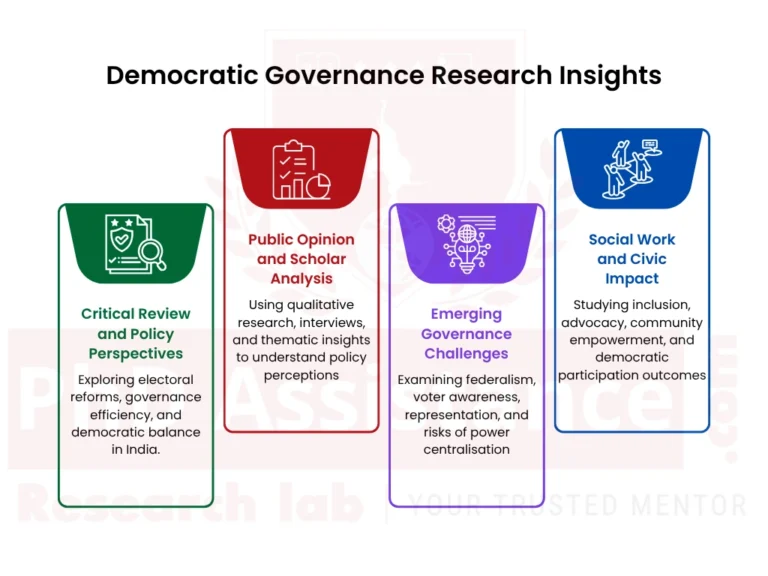
The themes reported are largely critical of the proposal. Participants raised concerns about centralisation and federalism, India's linguistic and cultural diversity, democratic participation being valued above cost savings, the position of regional parties and marginalised groups, polarisation, voter confusion, misinformation and practical feasibility. They also questioned the claim that frequent elections cause policy instability. The authors propose social work interventions such as multilingual civic education, voter engagement with marginalised groups, media literacy and social audits. They acknowledge that the findings are context specific and that the sample was limited to politically active scholars (Thiruvengatam et al., 2026).
Arguments for and against, as the sources state them
A reader needs the wider debate to judge whether a study has captured it. The table sets out arguments as they appear in the sources reviewed here; it does not weigh them.
| Issue | Argument made in favour | Argument made against or concern raised |
|---|---|---|
| Cost and administration | Savings on repeated election expenditure and less frequent deployment of administrative and security staff (Law Commission of India, 2018) | Participants in the preprint argued that democratic participation should not be traded for cost savings (Thiruvengatam et al., 2026) |
| Governance | Greater stability and predictability, with less disruption from repeated election periods (Press Information Bureau, 2024) | Participants disputed that frequent elections cause policy instability (Thiruvengatam et al., 2026) |
| Federalism and regional parties | The Law Commission draft reported that those raising federalism concerns had not shown, to its satisfaction, how federal principles would be violated (Law Commission of India, 2018) | National issues might eclipse local ones and favour national over regional parties (Law Commission of India, 2018; Thiruvengatam et al., 2026) |
| Voter behaviour | Higher turnout was cited as a benefit in the Law Commission draft (Law Commission of India, 2018) | Synchronised elections were associated with more straight-ticket voting and a higher likelihood of the same party winning at both levels (Balasubramaniam et al., 2025) |
| Development outcomes | The High-Level Committee reported views that staggered elections harm growth and public spending (Press Information Bureau, 2024) | One peer-reviewed study found no measurable effect of synchronisation on development outcomes (Balasubramaniam et al., 2025) |
The High-Level Committee reported that 32 of 47 political parties that submitted views supported simultaneous elections (Press Information Bureau, 2024). Empirical evidence on effects is limited and the studies measure different things, so careful researchers on any side should be cautious about strong causal claims.
Strengths of the study
- A timely, under-studied question. Qualitative evidence on how educated citizens reason about the proposal is scarce, and the study opens that area.
- Appropriate method for the aim. Semi-structured interviews suit an exploratory question about reasoning and meanings.
- Transparency on participants. The authors report discipline, level of engagement and political orientation for each participant, which lets readers judge the sample for themselves.
- Stated limitations. The authors acknowledge that findings are context specific and confined to politically active scholars.
- Open access and consent. The preprint is openly licensed and reports written consent, pseudonyms and permission to publish quotations.
Methodological issues
Sampling frame and composition
Recruiting through campus political groups produced informed participants, but it also defines who could be heard. All participants were men from one university, and five of the seven were described as left-leaning. Robinson's framework asks researchers to define a sample universe, justify its size, choose a strategy and manage recruitment bias (Robinson, 2014). Here, the title refers to "PhD scholars", while the sample universe is narrower: politically active, male scholars at one institution, reached through party networks. On a contested policy, the balance of orientations matters, because it can shape which themes dominate. The study cannot tell us whether its largely critical themes reflect scholars in general, scholars of a particular orientation, or the recruitment route.
Sample size and saturation
Seven interviews can be enough for a focused question with a specific sample; empirical work suggests that many themes appear early in homogeneous samples (Guest et al., 2006; Hennink & Kaiser, 2022). But saturation judged within a homogeneous group does not show that perspectives absent from the group have been captured. Malterud et al. (2016) propose information power, which depends on the study's aim, sample specificity, use of theory, quality of dialogue and analysis strategy, as a clearer justification. Within reflexive thematic analysis, Braun and Clarke (2021) caution that saturation sits uneasily with an approach in which themes are developed by the researcher rather than discovered.
Analysis, reflexivity and reporting
On a politically charged topic, readers need to know who the researchers are in relation to the issue, how the interview guide was framed, and how competing interpretations were handled. Reflexive accounts of positionality address this (Finlay, 2002), and reporting standards such as COREQ and SRQR list the details expected (Tong et al., 2007; O'Brien et al., 2014). Quality criteria such as sincerity, credibility and meaningful coherence also apply (Tracy, 2010). A reader would want to see the interview questions, any prompts about benefits as well as risks, and whether views contrary to the dominant themes were sought and reported.
Ethics and data
The preprint reports that formal ethics approval was waived under the university's institutional ethics committee policy and national guidelines, on the basis that the research was minimal risk, and that written consent was obtained (Thiruvengatam et al., 2026). Political opinions are a sensitive category of information, and participants were identifiable as active members of campus political groups at a named university. A doctoral researcher in a similar position would be wise to seek a formal ethics review rather than rely on an exemption, and to explain how pseudonyms and the reporting of discipline and orientation together protect anonymity in a small group. The authors' decision not to share the dataset, given its political sensitivity, is reasonable, though it means readers cannot check the analysis against the transcripts.
From findings to recommendations
The social work interventions proposed follow from the themes, but their scope, including civic education and policy advocacy, goes beyond what seven interviews can establish. Presenting them as ideas for further study rather than as conclusions would better match the evidence.
Designing a balanced study: a walkthrough
The walkthrough below is illustrative and hypothetical. It shows how a doctoral researcher might study views on any contested reform without taking sides.
- Define the population of interest. For example, doctoral scholars in social sciences at several universities in different states, rather than members of campus political groups alone.
- Sample for variation. Use purposive sampling with quotas for gender, discipline, region and political orientation, including people who are not politically active (Robinson, 2014).
- Recruit through neutral channels. Departmental mailing lists or graduate schools, rather than party networks, reduce selection effects.
- Write a balanced guide. Ask open questions, then invite participants to consider both claimed benefits and concerns, drawing on the arguments in official reports and the literature.
- Justify sample size. Argue from information power and report how variation across groups was covered (Malterud et al., 2016).
- Analyse reflexively and report fully. Record your own position, report dissenting views, and follow a reporting standard (Braun & Clarke, 2021; Tong et al., 2007).
| Report | Why it matters on a contested topic |
|---|---|
| Sample universe and recruitment channels | Shows whose views could have been heard |
| Participants' characteristics, including orientation where relevant | Lets readers judge balance |
| Interview guide | Shows whether questions invited views on all sides |
| Researcher positionality | Makes possible influences on interpretation visible |
| Dissenting or minority views | Shows that the analysis did not silence disagreement |
| Peer-review status of sources | Signals how provisional the evidence is |
Common mistakes
- Generalising from one institution or one network to "scholars" or "citizens" in a title or conclusion.
- Recruiting only through groups that already hold strong views on the issue.
- Using saturation as the sole justification for a small, homogeneous sample.
- Writing interview questions that presuppose a conclusion about the policy.
- Letting the researcher's own political views shape the analysis without a reflexive account.
- Citing a preprint as settled evidence without noting its status.
Key takeaways
- Thiruvengatam et al. (2026) interviewed seven politically active, male PhD scholars at one university about One Nation One Election; the study is a preprint.
- Its themes are mainly critical of the proposal, but the narrow and unbalanced sample means they cannot represent scholars in general.
- Official reports and empirical research set out arguments on both sides, and the evidence on effects is limited (Press Information Bureau, 2024; Law Commission of India, 2018; Balasubramaniam et al., 2025).
- Sample size is better justified by information power than by saturation in a homogeneous group (Malterud et al., 2016).
- Balanced sampling, a neutral interview guide, reflexivity and full reporting make research on contested topics defensible (Tong et al., 2007).