
How to use this list
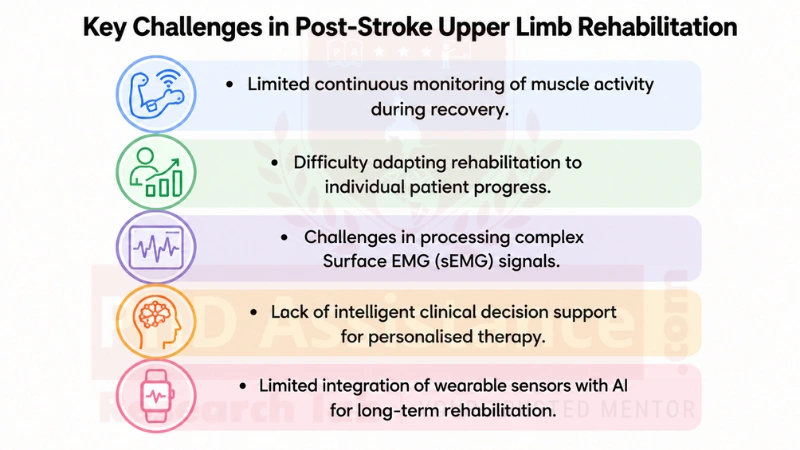
Surface electromyography (sEMG) records the electrical activity of muscles through skin electrodes. After stroke it can show which muscles are weak and how activation is coordinated. Lv et al. (2023) recorded six forearm muscles in eight people with chronic stroke during three grip tasks, computed a weakness index from each muscle's activity, and found distinct, task-dependent weakness patterns that differed between individuals. Findings like these are the case for personalised assessment, and the reason most titles below start by checking that a wearable measure is valid and reliable.
The rebuilt titles keep every idea but make each one testable with a realistic sample. Each table gives a possible research question, a likely design and why the topic matters now. For related areas see occupational therapy topics, digital therapeutics in connected healthcare and the topics hub.
Theme 1: Measurement and validation
| Dissertation title | Possible research question | Likely design and data | Why it matters now |
|---|---|---|---|
| Validity and test-retest reliability of a wearable surface EMG system for quantifying upper limb muscle weakness after stroke | How closely do wearable sEMG weakness measures agree with clinical motor scales and laboratory sEMG, and how repeatable are they across sessions? | Repeated-measures validation study in a stroke rehabilitation unit; agreement and reliability statistics | Muscle weakness after stroke is uneven and task-dependent (Lv et al., 2023) |
| High-density surface EMG muscle synergy measures as candidate digital biomarkers of upper limb recovery after stroke: a longitudinal validation study | Do synergy measures from high-density sEMG change with recovery, and do they track clinical scores better than conventional amplitude measures? | Longitudinal cohort with assessments at fixed intervals; mixed-effects models; comparison with clinical scales | Digital biomarkers need a staged path from sensor data to validated measure (Daniore et al., 2024) |
Evidence that the gap is real. Daniore et al. (2024) set out lessons for turning wearable sensor data into digital biomarkers, stressing clear definitions, validation against reference measures and attention to real-world variation. The Mobilise-D work on gait shows what such validation looks like at scale (Micó-Amigo et al., 2023). Comparable validation evidence for wearable sEMG in upper limb stroke rehabilitation is a natural doctoral contribution.
Theme 2: Prediction and personalisation
| Dissertation title | Possible research question | Likely design and data | Why it matters now |
|---|---|---|---|
| Personalised versus population machine-learning models for predicting upper limb motor scores from surface EMG features in stroke survivors | Do models fitted to each person's own data predict motor scores more accurately than a population model, and how many sessions does a personal model need? | Prospective cohort with repeated sessions; nested cross-validation by participant; reporting to TRIPOD+AI | Wearable sensors combined with machine learning are an active rehabilitation research area (Wei & Wu, 2023; Collins et al., 2024) |
| Patient-specific musculoskeletal models informed by surface EMG for predicting response to upper limb therapy: a proof-of-concept study | Can an sEMG-informed model, updated after each session, predict the next session's performance better than a simple trend? | Single-case experimental design with several participants; repeated measurement; model-based prediction compared with trend baselines | A digital twin needs two-way data flow, which many health models lack (Katsoulakis et al., 2024; National Academies of Sciences, Engineering, and Medicine, 2024) |
Evidence that the gap is real. Wei and Wu (2023) reviewed wearable sensors and machine-learning algorithms in rehabilitation training and describe a growing but varied field. Prediction titles should follow reporting standards for machine-learning prediction models (Collins et al., 2024). For the "digital twin" idea, a scoping review found health digital twins active but still at an early stage of adoption (Katsoulakis et al., 2024), and the National Academies of Sciences, Engineering, and Medicine (2024) report defines a twin by two-way data flow with its physical counterpart, which many simulation models lack. A carefully scoped model that is updated after each session is therefore a defensible step.Single-case experimental designs suit this work because they give rigorous evidence from repeated measures in few people (Aydin, 2024).
Theme 3: Home and remote monitoring
| Dissertation title | Possible research question | Likely design and data | Why it matters now |
|---|---|---|---|
| Feasibility, adherence and data quality of home-based wearable surface EMG monitoring of upper limb rehabilitation after stroke: a mixed-methods study | Will stroke survivors and carers use a home sEMG system as planned, what proportion of recordings are usable, and what helps or hinders use? | Feasibility study with pre-set progression criteria; device logs and signal-quality metrics; interviews with participants and therapists | Real-world sensor use brings data-quality problems not seen in the laboratory (Micó-Amigo et al., 2023) |
Evidence that the gap is real. Laboratory accuracy does not ensure usable data at home, where electrode placement, skin condition and adherence vary. The Mobilise-D consortium's recommendations on real-world gait assessment show why validation in daily life is a separate step from laboratory validation (Micó-Amigo et al., 2023). A feasibility study that sets progression criteria and reports usable-data rates is a sound first step before any "AI platform".
How to test a title before you commit
Use the general method in how to choose a PhD topic and how to select a PhD topic, or our topic selection support, and screen each idea with the FINER criteria (Hulley et al., 2013). In this field, check the following.
- Participants: confirm a clinical partner can recruit enough stroke survivors in your time frame.
- Ethics: allow time for health research ethics review and device safety checks.
- Equipment: confirm access to the sEMG system, including high-density arrays if you need them.
- Reference measure: name the clinical scale or laboratory measure you will validate against.
Worked example (illustrative). A student begins with the live title on an "AI-driven remote monitoring platform". With no software team and one partner clinic, she reframes it as a feasibility study: twenty participants use a commercial sEMG sleeve at home for six weeks, and she measures adherence, usable-recording rates and participants' experiences against progression criteria set in advance. The results tell her whether a later prediction study is worth running.
Common mistakes
- Claiming sEMG diagnoses stroke or neuromuscular disease.
- Building prediction models on a measure whose reliability has not been checked.
- Calling a static model a digital twin.
- Promising "continuous" home monitoring without measuring wear time or data quality.
- Cross-validating at the recording level, so the same person appears in training and test data.
Key takeaways
- Upper limb weakness after stroke varies by person and task, which motivates personalised sEMG assessment (Lv et al., 2023).
- Wearable measures need staged validation before they serve as digital biomarkers (Daniore et al., 2024).
- Prediction titles should follow TRIPOD+AI reporting (Collins et al., 2024).
- Health digital twins are at an early stage, so define and scope the term carefully (Katsoulakis et al., 2024; National Academies of Sciences, Engineering, and Medicine, 2024).
- Screen every shortlisted title for feasibility, novelty, ethics and relevance (Hulley et al., 2013).