
How to use this list
Most secure communication today depends on public-key schemes such as RSA and elliptic-curve cryptography. Shor (1997) showed that a sufficiently large quantum computer could solve the factoring and discrete logarithm problems behind them in polynomial time. Post-quantum cryptography answers this with algorithms that run on ordinary computers but rest on problems, such as those on lattices, for which no efficient quantum attack is known. Standards bodies have begun publishing such algorithms, so the open questions are now practical: how they perform, how systems migrate, and whether implementations leak secrets.
Research output in the field has grown quickly, and a scientometric study maps where that work is concentrated (Hanafi & Ali, 2025). That growth is a reason to choose a narrow, measurable title. Each table row gives a possible research question, a likely design and why the title matters now.
Related lists: quantum-secure computing topics (migration planning and AI-assisted defence), quantum-resistant cryptography titles, homomorphic encryption in edge computing, cybersecurity topics and the topic lists hub.
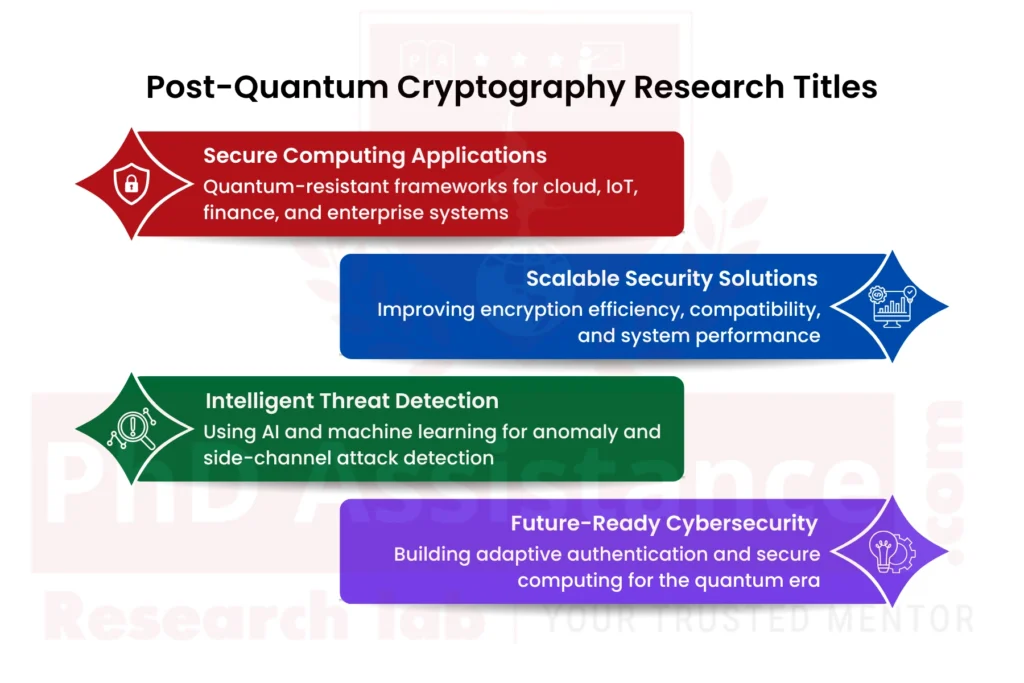
Theme 1: Key management in cloud and IoT settings
| Dissertation title | Possible research question | Likely design and data | Why it matters now |
|---|---|---|---|
| Hybrid classical and post-quantum key management for a cloud storage service: a performance and compatibility evaluation | What latency, storage and compatibility costs arise when key wrapping and key exchange in one cloud storage service move to hybrid classical plus lattice-based schemes? | Testbed experiment on a replicated service; repeated timed runs against a classical baseline; failure logs | Stored data stays sensitive for years, so the keys protecting it need quantum-resistant exchange early |
| Standardised post-quantum key exchange and signatures on constrained IoT microcontrollers | Which parameter sets and protocol settings keep standardised post-quantum schemes within the memory, energy and latency budgets of two or three IoT device classes? | Laboratory benchmarking on named boards; energy and timing measurement; comparison with elliptic-curve baselines | Larger keys and signatures strain devices that will stay in the field for a decade or more |
Evidence that the gap is real. Shor's result targets exactly the public-key operations that protect key exchange and signatures (Shor, 1997), which is why these titles focus on keys rather than bulk encryption. Measured costs on real hardware are more useful to practitioners than new framework proposals, but only if the measurements are reliable: fix the hardware, control background load, repeat runs and report variation, following established benchmarking practice (Beyer et al., 2019).
Theme 2: Authentication and transactions
| Dissertation title | Possible research question | Likely design and data | Why it matters now |
|---|---|---|---|
| Crypto-agile certificate-based authentication: migrating an enterprise identity system to post-quantum signatures | What breaks, and what does it cost, when certificate chains in one identity system switch to post-quantum or hybrid signatures? | Case study plus testbed; certificate size and handshake measurements; interviews with system administrators | Authentication systems are hard to change quickly; crypto-agility is a design property worth evidence |
| Hybrid post-quantum key exchange and signatures in a payment messaging workflow: latency and throughput under load | How do hybrid key exchange and post-quantum signatures affect transaction latency and throughput in a representative payment messaging testbed? | Load-testing experiment with synthetic transactions; comparison with current configuration | Financial systems have strict latency limits and long-lived records that must remain verifiable |
Evidence that the gap is real. The scientometric mapping by Hanafi and Ali (2025) shows how quickly post-quantum research has grown, much of it on algorithms themselves. Evidence on what happens when real authentication and payment systems switch is thinner and harder to gather, because it needs a testbed or an industry partner. That is exactly where a doctoral study can add value.
Theme 3: Implementation security
| Dissertation title | Possible research question | Likely design and data | Why it matters now |
|---|---|---|---|
| Machine-learning-assisted side-channel leakage assessment of masked and unmasked lattice-based implementations | How much secret-dependent leakage do profiled machine-learning analyses find in masked and unmasked implementations on one hardware platform, and at what trace cost? | Laboratory power or electromagnetic trace collection; profiled analysis with train, validation and test splits by device and session | A mathematically sound scheme can still leak keys through its implementation |
Evidence that the gap is real. Machine learning in security research is prone to pitfalls such as sampling bias, inappropriate baselines and lab-only evaluation (Arp et al., 2022), and data leakage between training and test sets can inflate results in any ML-based science (Kapoor & Narayanan, 2023). For side-channel work this means splitting traces by device and session, not at random. A thesis that applies these safeguards produces a more trustworthy leakage estimate than one that reports a single accuracy figure.
How to test a title before you commit
Use the general method in how to choose a PhD topic and how to select a PhD topic, or our topic selection support, and screen each idea with the FINER criteria: feasible, interesting, novel, ethical and relevant (Hulley et al., 2013). For security methods more broadly, see choosing a cybersecurity methodology.
- Hardware and testbeds: confirm you can use the boards, oscilloscopes or servers for the whole project.
- Libraries: name the open-source implementations you will test and check they are maintained.
- Baselines: decide which classical configuration you compare against before you collect data.
- Partners: for identity or payment studies, agree confidentiality and publication terms early.
Worked example (illustrative). A researcher starts from the live title on "lightweight post-quantum protocols for IoT". She drops the idea of designing a new protocol and instead measures handshake time, memory use and energy per connection for two standardised key exchange parameter sets on three microcontroller boards, against an elliptic-curve baseline. The question is now answerable in three years, and the data set is reusable by others.
Common mistakes
- Proposing a new cryptographic algorithm without the specialist training and review that requires.
- Claiming that post-quantum schemes are needed for bulk data encryption.
- Calling a design "scalable" or "high-performance" without saying what will be measured.
- Covering cloud, mobile, enterprise and edge systems in one thesis.
- Reporting machine-learning side-channel results from random splits of traces from a single device.
Key takeaways
- Quantum attacks threaten public-key key exchange and signatures, so strong titles focus there (Shor, 1997).
- Fast growth in post-quantum research makes a narrow, measurable title more valuable (Hanafi & Ali, 2025).
- Benchmarking titles stand or fall on reliable, repeatable measurement (Beyer et al., 2019).
- Machine-learning side-channel studies must avoid common security-ML pitfalls and data leakage (Arp et al., 2022; Kapoor & Narayanan, 2023).
- Screen every shortlisted title for feasibility, novelty, ethics and relevance (Hulley et al., 2013).