

Why Mechanical Engineering PhD Research Proposals Get Rejected in Germany
June 19, 2026
Causal Inference and Topological Analysis for Temporal Pattern Recognition
June 20, 2026How to Overcome Literature Review Challenges in AI PhD Research in the UK
- June 20, 2026
- PhD Literature Review
Introduction
AI research is already revolutionising many sectors of industry across the United Kingdom, such as health, finance, cyber security, manufacturing, teaching, and autonomous systems. Developments are growing rapidly in machine learning, deep learning, natural language processing, computer vision, and the doctoral researcher’s task in the world of AI is to invent something new.
A thorough literature review will be fundamental to every AI PhD project. It is essential to help scholars to gain insights into existing theory, methods, datasets, frameworks and research gaps. In the UK, many AI PhD students find it very difficult to perform a literature review due to large numbers of publications, rapidly changing technology, interdisciplinary requirements and the difficulty of finding research gaps.
A poorly written literature review will impact the entire PhD research- from the design, creativity of research, publication potential of the paper, to the final thesis approval. Being able to foresee all these problems and to apply relevant solutions to them will remarkably enhance AI research. PhD Assistance Research Lab provides “PhD Literature Review Writing Services in UK” in a systematic way for UK-based AI PhD researchers.
What you will learn from this blog?
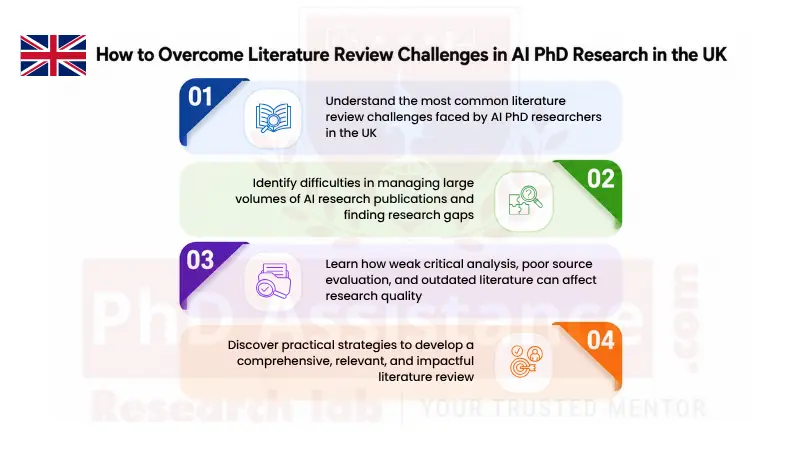
- Common literature review challenges faced by AI PhD researchers in the UK
- Difficulties in identifying research gaps in Artificial Intelligence
- Strategies for managing large volumes of AI research publications
- Methods for conducting critical analysis of AI literature
- Best practices for developing a high-quality literature review
- Practical approaches to strengthen doctoral research outcomes
PhD AI Literature Review Services in UK for Doctoral Scholars
The crucial part of the AI PhD project is the literature review. In this stage, research needs to assess various research papers, compare methodologies, analyse outcomes, recognise drawbacks and identify the importance of the current research.
Compared to undergraduate and master’s level literature reviews, PhD level requires the synthesis and critical assessment, a theoretical foundation, as well as clear identification of the research gaps. AI researchers would have to examine diverse academic sources, including journal papers, conference papers, technical reports, benchmark papers, industry papers and so on.
Many researchers approach professional PhD AI Literature Review Services in UK to enhance the research quality, structure complex literature in a systematic approach, detect the literature gaps and to keep in alignment with the requirements of the university and the publication practices.
Major Literature Review Challenges in AI PhD Research in the UK
1. Managing the Rapid Growth of AI Research Publications
Artificial Intelligence is a highly rapidly growing field of research in the world, where thousands of papers are submitted annually and published by top-tier journals, conferences, and on preprint servers, such as NeurIPS, ICML, AAAI, ACL, and CVPR, respectively. Therefore, most AI PhD researchers, especially in the UK, struggle to stay updated on AI and find the most suitable research papers for their studies.
The inability to handle a vast quantity of literature may lead to an incomplete literature review and the omission of important articles, and a poorly developed theoretical basis for the work. As a result, researchers might inadvertently neglect a key piece of research or reproduce existing studies, leading to reduced originality.
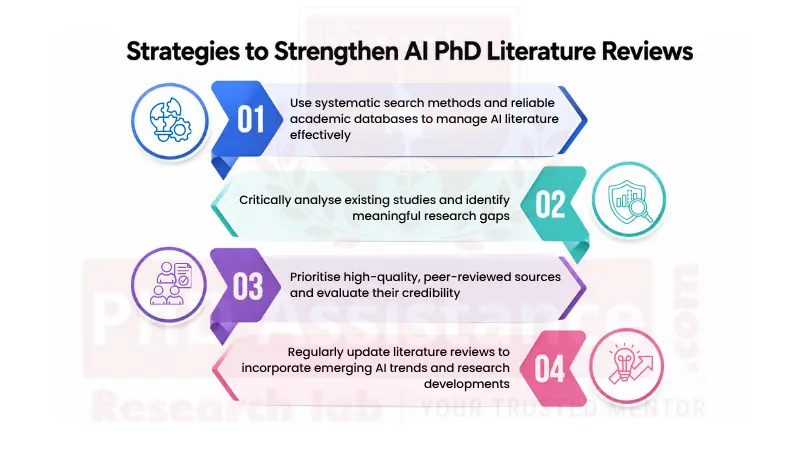
To avoid such problems, researchers should develop systematic approaches to their searches, employ a range of authoritative databases and define inclusion and exclusion criteria. Use of reference management software such as Zotero, Mendeley or EndNote can greatly facilitate literature management and organisation.
Example: Kitchenham and Charters (2007) highlighted the significance of systematic literature review methods when handling massive literature bodies and gathering evidence. They claimed that by following a systematic review procedure, the researchers will be able to identify appropriate research works and reduce selection bias. This shows the usefulness of systematic literature review methods when dealing with increasing bodies of AI literature.
2. Identifying Genuine Research Gaps with Structured PhD Literature Review Support in UK
While many AI researchers are adept at summarising previous work, they may find it difficult to formulate and articulate significant research gaps. Several areas of AI have already been widely studied, and it takes effort to ensure that your potential research area presents a novel and important contribution.
If the gap in research is not well-defined, there is a risk that your proposal will appear trivial and lack novelty, to the disappointment of supervisors and publishers, and the resulting research can then fail to make a significant contribution. This can be addressed through customised PhD Literature Review Support in UK.
Researchers must carefully evaluate the drawbacks of the prior studies, compare these research methods, and then apply cutting-edge technology like explainable AI, trustworthy AI, federated learning, AI ethics, multi modal systems to reveal the pending problems and to seek promising directions for research.
Example: The work of Webster and Watson (2002) indicates that literature reviews should go beyond merely providing a summary of the current state of knowledge and go beyond to find gaps that could lead to further research. Researchers are encouraged to critically analyse the existing research, identify what is lacking in prior research, and find the unexamined research that could be pursued.
3. Lack of Critical Analysis and Synthesis
One deficiency I notice often within AI literature reviews is that research is often described, rather than subjected to a critical assessment in terms of its strengths and weaknesses and how each study relates to others. Describing previous work only shows that a scholar is familiar with the field; it does not critically assess it.
Without this critical appraisal, the justification for your own research can be lost. Supervisors and examiners look for PhD Researchers to compare approaches, appraise results, analyse differences and establish how previous research helps fill the gaps in your chosen subject.
Authors should concentrate on comparison of methods, limitations of datasets, outcomes of performance, and identification of general findings in studies. Using thematic frameworks can help provide a coherent PhD Dissertation Literature Review in UK.
Example: Torraco (2005) maintained that literature reviews must integrate knowledge and produce new ideas instead of merely summarising earlier work. The author stresses that by integrating knowledge from different sources, researchers can reach a greater understanding of a research problem and discover trends.
4. Evaluating the Quality and Credibility of Sources
AI researchers have access to journals, conferences, preprints, technical reports, industry press and other sources of information. As helpful as this information can be, it’s often difficult to sort through all the information and know which sources to trust.
Citing low-quality, non-peer-reviewed sources may diminish the validity of the literature review and damage the credibility of the research itself. This may even be more of a problem in AI, where new results may appear in the literature without having been submitted for peer review.
To counter this problem, one would rather prioritise using peer-reviewed journal articles, acclaimed conference papers and high influence factors. The literature review could become more solid by analysing methodology, publications and influence.
Example: Okoli and Schabram (2010) identified that in systematic reviews, it is essential to assess the quality of literature so that research may provide a trustworthy and credible result. Okoli and Schabram’s findings revealed that by assessing the literature for its credibility and relevance as an academic source, the strength of a literature review is increased.
Get the pricing details for the literature review at PhD Assistance Research Lab, designed to assist researchers in developing a strong literature review.
5. Keeping Literature Reviews Current in a Rapidly Evolving Field
The literature surrounding the application of AI technology is constantly developing, and this has the added difficulty for a researcher that they are constantly having to update their literature reviews. This is because new algorithms, datasets, and applications of AI that constantly arise could lead to research being diverted in the specific area under consideration.
An outdated literature review may result in more recent work not being considered and thus affect the research value that is suggested. As this work has shown, Universities and supervisors in particular demand that doctoral students are aware of the latest developments in their respective fields.
Researchers ought to routinely update their literature searches and keep track of the primary AI conferences as well as premier research groups and leverage citation alerts for new publications. Framing the literature review as an ongoing task rather than a singular, definitive activity may ensure its continued applicability for a PhD.
Example: As was indicated by Snyder (2019), the ongoing tracking of literature is vital to the continued importance and academic rigour of a research review when the topic area is changing so rapidly. The paper also pointed out that authors should be routinely updating their literature searches for emerging research topics and trends.
Strategies to Prevent Mechanical Engineering PhD Assignment Rejection
- Analyse and critique research methodologies and results carefully
- Highlight specific research gaps and possibilities for future research
- Organise references using citation management software.
- Use thematic and conceptual frameworks to synthesise evidence.
- Regularly update literature searches throughout the PhD journey.
- Seek feedback from supervisors and AI subject experts.
- Maintain originality and avoid excessive dependence on descriptive summaries.
Conclusion
A thorough literature review is a key requirement for any good AI PhD in the UK. In practice, many researchers suffer from ‘information overload’, the difficulty of pinpointing the gap, critical analysis and evaluating sources, and the pace of AI technological change.
Doctoral students who incorporate these systematic review approaches, rigorously analyse the prior literature, judge the validity of sources and constantly learn and keep updated will establish high-quality literature reviews that yield high-quality research results. Such a quality literature review will be highly instrumental in improving the quality of their theses and enhancing publication chances and sustained academic achievement in AI.
PhD Assistance Research Lab provides expert PhD Thesis Literature Review Help in UK, enabling doctoral candidates to create robust research foundations and academic excellence.
Book a Free Expert Consultation to get mentoring on conducting a robust literature review.
References
- Kitchenham, B., & Charters, S. (2007). Guidelines for performing systematic literature reviews in software engineering (Version 2.3). EBSE Technical Report. Keele University and Durham University. https://legacyfileshare.elsevier.com/promis_misc/525444systematicreviewsguide.pdf
- Okoli, C., & Schabram, K. (2010). A guide to conducting a systematic literature review of information systems research. SSRN Electronic Journal. https://doi.org/10.2139/ssrn.1954824
- Snyder, H. (2019). Literature review as a research methodology: An overview and guidelines. Journal of Business Research, 104, 333–339. https://doi.org/10.1016/j.jbusres.2019.07.039
- Torraco, R. J. (2005). Writing integrative literature reviews: Guidelines and examples. Human Resource Development Review, 4(3), 356–367. https://doi.org/10.1177/1534484305278283
- Webster, J., & Watson, R. T. (2002). Analyzing the past to prepare for the future: Writing a literature review. MIS Quarterly, 26(2), xiii–xxiii. https://www.jstor.org/stable/4132319
