
The source and why it matters
This review examines Kusnadi et al. (2025), "Information technology and its impact on modern classroom dynamics: A computer science perspective", which appeared in Aptisi Transactions on Technopreneurship (volume 7, issue 1, pages 282 to 293). Its authors work at Catur Insan Cendekia University and ISB Atma Luhur in Indonesia, and one co-author is based in a private company. The paper is open access under a Creative Commons licence.
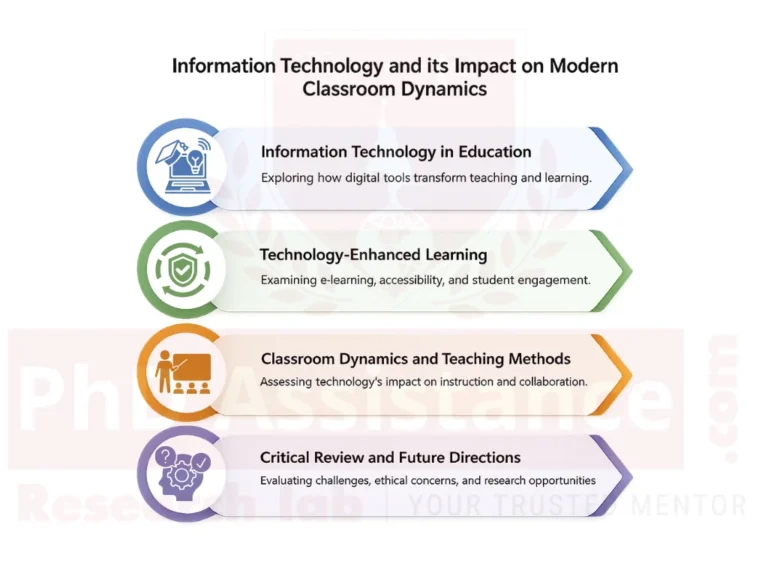
Education researchers have good reason to care about the question it asks. Learning management systems, simulation software and analytics dashboards are now ordinary features of schools and universities, and many institutions kept blended teaching after the pandemic. Generative AI has since added a new layer. Doctoral candidates in education are therefore frequently asked to evaluate a digital tool or reform, and this paper illustrates both why a quick survey with a structural model is tempting and why its results need careful reading.
What the study did and found
The abstract frames the study as an analysis of the benefits and obstacles of bringing information technology into classrooms, focusing on learning management systems, simulation tools and data analytics. It argues that computer science principles, such as algorithms, programming and networking, make better educational solutions possible, and it recommends continuing professional development for teachers, closer alignment between curriculum and technology, and wider access to devices and connectivity (Kusnadi et al., 2025).
The empirical core is a model of five constructs linked by five hypotheses. The authors estimate it with partial least squares structural equation modelling (PLS-SEM) in SmartPLS 4.0, drawing on questionnaire responses from 120 people at schools in several parts of Indonesia.
| Construct | Abbreviation | Role in the model (as described) |
|---|---|---|
| Information technology advancements | IA | The technological driver of change |
| Modern classrooms | MC | The changed learning environment |
| Teaching methodologies | TM | How teaching is delivered |
| Classroom dynamics | CD | Interaction, involvement and engagement |
| Computer science techniques | CST | Computing methods that support teaching |
From the model, the authors conclude that information technology benefits modern classrooms and teaching methods, that teaching methods relate both to classrooms and to computer science approaches, and that modern classrooms encourage student involvement and learning. They also acknowledge costs: unequal access, threats to security and privacy, and too much screen time.
Strengths
- A timely question in an under-studied setting. Digital change in the schools of a large middle-income country receives less attention than comparable change in North America and Europe.
- A model that can be challenged. Writing the expected relationships as hypotheses and testing them together exposes the authors' assumptions, which is more useful than description alone.
- Candour about costs. By naming access, security and screen overuse, the paper avoids presenting technology as free of risk, in line with wider reviews (Timotheou et al., 2023).
- Well-aimed recommendations. Teacher development and infrastructure recur across the literature as conditions for successful integration, so the paper's practical advice points in the right direction.
Limitations and methodological issues
PLS-SEM is a sound way to estimate relationships among latent constructs, particularly in exploratory or prediction-oriented research, yet its worth rests on good measurement and full reporting (Hair et al., 2019; Hair & Alamer, 2022). Five problems limit what this particular study can claim.
- One questionnaire, one occasion. Every construct seems to come from the same instrument completed at a single time. Shared method can inflate the links between constructs, for instance when a general enthusiasm for technology colours every answer (Podsakoff et al., 2003). Procedural safeguards, such as separating measures in time, and statistical checks ought to be reported.
- Causal wording. Speaking of the "impact" of technology suggests cause and effect. A structural model fitted to perceptions gathered at one moment shows only that constructs vary together in the assumed direction; reverse causation and shared causes remain possible.
- Overlapping constructs. Modern classrooms, classroom dynamics and teaching methodologies are close in meaning. Unless discriminant validity is shown, for example through the heterotrait-monotrait ratio (Henseler et al., 2015), readers cannot tell whether the model separates five distinct things.
- A small and loosely described sample. One hundred and twenty respondents is modest for a five-construct model, and the sampling method decides how far results travel even within Indonesia. Whether respondents were students, teachers or both alters the meaning of every construct.
- No direct outcomes. Learning is inferred from what respondents believe. The paper reports no test scores, lesson observations or platform logs.
Readers should be able to locate the items below before they cite any PLS-SEM study as evidence. The criteria come from published reporting guidance. Where we could not confirm an item in this paper, a doctoral reader should consult the full text before relying on the result.
| What to look for | Why it matters | Typical guidance |
|---|---|---|
| Sampling frame, response rate and respondent type | Determines who the findings describe | Describe population, method and exclusions |
| Full item wording and sources | Shows what each construct actually measures | Report all items, ideally in an appendix |
| Indicator loadings, composite reliability, AVE | Convergent validity of each construct | Loadings about 0.708 or above; AVE at least 0.50 (Hair et al., 2019) |
| HTMT ratios | Discriminant validity between similar constructs | Values below 0.85 or 0.90 (Henseler et al., 2015) |
| Path coefficients with confidence intervals | Size and precision of relationships | Bootstrapped intervals, not only p values |
| R squared, effect sizes and predictive checks | Whether the model explains or predicts anything useful | R squared, f squared and out-of-sample prediction (Hair et al., 2019) |
| Common method bias checks | Whether shared method inflates associations | Procedural and statistical remedies (Podsakoff et al., 2003) |
| Sample size justification | Whether the study could detect the effects it tests | A priori power analysis (Deng et al., 2025) |
Theoretical framing and presentation
Although the subtitle promises a computer science perspective, the constructs actually tested are educational and organisational: how respondents see classrooms, teaching and engagement. The computing contribution, meaning how particular algorithms, networks or analytics functions shape what happens in a lesson, is asserted rather than investigated. Delivering on the subtitle would require naming specific systems and tracing them to specific classroom processes.
The theory is also thin. The writing is orderly and accessible to practitioners, although parts of the literature review report studies in sequence instead of comparing them. Doctoral writers can take a lesson from this: a literature review should weigh sources against one another, showing where they agree, where they conflict and what they leave unanswered.
How the study sits in the wider literature
The paper belongs, in effect, to the technology acceptance tradition. The technology acceptance model held that perceived usefulness and perceived ease of use drive intention to use a system (Davis, 1989), and the unified theory of acceptance and use of technology (UTAUT) added social influence and facilitating conditions (Venkatesh et al., 2003). Among teachers, a meta-analytic structural equation modelling study supported the core acceptance relations while finding wide variation between studies (Scherer et al., 2019). Anchoring the five constructs in one of these models would have made the hypotheses easier to defend and the results easier to compare.
Earlier large-scale evidence also tempers the paper's optimism. Drawing on PISA, OECD (2015) found that students who used computers moderately at school tended to do somewhat better than rare users, that very frequent users did much worse, and that countries investing heavily in educational ICT saw no appreciable gains in reading, mathematics or science. A review of digital technologies in schools likewise concluded that benefits hinge on teachers' digital competence, infrastructure and leadership rather than on the devices themselves (Timotheou et al., 2023). Research on how young people view the internet and their teachers (Szymkowiak et al., 2021), and on Google Classroom in teacher education (Gupta & Pathania, 2021), confirms that perceptions matter, but perceptions cannot stand in for outcome data.
Ethics receives little attention in the paper. Reviews of artificial intelligence in higher education have faulted the field for limited critical reflection on risk and for neglecting pedagogy and educators (Zawacki-Richter et al., 2019), and have urged more ethics, collaboration and rigour (Bond et al., 2024). The analytics platforms the paper discusses raise questions of learner surveillance, consent and fair automated decisions, which a computer science perspective is unusually well placed to examine.
What newer research adds (2024 to 2026)
Since the paper went to press, several syntheses and large studies have tested the assumptions on which it rests. The table summarises seven of them; the paragraphs that follow draw out what they mean for Kusnadi et al.
| Study | Design and data | Key finding | What it means for the reviewed paper |
|---|---|---|---|
| Deng et al. (2025) | Systematic review and meta-analysis of 69 experimental studies of ChatGPT (2022 to 2024) | ChatGPT interventions improved academic performance, motivation and higher-order thinking and reduced cognitive load; no significant effect on self-efficacy | Shows the kind of causal evidence a survey cannot supply, and warns about novelty effects and underpowered samples |
| Di Pietro and Castaño Muñoz (2025) | Meta-analysis of 740 estimates from 72 experimental and quasi-experimental studies of less advantaged students | Small positive effect that survives correction for publication bias; computer-assisted learning and behavioural interventions outperform simple access | Supports the call for wider access only if access comes with designed learning use |
| Wekerle et al. (2024) | 3,820 student assessments of 170 technology-enhanced university sessions; multilevel SEM | Interactive activities mattered for perceived learning and passive ones carried affective risks, but the expected overall superiority of constructive and interactive modes was not supported | What students do with technology, not its presence, is the variable to model |
| OECD (2024) | OECD policy analysis of PISA 2022 data on digital devices | Leisure use of devices at school is negatively correlated with performance; distraction from peers' devices is common | Gives substance to the paper's brief worry about screen time |
| Goodyear et al. (2025) | Cross-sectional study of 1,227 pupils aged 12 to 15 in 30 English secondary schools | Restrictive phone policies cut phone and social media time during school but showed no link with wellbeing or with overall use | Single policy levers rarely change outcomes on their own; context and implementation matter |
| Zhai et al. (2024) | Systematic review of 14 studies of AI dialogue systems (2017 to 2023) | Over-reliance may weaken critical and analytical thinking; hallucination, bias, plagiarism, privacy and transparency recur as concerns | Adds AI-specific ethical risks absent from the paper's account of challenges |
| Noureddine et al. (2025) | Meta-analysis of 10 UTAUT studies of higher education instructors | Performance expectancy, effort expectancy and social influence predicted adoption; facilitating conditions predicted use; results varied between studies | Offers a tested framework the paper could have used to justify its hypotheses |
Several findings support the paper's broad message. When technology is used to structure learning, it can help: Di Pietro and Castaño Muñoz (2025) report a small but reliable gain for less advantaged learners, and Deng et al. (2025) find positive effects of ChatGPT on performance, motivation and higher-order thinking. The paper's emphasis on teacher support also fits Noureddine et al. (2025), who identify facilitating conditions and institutional backing as drivers of instructors' actual use.
Other findings unsettle it. Di Pietro and Castaño Muñoz (2025) show that simply giving students devices does less than computer-assisted instruction or behavioural nudges, so a recommendation to widen access is incomplete without guidance on use. Wekerle et al. (2024) found that the type of learning activity mattered more precisely than broad categories predicted, which suggests that a construct as general as "information technology advancements" is too coarse to explain classroom dynamics. The OECD's 2024 analysis links leisure device use at school with lower performance (OECD, 2024), and evidence on phone restrictions shows that a single rule may not shift wellbeing or total screen time (Goodyear et al., 2025).
Newer work also sharpens the methodological critique. Deng et al. (2025) state plainly that cross-sectional studies of ChatGPT use cannot establish causality, and they recommend power analysis, objective measures and checks for novelty effects. Each recommendation applies to Kusnadi et al. What remains open is how these patterns play out in Indonesian schools specifically, how generative AI changes the teacher's role over a school year rather than a short trial, and how to guard against the over-reliance that Zhai et al. (2024) describe.
What it means for doctoral researchers
Cite Kusnadi et al. for what it is: a cross-sectional survey in Indonesian schools in which perceptions of information technology, teaching methods and classroom dynamics were positively associated. Claiming that it showed technology improves learning would go beyond the evidence, especially now that experimental syntheses are available to cite for causal questions (Deng et al., 2025; Di Pietro & Castaño Muñoz, 2025).
The newer literature also changes what counts as a worthwhile gap. Asking whether technology helps is no longer an open question in general terms. Sharper questions ask which learning activities, for which learners, under which school conditions, and with what risks of over-reliance or distraction (Wekerle et al., 2024; OECD, 2024; Zhai et al., 2024).
Worked example (illustrative)
Imagine a doctoral researcher who wants to know whether a learning management system changes student engagement in secondary schools. Following an explanatory sequential mixed methods logic (Creswell & Creswell, 2023), a design that answers the question more convincingly than one survey could have three strands:
- A quantitative strand comparing classes before and after adoption, using platform logs and attendance or assessment data, with a sample size justified by power analysis.
- A validated acceptance survey of teachers and students, based on an established model such as UTAUT, with items piloted and measurement quality reported in full.
- Lesson observation and interviews with a purposive sample of teachers to explain why engagement changed, or did not, in particular schools, coding the kinds of learning activity the platform supports.
This design takes longer than a single questionnaire, but each strand covers a weakness in the others. The ethics plan can also deal from the outset with consent for log data, the protection of minors and any use of AI tools by pupils.
Common mistakes in studies of technology in classrooms
- Describing associations from cross-sectional surveys with causal words such as "impact" and "effect".
- Measuring use, attitudes and outcomes in one questionnaire and ignoring common method bias.
- Defining constructs so broadly that they overlap, then reporting their high correlations as findings.
- Treating acceptance of a technology as proof that it improves learning.
- Treating access to devices as the intervention, rather than the learning activities the devices support.
- Omitting who responded, how they were sampled, the full item wording and the basis for the sample size.
- Listing privacy, equity and over-reliance as limitations instead of designing the study to examine them.
Key takeaways
- Kusnadi et al. (2025) report positive associations between information technology, teaching methods and classroom dynamics in a PLS-SEM survey of 120 respondents in Indonesia.
- Because the data are cross-sectional and self-reported, they support claims about perceived associations rather than causal impact (Podsakoff et al., 2003).
- Such a model can be trusted only with full measurement and structural reporting, including discriminant validity (Hair et al., 2019; Henseler et al., 2015).
- Experimental syntheses published since 2024 find real but conditional benefits, and show that designed learning use matters more than access (Deng et al., 2025; Di Pietro & Castaño Muñoz, 2025).
- Heavy leisure use of devices and over-reliance on AI tools are linked with poorer outcomes, so risks deserve as much study as benefits (OECD, 2024; Zhai et al., 2024).
- Stronger doctoral studies combine outcome data, validated acceptance measures and qualitative explanation, with ethics built in (Creswell & Creswell, 2023; Bond et al., 2024).