
Critical Review of Information technology and its impact on modern classroom dynamics: A computer science perspective
Introduction
The use of Information Technology in Classrooms has significantly affected the ways students learn, interact and access their learning materials. The introduction of computing, e-learning environments and cooperative online learning has introduced opportunities for Technology Enhanced Learning, and consequently, traditional learning methods are modified. Therefore, Information Technology has become an important research area within CS in Education.
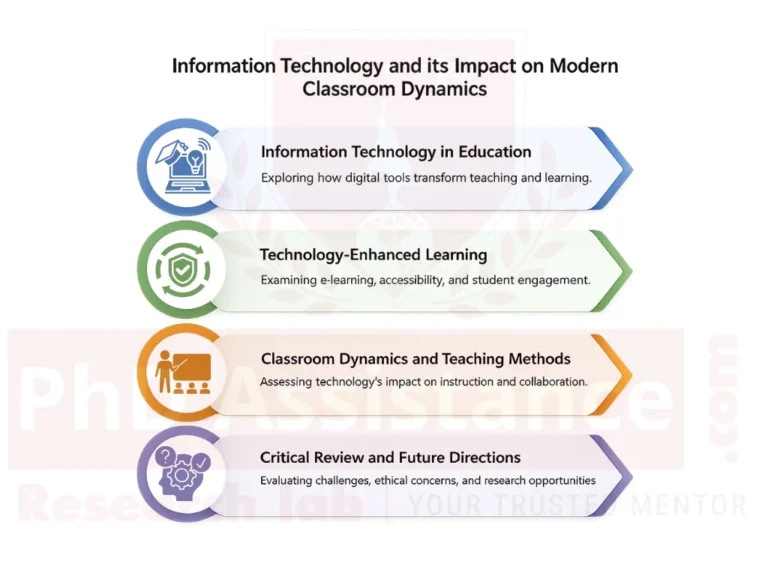
Kusnadi et al., in the publication Information Technology and Its Impact on Modern Classroom Dynamics: A Computer Science Perspective, investigate the impact of Information Technology in Modern Classrooms, pedagogical strategies, and overall learning. The investigation covers advantages and disadvantages of Modern Classroom Technologies, such as access, student engagement, the digital divide, and data security.
Through a quantitative research approach and PLS-SEM analysis, the authors examine Information Technology adoption and its relationship with the classroom process, teaching style and the method of computing science. The study adds to the existing literature on Digital Environments to explain how technology can be integrated into effective and equitable education and points to some challenges that need additional examination.
Summary of the article
In this paper, the effect of Information Technology (IT) on the modern classroom is examined from the viewpoint of computer science. The authors state that technological advancements have redefined teaching and learning delivery through increased accessibility. Main constructs have been addressed in this research study: Information Technology Advancements (IA), Modern Classrooms (MC), Teaching Methodologies (TM), Classroom Dynamics (CD) and Computer Science Techniques (CST).
The study proposes five hypotheses on the effect of technological advancements on the classroom settings and outcomes. Data were collected by survey questionnaire from 120 respondents from various schools and geographical locations throughout Indonesia. The PLS-SEM approach was adopted using SmartPLS 4.0 to test for the hypothesised relations.
It concludes that Information Technology is beneficial for modern classrooms and teaching methods. Teaching methods have impacts on classrooms and computer science approaches, while modern classrooms are positive for student involvement and their learning. This research added that digital technologies make learning more individual, social and accessible but have challenges too, such as access to technology, security and the overuse of screens.
Critique
Significance and contribution of the field
One of the strengths of the article is its relevance in dealing with Information Technology in the Modern Classroom, in a situation where a digital shift is sweeping every sector around the world, including the classroom. The paper fills a gap in Technology-Enhanced Learning by proving the impact of digital technologies on pedagogy, classroom interactions, and learning effects.
Szymkowiak et al. (2021) state that digital technologies have impacts on the learning motivation and effectiveness of students, and Gupta & Pathania (2021) reveal the collaboration and flexibility of Google Classroom. Kusnadi et al. (2025) build on this conversation from the point of view of Computer Science by providing insight into the ways technological systems create learning environments.
In addition, the findings of the study can be used to justify Hwang and Chien’s assertion that emerging technologies such as artificial intelligence and immersive learning environments will continue to shape the landscape of education. By stressing on the flexibility and digital accessibility of learning, the article is informative in the debate on Digital Environments.
Nonetheless, this research offers no insights or exploration of conflicting evidence and relies strongly on technology’s benefits. For instance, there exists literature by Alam (2023) about technology’s overreliance that may result in loss of attention, concentration, and diminished academic performance; this conflicting issue could have strengthened the paper’s critical impact if taken into consideration.
Methodology and research design
Methodologically, this is a highly robust study. PLS-SEM offers the benefit of investigating multifaceted relationships among several variables in the presence of latent constructs. With its quantitative design, the study demonstrates empirically how IT may affect the classroom.
SmartPLS 4.0 and the hypothesis testing procedure provide more empirical strength to the research. The authors provide sufficient clarity of the conceptual and structural model used as well as their variables and procedures.
However, there are several methodological limitations in the study. Only 120 subjects were sampled from Indonesia, which restricts the generalizability. Educational systems differ greatly among countries, and larger samples taken from several educational contexts would enhance external validity.
Moreover, self-report data were the only method employed in this survey. This method might be subject to response bias and subjectivity in the assessment of learning. According to Creswell & Creswell (2018), employing both a survey and other forms of qualitative methods such as interviews and classroom observation could generate more valuable understanding about an educational situation.
Theoretical and Interdisciplinary Analysis
The article is clearly interdisciplinary in scope. It draws on theory and ideas from Information Technology and Computer Science, and educational psychology and instructional design. The article describes how the use of Modern Technology enhances student engagement, interaction and individually customised learning experiences.
These findings are in accord with Constructivist Learning Theory, in which learners create knowledge by actively interacting with and collaborating with others, and Davis’s (1989) Technology Acceptance Model (TAM).
Also, the paper corroborates Damayanthi et al (2026)’s assertion that new technologies and AI are revolutionising teaching leadership and instruction. The focus on Computer Science in Education demonstrates the growing trend in importance given to programming, data analytics, and digital literacy in education.
However, compared to these positive aspects, the theoretical argumentation is rather descriptive. The authors present various concepts but do not deeply discuss theoretical debates surrounding adoption of educational technologies, digital equity, and socio-technical systems theory.
Ethical Considerations
The article describes several good ethical practices. First, it clearly states the method of data collection, description of participants, method of data analysis, and limitations of the study. An ethical report strengthens the validity and replicability of the research.
Secondly, the article also presents some interesting ethical concerns regarding privacy of data, cybersecurity and digital inequality, which are becoming prevalent as institutions are increasingly utilising cloud services and digital learning environments.
The study barely talks about the possible ethical issues with its approach to bibliometrics. Its dependence on the Web of Science database and exclusion of non-English papers could be problematic. Plus, there’s the issue of citation bias affecting Organisational Sensemaking research. Discussing these limitations more thoroughly would have made the study ethically clearer and more rigorous overall.
The issue of ethics is covered too sparingly here. While the authors raise issues about privacy and screen time, there are few suggestions given on how to counter this. Work done by Carter et al. (2020) addresses information technology identity and proper internet use, indicating a more robust ethical discussion could have benefitted the research.
Additionally, algorithmic bias, the ethics of artificial intelligence and surveillance within an educational context receive very little attention despite increasing attention within the broader field of educational technology.
Writing Style and Structure
Overall, the article is well organised, and the study progresses in a logical flow from introduction, through to literature review, methodology, results and finally conclusion. The application of concept models, frameworks of research and path analysis has been of great assistance in facilitating the reader’s ability to comprehend the study process.
The language used within the study is simple enough that it can be understood by researchers and practitioners in the field of Information Technology in Education. The fundamental concepts presented within this study are easily understandable to anyone interested in this area of study, be it a researcher, educator or policymaker.
Some sections, however, are slightly repetitious, particularly those about technology adoption and classroom reform. Additionally, in the literature review, the content focuses more on describing the studies rather than contrasting and critically examining them in relation to one another. Inclusion of more comparative critique among studies could add more analytical depth.
Conclusion
Kusnadi et al. (2025) contribute a lot to Information Technology in Modern Classroom by discussing how technology developments affect teaching, classroom interaction and results. The importance of the Digital Learning Environment is evident, and Computer Science principles will enable new ideas.
This paper agrees with Szymkowiak et al (2021), Gupta & Pathania (2021), Hwang & Chien (2022) and Damayanthi et al (2026) in recognising technology as being embedded within today’s classroom, although it also notes certain problems faced relating to accessibility, privacy and students’ well-being.
Although the robust methodology employed with PLS-SEM is evident, sample size, lack of depth of theory, and generalisation limitations constrain the extensive application of findings. A large, international sample, mixed-methods and theoretical enrichment would allow for more insight into the complex interactions between Modern Classroom Technology and student learning.
“Are you facing challenges in writing a high-quality critical review for your research? The PhD Assistance Research Lab offers specialised guidance tailored to doctoral scholars and early-career researchers.”
Reference
- Alam, A. (2023). Digital transformation in education and the impact of technology on student learning outcomes. Education and Information Technologies, 28(5), 5671–5690.
- Carter, M., Petter, S., Grover, V., & Thatcher, J. B. (2020). Information technology identity: A key determinant of IT use and its consequences. MIS Quarterly, 44(3), 983–1021.
- Creswell, J. W., & Creswell, J. D. (2018). Research design: Qualitative, quantitative, and mixed methods approaches (5th ed.). Sage Publications.
- Davis, F. D. (1989). Perceived usefulness, perceived ease of use, and user acceptance of information technology. MIS Quarterly, 13(3), 319–340. https://doi.org/10.2307/249008
- Damayanthi, Natalina & Angelina, Widya. (2026). Education Leadership in The Era of Digital Transformation and Artificial Intelligence: Implications for Sustainable Human Development. Feedforward: Journal of Human Resource. 6. 1-20. 10.19166/ff.v6i1.10357.
- Gupta, A., & Pathania, P. (2021). To study the impact of Google Classroom as a platform of learning and collaboration at the teacher education level. Education and Information Technologies, 26(1), 843–857. https://doi.org/10.1007/s10639-020-10294-1
- Hwang, G. J., & Chien, S. Y. (2022). Definition, roles, and potential research issues of the metaverse in education: An artificial intelligence perspective. Computers and Education: Artificial Intelligence, 3, 100082. https://doi.org/10.1016/j.caeai.2022.100082
- Kusnadi, K., et al. (2025). Information technology and its impact on modern classroom dynamics: A computer science perspective. International Journal of Information Systems and Computer Science, Volume(Issue), pages. (Complete publication details should be added from the original article.)
- Szymkowiak, A., Melović, B., Dabić, M., Jeganathan, K., & Kundi, G. S. (2021). Information technology and Gen Z: The role of teachers, the internet, and technology in the education of young people. Technology in Society, 65, 101565. https://doi.org/10.1016/j.techsoc.2021.101565