
Can AI support qualitative research?
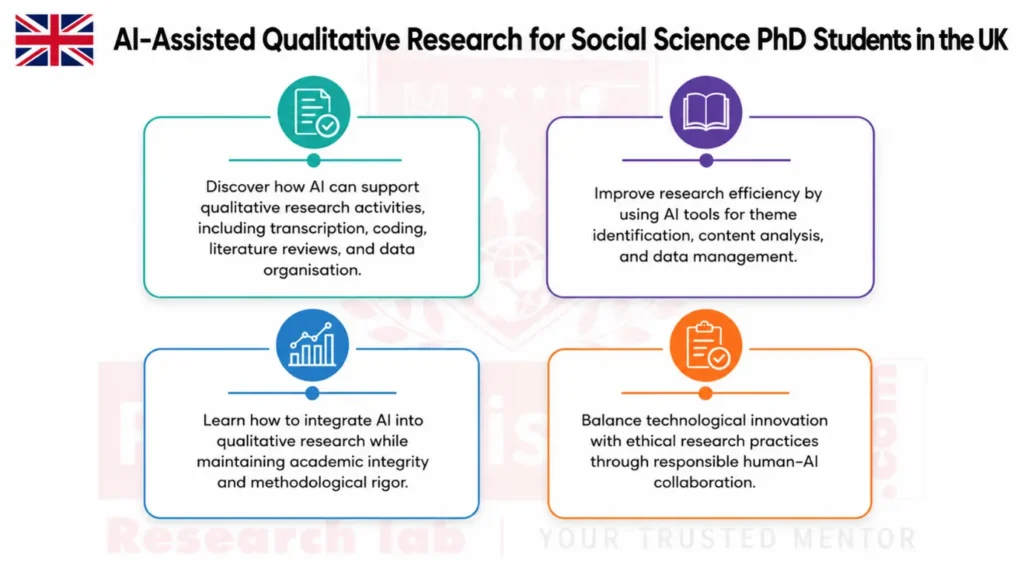
Social science doctoral researchers in the UK now meet AI at every stage of qualitative work: automatic transcription of interviews, summaries of focus groups, suggested codes and help with literature searching and editing. These tools save time on large data sets. They also raise four ethical questions that this article works through: confidentiality and consent, data protection, bias in interpretation, and honest disclosure.
The short answer is that AI can support some mechanical tasks, but it cannot take responsibility for the analysis. In reflexive approaches such as thematic analysis, themes are built by the researcher through sustained engagement with the data, and quality depends on that interpretive work (Braun & Clarke, 2021). A tool can propose; the researcher decides, checks and accounts for every decision.
What the evidence shows so far
Peer-reviewed tests of AI in qualitative analysis are still few, and studies from UK institutions are fewer still, so the evidence below combines UK work with the closest international studies.
| Source | Setting | What was done | Lesson for a UK PhD |
|---|---|---|---|
| De Paoli (2024) | UK-based author; open interview data sets | Inductive thematic analysis with GPT-3.5-Turbo compared with published analyses | Many main themes were recovered, but human oversight and careful prompting were needed |
| Morgan (2023) | United States; two focus group data sets | ChatGPT used to re-analyse data already analysed by the author | Concrete, descriptive themes were found; subtle, interpretive ones were missed |
| Wachinger et al. (2025) | Germany-led; one interview | ChatGPT compared with an experienced qualitative researcher | Themes overlapped, but quotations were altered and two were invented |
| Davison et al. (2024) | International editorial team | Editorial on the ethics of generative AI for qualitative analysis | Raises consent, confidentiality and accountability questions before any upload |
De Paoli (2024) found that a large language model inferred most of the main themes reported in earlier analyses of two open interview data sets, but recommended human oversight. Morgan (2023) found that ChatGPT handled descriptive themes well and struggled with interpretive ones, and that its output was useful only to an analyst who already knew the data. Wachinger et al. (2025) add the most practical warning: the model altered some quotations without saying so and produced two that did not appear in the transcript. In a thesis, a fabricated quotation is a serious integrity problem whoever produced it.
Ethics approval and consent come first
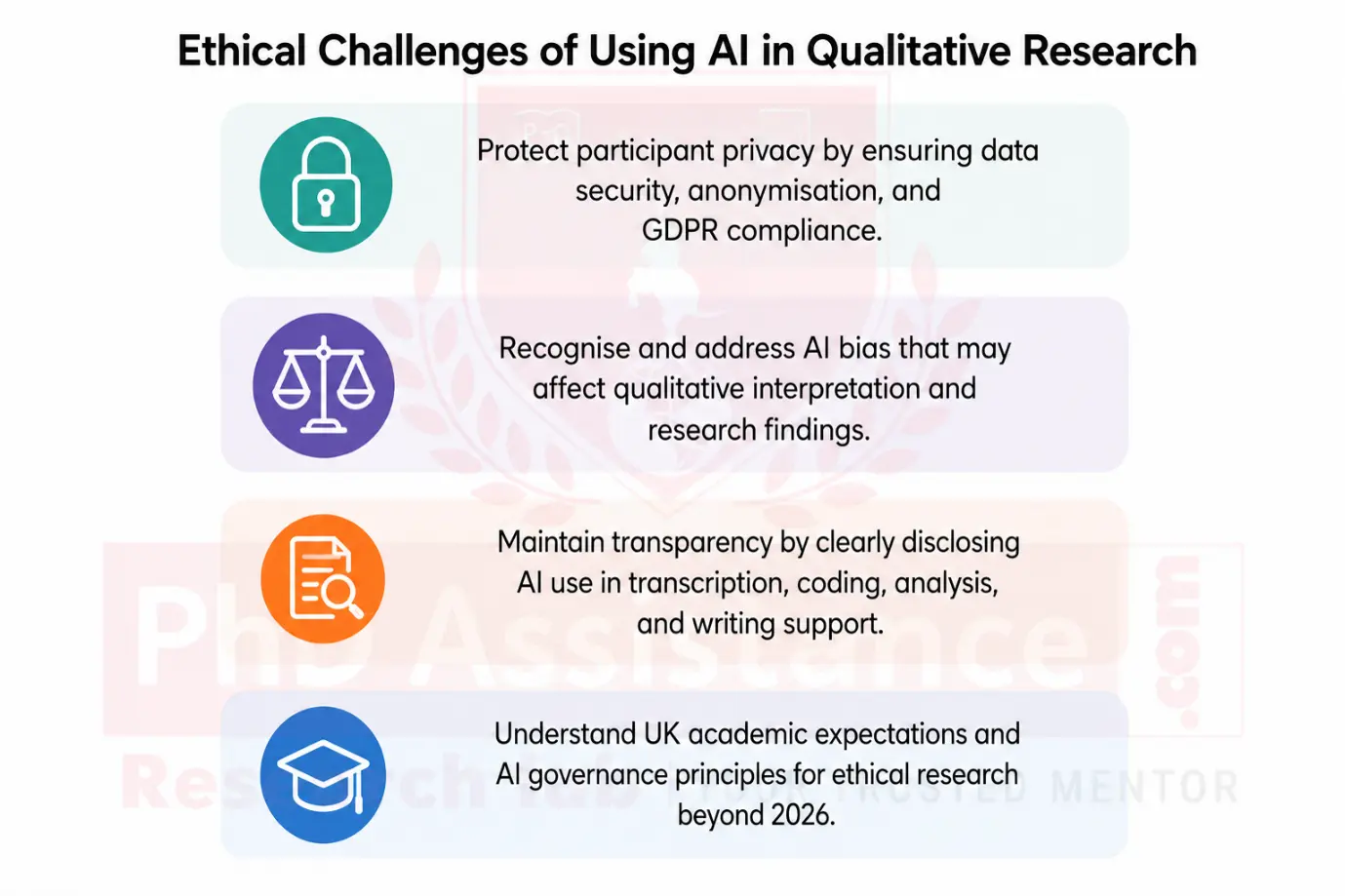
In the UK, ethics review is run by your university's research ethics committee, and social science committees commonly draw on professional codes such as the British Educational Research Association guidelines, which ask researchers to explain to participants how their data will be stored, used and shared (BERA, 2024). If you intend to transcribe, summarise or code participant data with an AI tool, say so in the ethics application and in the participant information sheet. Name the type of tool, where processing happens and whether the provider keeps or reuses inputs.
If your approval was granted before you decided to use AI, treat the change as an amendment rather than proceeding quietly. Consent obtained for "transcription by the researcher" does not obviously cover upload to a commercial service. Ethically important moments in qualitative research often arise in such everyday decisions rather than in the formal application (Guillemin & Gillam, 2004).
Data protection: map the data flow before you upload
Interview transcripts, recordings and field notes usually contain personal data, and often special category data such as health, ethnicity or political opinion. UK universities remind staff and students that data protection law applies whatever technology is used, and that personal or sensitive data entered into a generative AI platform may become exposed (Aberystwyth University, n.d.). Before using any tool, map where the data go.
| Question | Lower-risk answer | Higher-risk answer |
|---|---|---|
| Where is the data processed? | On your own device or a university-licensed service | An unknown or overseas consumer service |
| Does the provider reuse inputs? | Contract excludes training on your data | Terms allow retention or training |
| Who approved the tool? | Listed by your university or data protection officer | Chosen personally without review |
| What is uploaded? | Pseudonymised extracts needed for the task | Full recordings or identifiable transcripts |
| Is it covered by consent and ethics? | Named in the approved application | Not mentioned anywhere |
Pseudonymise early, remove contextual identifiers, keep the key separately and upload only what the task needs. Remember that rich qualitative data can identify a person through context even without names, so de-identification lowers risk rather than removing your duties. Your university's data protection officer can tell you which tools have agreements in place and whether a data protection impact assessment is needed.
Bias and interpretation
Large language models learn from vast text collections and can reproduce social biases in what they treat as typical, salient or normal (Gallegos et al., 2024). In qualitative work this can push minority or unusual accounts to the margins, because the model favours patterns that look common. Automatic transcription can also perform worse for some accents and dialects, which matters in UK studies with diverse participants.
Treat AI output as another reader's suggestions. Check each proposed code against the data, look actively for deviant cases the tool missed, and write reflexive memos on where you accepted or rejected its suggestions. That record shows examiners that interpretation remained yours (Braun & Clarke, 2021).
Disclosure in the thesis and in journals
The Russell Group's principles, published in July 2023, commit its universities to AI literacy and to upholding academic integrity, and they concentrate on teaching and assessment rather than research (Russell Group, 2023). For research, follow your university's own policy and graduate school guidance, which typically require you to state when and to what extent AI was used (Aberystwyth University, n.d.). The European Commission's living guidelines, now in a third edition dated May 2026, likewise say researchers remain responsible for their output and that AI tools are not authors (European Commission, 2026).
Publishers agree that AI tools cannot be listed as authors and that authors are accountable for content (Committee on Publication Ethics, 2023), but their detailed instructions on what to disclose and where vary considerably (Ganjavi et al., 2024). In your methods chapter, report the tool and version, the tasks, the data it received and how you checked its output; keep a dated log so the statement is accurate. Davison et al. (2024) argue that these questions should be settled before analysis begins.
Worked example (illustrative)
A hypothetical sociology doctoral researcher plans 30 interviews with care workers about workplace stress. She wants automatic transcription and help with first-pass coding. In the ethics application she names a university-licensed transcription service that keeps data in the UK, states that transcripts will be pseudonymised before any coding support is used, and explains this in the information sheet. She does not upload recordings to a consumer chatbot.
For coding, she codes the first five transcripts herself, then compares AI-suggested codes on pseudonymised extracts with her own, noting agreements, disagreements and invented or altered quotations, which she checks against the transcript (Wachinger et al., 2025). Her methods chapter includes a disclosure paragraph and a log of prompts and decisions. For qualitative design more broadly, see planning a rigorous qualitative study and supervision in the era of generative AI.
Common mistakes and a checklist
- Uploading identifiable transcripts to a consumer AI service not covered by ethics approval.
- Treating a university's teaching-focused AI principles as permission for research use.
- Quoting from an AI summary instead of the transcript.
- Reporting AI-generated themes without describing how they were checked.
- Disclosing nothing because the tool was "only" used for transcription or editing.
Before using AI, check that you have: ethics approval or an amendment covering the tool; consent wording that names AI processing; compliance with UK data protection law and your university's policy; pseudonymised inputs; AI used for support rather than final interpretation; every output critically checked; personal responsibility for the analysis; and a disclosure statement that follows institutional guidance.
Key takeaways
- Early studies show AI can recover descriptive themes but misses interpretive ones and can alter quotations (Morgan, 2023; Wachinger et al., 2025; De Paoli, 2024).
- Any AI processing of participant data must be covered by ethics approval and consent (BERA, 2024).
- Data protection law applies whatever the technology, so map the data flow and pseudonymise before upload (Aberystwyth University, n.d.).
- Model bias can marginalise unusual accounts, so check AI suggestions against the data (Gallegos et al., 2024; Braun & Clarke, 2021).
- Disclose AI use as your university and publisher require; AI cannot be an author (Committee on Publication Ethics, 2023; Ganjavi et al., 2024; Russell Group, 2023).