

Call for Papers on Hype Studies: A Research Agenda for Organising in Digital Futures
May 15, 2026
Critical Review of Advancing international business research through artificial intelligence and machine learning applications
May 16, 2026Why UAE PhD Students Struggle to Choose AI Research Topics
- May 16, 2026
- Topic Selection
Introduction
Research on Artificial Intelligence (AI) is changing the way academic, corporate, and governmental domains operate around the globe. In the UAE, research and educational institutes actively encourage the conduct of doctoral-level research in AI with relevance to government programs in areas like smart cities, digital governments, healthcare advancements, sustainability, fintech evolution, and Industry 4.0. While there are many opportunities available, many UAE-based PhD scholars face challenges while deciding on AI research topics for their dissertations.
Choosing a research topic in Artificial Intelligence is much more complicated than any other general area of study. The PhD candidate must take into consideration various aspects such as the topic’s novelty, feasibility, publishing possibility, application, availability of data, ethics, and sustainability for future research. Considering that artificial intelligence technology is rapidly advancing, students find it hard to determine whether the topic is still relevant.
The blog presents some of the key reasons why PhD students in the UAE struggle with choosing AI topics, together with examples of practical research studies that showcase this problem. At the PhD Assistance Research Lab, experts offer professional PhD topic selection help in UAE for students struggling to choose an AI research topic.
What you will learn from this blog?
- Major reasons why UAE PhD students struggle to choose AI research topics
- Challenges in identifying genuine research gaps within AI literature
- Common difficulties related to data accessibility and dataset availability
- How interdisciplinary complexity affects AI doctoral research in the UAE
- The impact of trending AI technologies on PhD topic selection decisions
Research Gap-Based PhD AI Topic Selection Service in UAE
Finding a significant research gap is one of the most difficult aspects of conducting doctoral research in artificial intelligence. It is very difficult for many UAE-based PhD students to differentiate between popular AI topics and actual research gaps that make an academic contribution.
A research gap analysis provides researchers with an opportunity to explore unsolved research areas, limitations, and opportunities in the existing literature on AI. This would help students formulate innovative, realistic, and journal-worthy PhD topics based on AI progress and UAE research focus areas.
A reliable PhD AI Topic Selection Service in UAE helps researchers in conducting literature review, identifying gaps, assessing data availability, and developing methodologies to create effective doctoral research proposals.
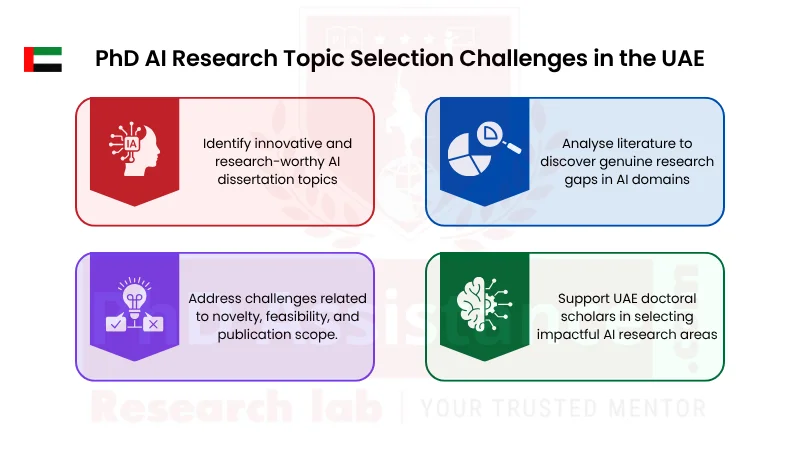
Why UAE Students Struggle to Choose AI Topics?
1. Rapid Evolution of AI Technologies
The study of Computer Science at the PhD level makes extensive use of technologies like real-time computing systems, distributed database systems, cloud computing platforms, AI-powered analytical tools, IoT sensor systems, and cybersecurity technologies. PhD students usually face difficulties when conducting research due to the inability to create reliable data sets.
Brown et al. (2020) presented GPT-3 as a large AI model able to execute several AI functions using little supervision. This study has brought major changes to the direction of research in the areas of NLP, generative AI, and automatic content creation, inspiring several thousand research works on similar AI topics.
Given that technological changes happen so quickly currently, many PhD students in the UAE are having a tough time deciding on whether to go into cutting-edge but highly innovative research topics or more secure theoretical topics in their fields of study.
2. Difficulty in Identifying Research Gaps and the Need for PhD Dissertation Topic Selection Help in UAE
The second significant issue that the UAE PhD students confront in their AI-based research is finding an appropriate research gap in the abundance of AI literature. Every year, thousands of papers are written on AI topics in the fields of health care, cyber security, education, finance, sustainable development, and smart governance frameworks.
For example, Esteva et al. (2017) showed that deep neural networks could classify skin cancer to the level of dermatologists. After this work, there was a rapid expansion of AI research in healthcare with applications in disease prediction, medical imaging, and clinical decision support systems. Such rapid growth led to highly competitive research fields, where finding original topics became difficult for new PhD students.
This makes it difficult for many PhD students in the UAE to identify whether the research concepts they have are novel, theory-contribution-worthy, feasible, and publication-ready. Professional PhD Dissertation Topic Selection Help in UAE helps researchers identify research gaps, novelty in concepts, feasibility, and important topics in AI that are trending right now.
3. Interdisciplinary Complexity in AI Research
Contemporary AI research needs interdisciplinary collaboration that includes the areas of healthcare, business analysis, engineering, economics, sustainability, policymaking, and cybersecurity. Most UAE students pursuing their doctoral studies have excellent technical skills in machine learning and programming but lack domain knowledge in other fields.
For example, Davenport and Kalakota (2019) stressed the need for medical knowledge and healthcare regulatory expertise, among other aspects, besides having machine learning knowledge, in order for the successful implementation of artificial intelligence in the healthcare sector to occur.
The implication of the above findings is that there are difficulties for doctoral students in integrating artificial intelligence with industrial problems.
Get the pricing details for the PhD topic selection service at PhD Assistance Research Lab, designed to assist researchers in developing successful PhD topics.
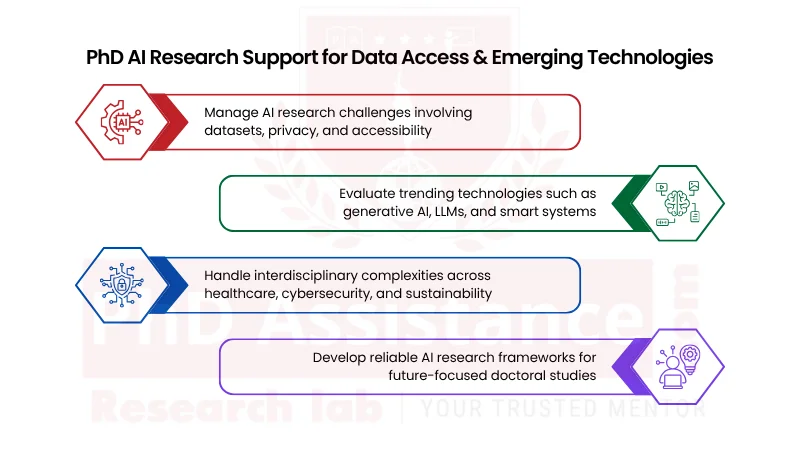
4. Challenges Related to Data Access and Availability
Data availability continues to be a major impediment to doctoral research in artificial intelligence. To conduct training, testing, and validation of machine learning algorithms, massive amounts of accurate and dependable data are required. Nevertheless, companies may not make these data sets available due to privacy laws, confidentiality issues, and security threats. Due to these challenges, researchers seek the best PhD Data Science Topic Selection help in UAE to find a suitable research area.
For instance, Yang et al. (2019) elaborated on the development of federated learning to protect privacy in sensitive data used in the context of AI-powered healthcare infrastructure. This study drew attention to the increasing difficulties scientists encounter when trying to gain access to protected databases.
The lack of data makes most UAE PhD students reluctant to explore AI research areas even if they possess adequate technical proficiency and research skills.
5. Pressure to Choose Trending AI Topics
There is often a trend among PhD scholars to opt for very popular AI areas of research, such as ChatGPT, generative AI, blockchain-based AI, autonomy, and large language models. Despite being a fertile ground for academic publications, research grants, and industrial interest, this area is highly competitive and dynamic.
Vaswani et al. (2017) developed the architecture of the Transformer model, on the basis of which modern systems for generative AI and large language models are built. The research paper has greatly impacted the ongoing directions in AI studies.
In UAE academic settings, students tend to perceive that choosing current AI topics can enhance their chances of publishing and future career prospects.
Conclusion
Selecting a topic for AI research is increasingly challenging for UAE doctoral students, owing to the speed of technological advancement, interdisciplinary nature of the field, difficulties acquiring datasets, ethical concerns, and competition within fascinating areas of AI research. The research environment for AI research remains dynamic, and it poses a challenge for PhD candidates.
Empirical evidence from the real world indicates that contemporary AI research is much broader than simply developing algorithms but entails the merging of algorithms with governance, ethics, domain knowledge, and digital transformation frameworks. Consequently, UAE PhD students would benefit from the involvement of academic advisors who can facilitate their process of finding suitable topics for their dissertations. The Professional PhD AI Research Topic Selection Service in UAE will help scholars develop ideas and find topics at the PhD level.
Book a Free Expert Consultation with PhD Assistance to avoid these struggles in selecting a PhD topic.
References
- Brown, T. B., Mann, B., Ryder, N., Subbiah, M., Kaplan, J., Dhariwal, P., … & Amodei, D. (2020). Language models are few-shot learners. Advances in Neural Information Processing Systems, 33, 1877–1901.
- Davenport, T., & Kalakota, R. (2019). The potential for artificial intelligence in healthcare. Future Healthcare Journal, 6(2), 94–98.
- Esteva, A., Kuprel, B., Novoa, R. A., Ko, J., Swetter, S. M., Blau, H. M., & Thrun, S. (2017). Dermatologist-level classification of skin cancer with deep neural networks. Nature, 542(7639), 115–118.
- Vaswani, A., Shazeer, N., Parmar, N., Uszkoreit, J., Jones, L., Gomez, A. N., … & Polosukhin, I. (2017). Attention is all you need. Advances in Neural Information Processing Systems, 30, 5998–6008.
- Yang, Q., Liu, Y., Chen, T., & Tong, Y. (2019). Federated machine learning: Concept and applications. ACM Transactions on Intelligent Systems and Technology, 10(2), 1–19.
