
Call for Papers: Development of sunlight-activated materials for water treatment/desalination and energy production
Introduction
Water scarcity, environmental pollution, and the need for energy sustainability have increased the demand for innovative solar-driven technologies and techniques using solar technology. Solar-powered materials offer promising approaches to addressing environmental and energy challenges through processes like photocatalysis, photo-Fenton catalysis, photo-electrocatalysis, and photothermal conversion.
Special Issue “Development of Solar Light Activated Materials for Water Purification/Desalination and Energy Generation” of the journal Materials Letters aims to highlight advances in the development and characterisation of sunlight-activated materials for environmental remediation, water purification, desalination, and renewable energy generation. This special issue encourages research that highlights enhanced material properties and helps in solving problems associated with the commercialisation of new solar technologies.
The solar water treatment research community is invited to contribute original studies and innovative approaches addressing the development and application of advanced sunlight-responsive materials.
Why publish in this issue?
This Special Issue provides researchers with an opportunity to present emerging developments in solar-driven materials and their applications in water and energy technologies.
Key advantages:
Scope
The Special Issue welcomes original research articles and relevant contributions covering the development and application of sunlight-activated materials for environmental and energy applications.
Contact PhD Assistance Research Lab today for manuscript preparation and submission support tailored to Scopus- and PubMed-indexed journals.
Know More About This Issue
The development of photoactive materials is now gaining importance as an area of research to tackle the problems of water and energy at once. Advanced materials that utilise solar radiation can induce chemical, electrochemical, and thermal reactions and thus provide a means of sustainable purification, desalination, resource recovery, and energy generation.
Studies on solar desalination are especially significant owing to the capacity of photothermal materials to convert solar energy into localised heating for the evaporation and purification of water. Likewise, photocatalytic and photo-electrocatalytic materials may be used to degrade contaminants and convert renewable resources into useful products.
This Call for papers solar energy materials thus calls for studies on the properties of light-active materials, including better performance, selectivity, stability, efficiency, and applicability. The use of both experimental and theoretical approaches to study such materials is encouraged.
Key factors
Research contributions may address:
How We Support Your Submission
PhD Assistance Research Lab provides research and publication support to help researchers prepare manuscripts for submission to suitable journals and Special Issues. Our services focus on improving manuscript quality, scientific presentation, clarity, and submission readiness.
Our services include:
Journal Indexing and Submission Information
Authors should refer to the journal’s official website and the relevant indexing databases for the most current information about journal indexing, eligibility, article types, submission requirements, and publication policies. Indexing status may change over time and should be independently verified by authors before submission.
Journal Guidelines:
Verify the latest author guidelines before submission
As a researcher studying light-activated materials, photocatalysis, solar water purification, desalination, photothermal processes, or sustainable energy generation, this Special Issue represents a chance for you to get involved in one of the most dynamic fields in solar-powered environmental and energy studies.
Is My Paper a Fit?
Your manuscript may be a good fit if it:
Check Your Manuscript’s Fit for This Special Issue
Get guidance on your manuscript’s scope, structure, and submission readiness for this Special Issue. The free guide covers manuscript preparation, formatting, Peer review, and submission readiness.
FAQs:
- What are sunlight-activated materials?
Sunlight-activated materials are specially designed materials that use solar energy to drive chemical, thermal, or electrochemical processes for environmental and energy applications. - How do sunlight-activated materials treat water?
They can use photocatalysis, photo-Fenton catalysis, or photoelectrocatalysis to break down pollutants and contaminants in water using sunlight. - How does solar-driven desalination work?
Solar-driven desalination uses sunlight-activated photothermal materials to convert solar energy into heat, promoting water evaporation and separating freshwater from salts and other impurities. - What materials are used for solar water treatment?
Materials include photocatalysts, photo-Fenton catalysts, photoanodes, and photothermal materials designed to efficiently absorb and utilise sunlight. - What are the main research challenges for sunlight-activated materials?
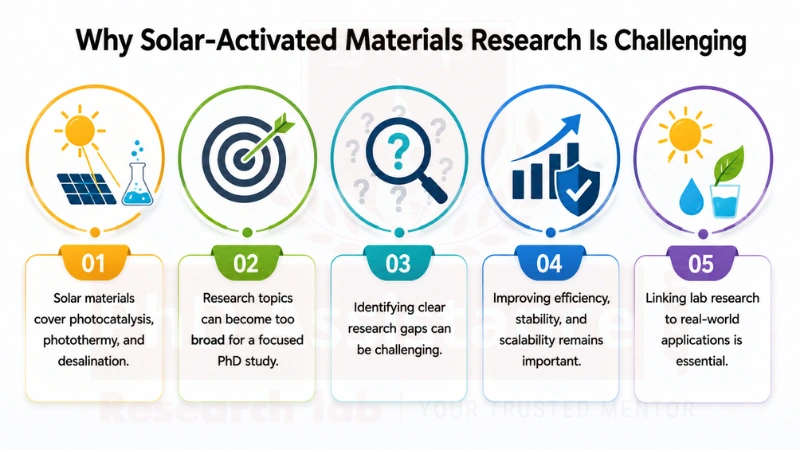
Key challenges include improving material efficiency and stability, reducing energy requirements, achieving scalability, and transferring laboratory technologies into practical real-world applications.
Reference
Elsevier. (2026). Call for papers: Development of sunlight-activated materials for water treatment/desalination and energy production. [ScienceDirect.com by Elsevier]. Materials Letters | ScienceDirect.com by Elsevier – Materials Letters | ScienceDirect.com by Elsevier