

Struggling to Get Your Engineering PhD Manuscript Accepted in the UK Here Is What Is Going Wrong
May 11, 2026
How to Write a PhD Part Dissertation in UAE Management: Applying Explainable AI and Strategic Leadership Models
May 12, 2026Why Data Collection Fails in Computer Science PhD in UAE and How to Fix It
- May 12, 2026
- PhD Data Collection
Introduction
UAE’s research system is continuously growing through developments in artificial intelligence, cybersecurity, cloud computing, internet-of-things systems, blockchain technology, machine learning, smart city concepts, autonomous technologies, and big data engineering. UAE higher education institutions mandate Computer Science PhD courses to generate technically robust research that is based on accurate data gathering, computational verification, scalable system design, and replicable experiments using international research standards.
Data collection is one of the most challenging stages for Computer Science PhD students since contemporary computer science experiments require the use of big data sets, distributed computing, sensor stream processing, safe data pipelines, and state-of-the-art lab facilities. Problems include unreliable data sets, API access constraints, cybersecurity policies, data gaps, sampling bias, Internet of Things (IoT) hardware disparities, cloud computing problems, and ethical standards when acquiring data through artificial intelligence systems.
In this blog, we have discussed the key reasons behind unsuccessful data collection processes in Computer Science PhD research studies conducted at UAE universities, along with possible technical measures to improve data collection procedures. PhD Assistance Research Lab offers professional PhD Data Collection Service in UAE for students pursuing Computer Science PhD research studies.
What you will learn from this blog?
- Major reasons Computer Science PhD data collection fails in the UAE
- Common AI, IoT, cybersecurity, and cloud data acquisition issues
- Technical problems in dataset reliability and system integration
- Best practices for scalable and secure research data collection
- Advanced solutions for computational validation and reproducibility
Why Does Data Collection Fail in Computer Science PhD Research in the UAE?
The study of Computer Science at the PhD level makes extensive use of technologies like real-time computing systems, distributed database systems, cloud computing platforms, AI-powered analytical tools, IoT sensor systems, and cybersecurity technologies. PhD students usually face difficulties when conducting research due to the inability to create reliable data sets.
The researchers in machine learning, blockchain, cybersecurity, edge computing, smart healthcare, computer vision, digital twins, and intelligent transport systems have faced problems with the collection of data because of unstable APIs, inadequate system integration, improper sensor calibration, insufficient computing power, high network latency, privacy constraints, and a lack of data structures.
Example: An IoT-based smart healthcare monitoring system was designed by Alshammari et al. for the analysis of patient data in hospitals in the UAE. It was found during research that unsteady wearables and unreliable transmission from sensors caused incomplete physiological data, thus affecting machine learning accuracy.
Customised PhD Computer Science Data Collection Service in UAE
1. Defining a Technically Valid Data Collection Architecture
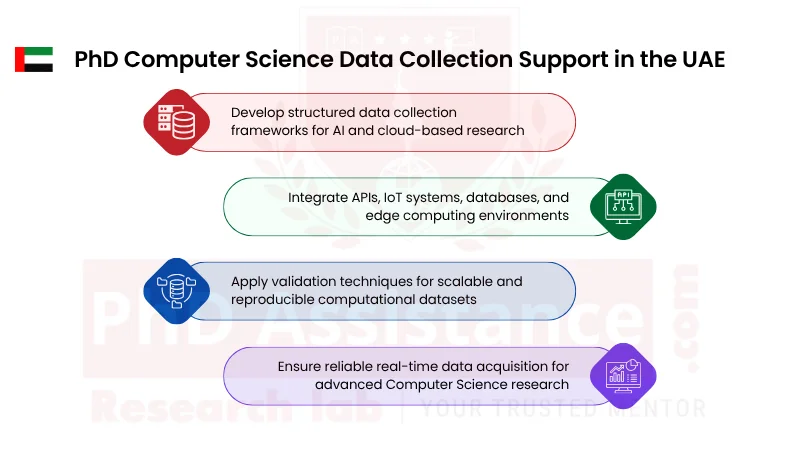
Computer Science researchers often encounter problems due to the need for well-organised data collection mechanisms that work together with artificial intelligence technologies, databases, application programming interfaces, edge computing, and cloud computing environments.
A successful Computer Science research study entails an interconnection between computational goals, data engineering processes, security procedures, and validation approaches. The problem arises when researchers gather datasets without addressing reproducibility, consistency, and computational compatibility. Therefore, many researchers need a reliable PhD Computer Science Data Collection Service in UAE to frame a technically valid data collection infrastructure
Example: Chandana et al. (2025) proposed an intelligent transportation system through artificial intelligence by deploying IoT traffic sensors and edge computing platforms for predicting smart cities’ traffic conditions. It was found that time stamp synchronisation problems, different communication protocols of sensors, and unreliable data collection processes in real time decreased the prediction accuracy of intelligent traffic management systems through machine learning algorithms.
2. Big Data, AI, and Cloud Integration Challenges
The quality of Computer Science research relies significantly on data engineering scalability, distributed computing efficiency, and computational reliability. Scientists often encounter problems combining cloud databases, machine learning processes, edge computing, and live APIs due to constant synchronisation demands in modern computing systems.
Several Computer Science datasets lack API response data, cloud synchronisation, data redundancy, real-time latency, storage stability, and biases in machine learning datasets. Technical difficulties associated with these issues can lower the credibility of the analysis and the efficiency of model training. Scientists who use artificial intelligence for recommendations, blockchain analysis, cybersecurity detection, and cloud computing performance optimisation do not usually test whether their collected datasets reflect reality.
Example: Saeed et al. (2022) have designed an intrusion detection system using machine learning for cloud computing architecture and found that inconsistencies in network traffic logs, insufficient telemetry data gathering, and huge time series anomalies caused a significant drop in intrusion detection performance.
3. Ensuring IoT Sensor Reliability and Real-Time Data Acquisition with PhD Data Collection Help in UAE
IoT-based computer science PhD research is becoming popular because it depends on IoT infrastructure, autonomous systems, robotics platforms, wearables, and edge computing to collect data in real time. Due to the increased technical complexity in these systems, many people choose to seek PhD Data Collection Help in UAE. There are some difficulties that have come up due to the use of IoT infrastructure for computer science research environments.
Researchers who develop intelligent cities, driverless vehicles, industrial automation, health monitoring, and intelligent surveillance are often faced with packet loss, lack of synchronisation between devices, sensor drift, latency in edge computing, environmental signal interference, and unstable wireless communication. These factors have direct implications for data set consistency, repeatability of computation, and accurate predictions in machine learning algorithms.
Example: The SEMAR Real-Time IoT Environmental Monitoring Platform was invented by Panduman et al. (2024), and it showed that real-time data inconsistency, environmental instability, and communication costs heavily impacted the efficiency of predicting models and environmental analytics. This proves that IoT validation methodologies are essential for Computer Science PhD studies.
Get the pricing details for the PhD data collection service at PhD Assistance Research Lab, designed to assist researchers in developing successful data collection methods.
4. Cybersecurity, Privacy, and Ethical Data Collection Issues
Cybersecurity measures, ethical AI guidelines, and privacy policies regarding sensitive datasets are important aspects within Computer Science research conducted in UAE. Researchers who collect data from medical institutions, financial software, biometrics, cloud computing technology, and monitoring applications need to meet higher levels of security, encryption, and ethics.
A wide range of problems that can be encountered by doctoral researchers regarding cybersecurity include: issues of accessing encrypted data, delayed ethical approval, GDPR and UAE privacy compliance, inability to anonymise data, inability to provide secure data storage options, and blockchain verification problems.
Attou et al. developed a cloud-based intrusion detection framework using machine learning techniques and identified that incomplete network monitoring, encrypted traffic limitations, and feature-selection inconsistencies reduced anomaly detection performance in cloud security systems. Similarly, Javadpour et al. highlighted that massive cloud datasets and evolving cyberattack patterns create major challenges for reproducible cybersecurity data collection environments.
Overcoming Computer Science Data Collection Challenges
PhD research in Computer Science becomes very difficult due to the need to coordinate and balance all distributed systems, AI pipelines, cloud-based computing setups, Internet of Things, security, and reproducible computation at once. Failure to collect adequate data often results from underestimating the intricacies of building a computational system.
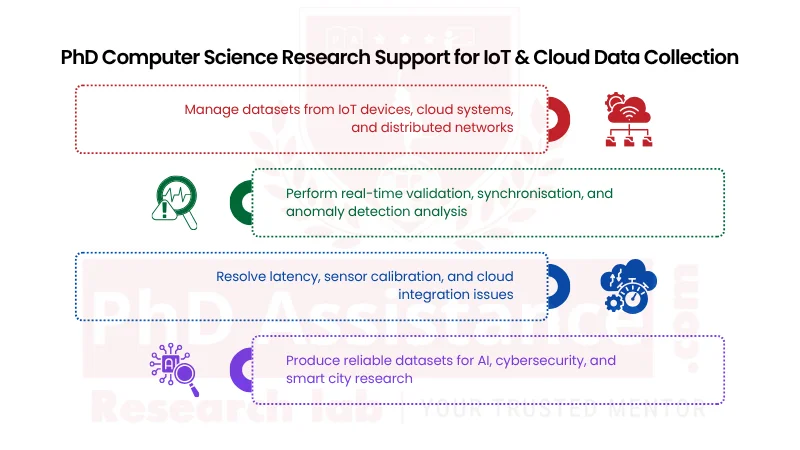
Anomaly detection approaches, employing AI technologies, are used by scientists to increase data quality and analytical efficiency by detecting inconsistencies, corrupted data, and anomalies in user behaviour. Sensor calibration benchmarking and distributed systems validation are conducted by researchers to ensure the efficiency and accuracy of IoT environments, machine learning, and real-time monitoring solutions in Computer Science. With the assistance of Professional PhD Data Collection Support in UAE, scholars will be able to implement technical systems for the acquisition and monitoring of data.
Moreover, the implementation of cybersecurity compliance standards and the development of reproducible computing workflows are crucial in ensuring that the research environment remains safe, ethical, and scientifically valid.
Conclusion
UAE-based PhD students in Computer Science often experience data collection failures because of the unstable nature of their computational environment, poor data engineering tools, IoT issues, cybersecurity, synchronisation issues in cloud computing, and a lack of proper data validation mechanisms. The modern-day computer science research demands highly technical, scalable, and secure data collection frameworks.
Data collection failures can be reduced through structured computational architectures, secure cloud infrastructures, real-time validation mechanisms, scalable IoT frameworks, and advanced cybersecurity compliance strategies. Expert PhD Computer Science Data Collection Methods in UAE can support researchers in improving research accuracy, technical reliability, and large-scale computational reproducibility.
Book a Free Expert Consultation with PhD Assistance to avoid data collection failure and develop a high-quality dissertation.
References
- Alshammari, Hamoud. (2023). The internet of things healthcare monitoring system based on MQTT protocol. Alexandria Engineering Journal. 69. 275-287. 10.1016/j.aej.2023.01.065.
- Chandana, Mrs & S V, Sai. (2025). AI-ENABLED INTELLIGENT TRANSPORTATION SYSTEMS FOR SUSTAINABLE URBAN TRAFFIC MANAGEMENT USING IOT. 05. 2610-2618.
- Saeed, Muhammad Salman & Saurabh, Raman & Bhasme, Sarang & Nazarov, Alexey. (2022). Machine Learning-Based Intrusion Detection System in Cloud Environment. 1-6. 10.1109/ITNT55410.2022.9848611.
- Panduman, Y. Y. F., Funabiki, N., Fajrianti, E. D., Fang, S., & Sukaridhoto, S. (2024). A survey of AI techniques in IoT applications with use case investigations in the smart environmental monitoring and analytics in real-time IoT platform. Information, 15(3), 153.
- Attou, Hanaa & Guezzaz, Azidine & Benkirane, Said & Azrour, Mourade & Farhaoui, Yousef. (2023). Cloud-Based Intrusion Detection Approach Using Machine Learning Techniques. Big Data Mining and Analytics. 6. 311-320. 10.26599/BDMA.2022.9020038.
