
What UK examiners expect from a literature review
In UK doctorates the literature review is examined as evidence of judgement, not of reading. The Quality Assurance Agency describes the doctorate as requiring an original contribution to knowledge and states that most doctoral examiners are looking for work that is original in nature and makes a contribution to knowledge (QAA, 2020). A review supports that claim in two ways. It shows that the candidate understands the techniques and methods current in the field, and it locates the precise point at which existing work stops.
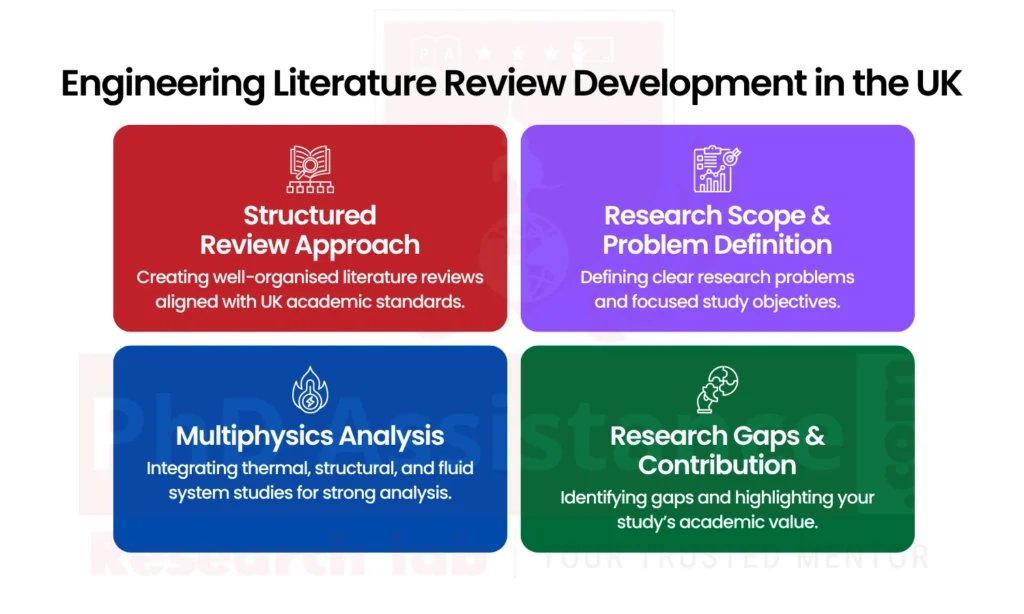
Multiphysics simulation makes both tasks harder. A study of a battery, an aircraft panel or a heart valve may couple heat transfer, structural mechanics, fluid flow and electrochemistry, each with its own literature, solvers and validation traditions. A review that summarises each paper in turn will not show an examiner why one coupled model is more credible than another. The aim of this guide is to give you a way of reading multiphysics papers comparatively, using published UK studies as the worked material.
How UK research groups report multiphysics models
The studies below were chosen because their authors were affiliated with UK institutions when the work was published and because each reports its coupling, comparison data and limitations openly. They are not a complete survey of UK multiphysics research. They are examples of the features you should extract from every paper you review.
Electrochemical and thermal coupling at Oxford
Timms et al. (2021), at the Mathematical Institute of the University of Oxford and the Faraday Institution, coupled porous electrode theory for the electrochemistry of a lithium-ion pouch cell with an energy balance for its thermal behaviour, and modelled the current collectors as Ohmic conductors. They used asymptotic analysis, exploiting the thin geometry of the cell, to reduce the three-dimensional problem to one-dimensional through-cell models coupled through two-dimensional current collector problems, and then to a single volume-averaged model. They compared the reduced models with full simulations in the commercial finite element package COMSOL and stated where the reduction loses accuracy: near the cell edges, and when temperature gradients become large. The same group released the open-source PyBaMM framework so that models and numerical methods can be compared while the rest of the implementation is held fixed (Sulzer et al., 2021).
Experiment as the arbiter at Imperial College London
Hunt et al. (2016), in Mechanical Engineering at Imperial College London, compared surface cooling and tab cooling of lithium-ion pouch cells experimentally. After 1,000 cycles, surface cooling gave a rate of loss of usable capacity under load about three times that of tab cooling. The authors attributed the difference to the direction of thermal gradients: gradients perpendicular to the electrode layers produced uneven current distribution, while tab cooling produced in-plane gradients. For a reviewer, this is the kind of experimental result that tests whether coupled thermal-electrochemical models capture the mechanism that matters, not only the average temperature.
Fluid-structure interaction at Swansea
Swansea University has a long record in computational fluid-structure interaction. Dettmer and Perić (2006) set out a finite element framework for fluid-structure interaction, covering formulation and applications. In later work, Dettmer and Perić (2008) examined how the terms that couple fluid flow with the motion of the fluid mesh affect the convergence of partitioned Newton methods, and showed that computing these terms exactly can substantially improve efficiency in problems such as flow in flexible pipes. The wider literature explains why such choices matter: Causin et al. (2005) showed that the added-mass effect can make simple partitioned schemes unstable when the fluid and structure densities are comparable, as in blood flow.
Combining models with measurement at Cambridge
Girolami et al. (2021), in the Department of Engineering at the University of Cambridge and at the Alan Turing Institute, proposed the statistical finite element method (statFEM). It treats observed data as the sum of a finite element prediction, a model misspecification term and measurement noise, and uses Bayesian inference to update the finite element solution as sensor data arrive, for example strains from fibre-optic sensor networks. Their worked examples were mainly synthetic, and they noted that scaling to high-dimensional parameter spaces needs more advanced sampling. The paper is useful to a reviewer because it makes model error an explicit quantity rather than something hidden inside a validation plot.
| Study | Physics coupled | How the model was tested | Limitation reported |
|---|---|---|---|
| Timms et al. (2021), Oxford | Electrochemistry, heat, current collector conduction | Reduced models against full COMSOL simulations | Accuracy falls near cell edges and with large temperature gradients |
| Hunt et al. (2016), Imperial | Thermal management and degradation (experiment) | Cycling of cells under two cooling strategies | Mechanism inferred from gradient direction; a test case for models |
| Dettmer & Perić (2008), Swansea | Fluid flow, structural motion, mesh motion | Convergence of partitioned Newton schemes on test problems | Efficiency depends on how coupling terms are computed |
| Girolami et al. (2021), Cambridge | Finite element model with sensor data | Synthetic examples with known truth | Scaling to high-dimensional parameters needs better sampling |
A review workflow for multiphysics studies
The steps below follow the logic of a standard review (scope, search, analysis, integration, structure and gaps) but make each step specific to coupled simulation.
- Define the scope by physics and purpose. Name the fields (for example heat transfer and structural mechanics), the direction of coupling (one-way or two-way) and the decision the simulation supports. A review of two-way fluid-structure interaction for valves is a different review from one of one-way thermal stress in turbine blades.
- Search systematically and record it. Use at least two databases suited to engineering, such as Scopus, Web of Science and IEEE Xplore, record the search strings and dates, and screen against written inclusion criteria. Guidance developed at Keele and Durham universities for software engineering adapts well to simulation research (Kitchenham & Charters, 2007). Decide early what kind of review you are writing, because a scoping review, a systematic review and a critical review carry different obligations (Grant & Booth, 2009).
- Include foundational method sources. Numerical approximation of the governing equations (Quarteroni & Valli, 2008) and the finite element method itself (Zienkiewicz et al., 2013) are the basis on which coupled solvers are built; your reader needs to see that you can judge a discretisation, not only a result.
- Extract the same fields from every study. Use the extraction table in the next section, so that differences between studies become visible.
- Appraise verification and validation separately. Verification asks whether the equations are solved correctly; validation asks whether they are the right equations for the purpose (Oberkampf & Trucano, 2002). Many multiphysics papers report one and not the other.
- Synthesise by theme, not by paper. Group studies by coupling strategy, validation evidence or application, and write about the pattern across them.
- State gaps that follow from the synthesis. A gap is credible when it appears in your extraction table: for example, no study in the set validates the coupled quantity against measurement.
What to extract from each multiphysics study
| Field | What to record | Why it matters |
|---|---|---|
| Physics and coupling | Fields coupled; one-way or two-way; monolithic or partitioned | Determines stability, cost and which interactions the model can show |
| Governing equations and assumptions | Constitutive laws, simplifications (for example isothermal or small strain) | Assumptions set the domain in which results can be trusted |
| Discretisation and solver | Method (finite element, finite volume), software and version, mesh and time-step studies | Without convergence evidence, numerical error is unknown |
| Verification | Code verification, benchmark problems, comparison with a reference solution | Shows the equations are solved correctly |
| Validation | Experimental data used, quantities compared, conditions covered | Shows the model represents the physical system for its purpose |
| Uncertainty | Parameter uncertainty, sensor noise, model error | Separates real effects from noise (Girolami et al., 2021) |
| Data and code availability | Repository, licence, input files | Allows checking and reuse; expected by UK funders (EPSRC, 2022) |
Completing the table forces comparison. In the UK examples above, the Oxford pouch-cell study is verified against a fuller simulation but not, in the paper read here, against experiment; the Imperial study supplies experiment without a coupled model; the Cambridge study makes model error explicit but uses mainly synthetic data. Each is strong for its purpose. Placed side by side, they show where a doctoral project might contribute: a coupled model tested against the kind of experiment that discriminates between mechanisms.
Worked example: from extraction table to research gap
The following example is illustrative and hypothetical. A candidate is reviewing thermal-electrochemical models of pouch cells for fast charging. After screening, 32 studies remain.
- The candidate extracts each study into the table above. Twenty-six use partitioned or reduced models; six solve the full coupled system.
- Validation is grouped: 19 studies compare predicted voltage with experiment, 8 also compare surface temperature, and 3 compare internal temperature or current distribution.
- The candidate notes that experimental work such as Hunt et al. (2016) shows that the direction of thermal gradients drives degradation, so voltage and surface temperature alone may not test the mechanism.
- The synthesis paragraph reports this pattern across studies rather than describing each in turn.
- The gap is stated precisely: few models in the set have been validated against measurements of in-plane current or temperature distribution under cooling strategies that produce different gradient directions. The proposed project addresses that gap and states which reduced model, for example one of those of Timms et al. (2021), it will test.
Structuring the chapter
A UK thesis chapter usually works best when its structure follows the argument rather than the order in which papers were read. A common structure is:
- Introduction: the engineering problem, why coupling matters for it, and the scope and search method.
- Physical and numerical foundations: the governing equations and discretisation choices, kept brief and cited to standard sources.
- Thematic analysis: sections organised by coupling strategy, validation approach or application, each ending with a short synthesis.
- Critical evaluation: strengths and weaknesses across studies, supported by the extraction table.
- Gaps and research questions: the gaps that follow from the evaluation, and how your project addresses them.
Link this chapter to your methodology chapter. If the review shows that most studies omit mesh convergence or internal validation data, your own methods must include them; examiners will check that you apply your own criteria.
Common mistakes
- Summarising papers one at a time instead of comparing them on the same criteria.
- Reporting the software used (COMSOL, ANSYS, OpenFOAM) as if it described the method; the coupling scheme, assumptions and discretisation are what matter.
- Treating agreement with one experimental curve as validation of every coupled quantity.
- Ignoring stability and convergence problems in partitioned coupling, such as the added-mass effect (Causin et al., 2005).
- Excluding older method papers because they are not recent.
- Stating gaps that do not follow from the evidence presented, such as "no one has studied this" without a recorded search.
Key takeaways
- UK doctoral examiners read a literature review as evidence of judgement and of where an original contribution can be made (QAA, 2020).
- Extract the coupling strategy, verification, validation and uncertainty from every multiphysics study in the same form.
- Distinguish verification from validation, and report both (Oberkampf & Trucano, 2002).
- UK studies show different, equally legitimate ways of testing coupled models: against fuller simulations, against experiment, and with explicit model error (Timms et al., 2021; Hunt et al., 2016; Girolami et al., 2021).
- Partitioned coupling choices affect stability and efficiency and deserve critical comment (Dettmer & Perić, 2008; Causin et al., 2005).
- A credible research gap is one that is visible in your extraction table.