
How to Select the Best Topics for Research?
March 30, 2023How to format your Research Proposal ?
April 5, 2023Recommendations for future researchers in the paper “Theorizing Through Literature Reviews: The Miner-Prospector Continuum.”
Introduction
Using the category miner-prospector continuum, this paper investigates the consequences for theory development within review articles, providing new insights into how theoretical contributions can be created and articulating the risks and advantages of each. We help authors participate in what Hoon and Baluch (2019) call “powerful theorizing” through review by allowing them to see where their work “sits” on the continuum between tradition and innovation. The following is how the content is organized.
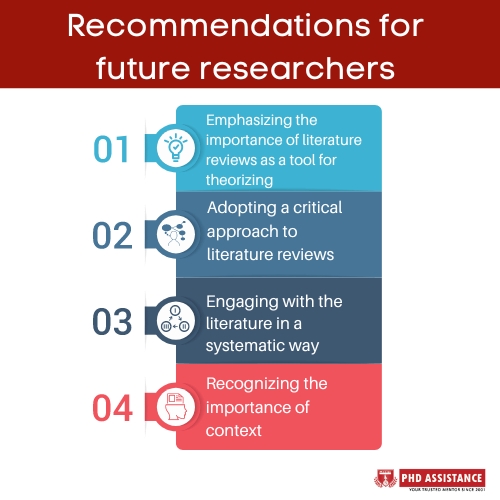
“Theorizing Through Literature Reviews: The Miner-Prospector Continuum” offers several recommendations, including:
- Emphasizing the importance of literature reviews as a tool for theorizing: The paper highlights the role of literature reviews in generating new theories and refining existing ones. The authors suggest that researchers should view literature reviews as a means of engaging in theoretical work rather than simply summarizing previous research.
- Adopting a critical approach to literature reviews: The authors argue that researchers should approach literature reviews with a critical mindset, questioning assumptions and challenging existing theories. This involves actively seeking out literature that challenges prevailing assumptions and looking for gaps or inconsistencies in existing research.
- Systematically engaging with the literature: The paper emphasizes the importance of engaging with the literature systematically, using tools such as citation networks and bibliometric analysis to identify key themes and connections between different studies.
- Recognizing the importance of context: The authors suggest that researchers should be mindful of the context in which research is conducted and seek to understand how different factors (such as cultural norms or institutional structures) might shape research outcomes.
Overall, the paper highlights the importance of literature reviews as a tool for theoretical development and offers several practical recommendations for researchers looking to engage in this kind of work.
Implications for Organization and Management Studies Research
Everyone created the miner-prospector continuum in this blog to explore the options, risks, and implications for theory development via literature reviews linked with different approaches situated along its length. By doing so, we allow authors to place various options and approaches within a literature review conceptual framework meticulously. Prospectors may view extant literature as a launch platform for future undertakings, questioning, disrupting, or circumventing established academic norms and assumptions. Authors may take a miner approach, adopting the discipline’s norms and reducing their contribution, whereas miners may take a prospector approach, adopting the norms of the discipline and carving out their contribution.
Editors and reviewers identify and articulate where a paper is positioned by explaining explicitly where and how a paper may need to establish the limits between familiarity and adventure. They have previously mentioned the need to foster innovation within organization and management studies research, raising support for academics to choose the “safer” miner strategy to review and the potentially risky and more difficult prospector pathways. They do, however, admit that while prospector reviews may, in theory, give the possibility of making conceptual contributions by opening up new vistas, individual academics may not.
Conclusion
Our miner-prospector continuum advances a step closer to enabling such endeavours. Categorizing various phases along the spectrum allows for various possible contributions within review papers, from valuable and pertinent mining reviews to more urging prospecting methods. In addition, we assist authors (editors and reviewers) in understanding the risks and benefits of each approach by clarifying where reviews may be positioned along the eight-category miner-prospector continuum, enabling proactive and strategic management of choice regarding tradition versus new challenges.
PhD Assistance
Our Ph.D. experts critically review the theory and the major research for the dissertation literature review that provides the immediate background of the research problem and furnishes the uniqueness and importance of the present study with that of the earlier published study. With the research gaps, a research framework will be developed based on the available empirical literature for the Ph.D. dissertation literature to contribute significantly to frame the research.
References
Breslin, D., & Gatrell, C. (2023). Theorizing Through Literature Reviews: The Miner-Prospector Continuum. Organizational Research Methods, 26(1), 139–167.
Hoon, C., & Baluch, A. M. (2019). The role of dialectical interrogation in review studies: Theorizing from what we see rather than what we have already seen. Journal of Management Studies.
