
Why formulating the problem comes first
A research problem states the gap in knowledge your study will address and why it matters. Formulating it carefully fixes the order of everything that follows: the literature you review, the design you choose, the data you collect and the analysis you plan. A vague problem leads to unfocused reading and data that cannot answer any question well.
Poorly chosen and poorly specified questions are also a source of research waste. Chalmers et al. (2014) argue that much research effort is lost because priorities are set without regard to users' needs or to what is already known. A doctoral problem that has been checked against existing evidence, including systematic reviews, is far less likely to repeat work that has already been done.
Two tools help. The FINER criteria ask whether a question is feasible, interesting, novel, ethical and relevant (Hulley et al., 2013). The PICO structure (population, intervention or exposure, comparison, outcome), often extended with time, turns the question into a form that guides design and searching (Farrugia et al., 2010).
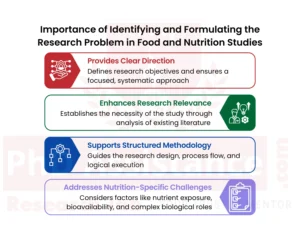
What makes nutrition questions different
Lichtenstein et al. (2008) set out considerations that distinguish nutrition questions from drug questions when systematic reviews are planned. The same considerations apply when you formulate a problem for a primary study, because they determine how the population, exposure and comparison must be defined.
| Consideration | Why it matters | How it shapes the problem statement |
|---|---|---|
| Baseline exposure | Nutrients come from diet, supplements, fortified foods and sometimes endogenous synthesis, so no one is unexposed | Define the comparison as a level of intake or status, and plan to measure background intake |
| Nutrient status | Response often depends on starting status; people who are replete may show little effect | Specify the status of the target population, or test whether effects differ by status |
| Bioavailability | Chemical form, food matrix and other dietary components change how much is absorbed and used | Name the form and vehicle, and record factors that enhance or inhibit absorption |
| Multiple functions | A nutrient can act on several systems, with benefits for one outcome and risks for another | Choose primary and secondary outcomes deliberately and consider safety outcomes |
| Undefined intervention | "Diet", "food" or "supplement" can mean many different exposures | Define the exposure precisely enough that another researcher could reproduce it |
| Dose and duration | Effects may follow a non-linear dose-response and take time to appear | Justify the dose range and duration from physiology and previous studies |
Working through each consideration
Baseline exposure
In a drug trial the control group usually receives none of the active substance. In nutrition, the control group still eats. For some nutrients the body also makes its own supply, as with vitamin D from sunlight. Your problem statement should therefore compare levels of exposure, and your design should measure background intake, bearing in mind that self-reported diet is prone to bias, including social desirability bias (Hebert et al., 1995).
Nutrient status
Someone who is deficient may respond strongly to extra intake, while someone who is replete may not respond at all. A problem framed for "adults" may therefore produce a null result that hides a real effect in a deficient subgroup. Decide whether your question concerns a population at risk of low status, and whether you will measure status with a biomarker at baseline.
Bioavailability
The same amount of a nutrient can be absorbed to very different degrees depending on its chemical form, the food matrix in which it is eaten and what else is in the meal. Iron is a familiar example: the form found in meat is generally absorbed more readily than the form in plant foods, and other dietary components can enhance or inhibit absorption. Specify the form and vehicle in your research question. Where bioavailability is uncertain, consider measuring a status biomarker during the study as well as intake, so that you can tell whether the exposure actually changed what reached the tissues.
Multiple and interrelated functions
Many nutrients influence several physiological systems and interact with other nutrients. A question about one outcome should acknowledge the others, both to choose secondary outcomes and to consider possible harms at higher intakes. It also affects interpretation: if a nutrient improves one marker but worsens another, the research problem should make clear which balance of effects matters for the population you study.
The undefined nature of the intervention
Whole foods, dietary patterns and supplements are complex exposures. Even a single category can hide variation: an expert consensus on probiotics, for instance, stresses that effects are specific to the microbial strains and amounts given (Hill et al., 2014). State what exactly is given or measured, how much, how often and for how long.
Dose and duration
Nutrient effects often do not rise in a straight line with intake. Benefits may appear only below a threshold of status, level off once needs are met, and give way to adverse effects at high intakes. A problem statement should therefore say which part of the intake range it concerns and justify the dose from physiology, dietary reference values and earlier studies. Duration matters as well: changes in body stores, tissue composition or clinical outcomes can take months, so a short study may answer a different question from the one you intended.
Checking the problem against evidence and practicalities
Before committing to a problem, search for systematic reviews and registered trials on the same question. If a recent review has found consistent results, a further small study is unlikely to add much; if it reports inconsistent findings because studies ignored baseline status or used different doses, your problem can be framed around that weakness. This is how a gap becomes a justified research problem rather than an assertion (Chalmers et al., 2014).
Then test feasibility honestly. Nutrition studies face particular practical problems: participants' adherence to diets or supplements over long periods, the difficulty of blinding whole-food interventions, seasonal variation in some exposures, and the cost of biomarker measurement. Dietary assessment tools also differ in burden and accuracy, so the tool you can afford shapes the question you can answer (Metallinos-Katsaras & Beto, 2025). Feasibility is not the only criterion, but a problem that cannot be studied within a doctorate needs reframing before the proposal is submitted.
Worked example (illustrative)
A hypothetical doctoral researcher begins with a broad interest: "Does vitamin D help muscle strength in older people?" Working through the considerations, she refines it step by step.
| PICO element | Broad version | Refined version |
|---|---|---|
| Population | Older people | Community-dwelling adults aged 70 and over with low vitamin D status at baseline |
| Intervention | Vitamin D | A stated form and daily dose of vitamin D for a stated duration, alongside usual diet |
| Comparison | No vitamin D | Placebo, with background intake and sun exposure measured in both groups |
| Outcome | Muscle strength | Grip strength as primary outcome; falls and serum status as secondary outcomes |
The refined problem now addresses status, exposure, form, dose and duration, and its FINER appraisal is easier: she can judge feasibility from recruitment numbers, novelty from recent systematic reviews and relevance from clinical guidelines (Hulley et al., 2013). If she chose an observational design instead, she would plan reporting against STROBE-nut, which adds nutrition-specific items such as how diet was assessed (Lachat et al., 2016).
Writing the problem statement
- State the health or food-system issue and why it matters.
- Summarise what is known, citing the most recent reviews, and identify the specific gap.
- Define population, exposure or intervention, comparison and outcome, including status, form and dose.
- Explain why the gap matters for practice, policy or theory.
- State the research question and, if appropriate, the hypothesis.
If your study uses surveys or dietary questionnaires, plan validated instruments and sampling early, because they shape what questions you can answer (Metallinos-Katsaras & Beto, 2025).
Common mistakes
- Treating the control group as unexposed and ignoring background intake.
- Recruiting a replete population and then concluding that a nutrient has no effect.
- Naming a nutrient without its form, dose, vehicle or duration.
- Choosing a single outcome without considering other functions or possible harms.
- Judging a problem only by feasibility rather than by all the FINER criteria (Hulley et al., 2013).
For related reading, see research problem identification in medical science, the importance of problem identification, survey methodology in nutrition research and the research-gap briefs on nutrition trials for muscle loss and nutrition and sarcopenia in type 2 diabetes.
Key takeaways
- A precise research problem guides the review, design and analysis and helps avoid research waste (Chalmers et al., 2014).
- Use FINER to appraise the question and PICO to structure it (Hulley et al., 2013; Farrugia et al., 2010).
- In nutrition, account for baseline exposure, nutrient status, bioavailability, multiple functions and the nature of the intervention (Lichtenstein et al., 2008).
- Specify form, dose, vehicle and duration so that the exposure can be reproduced (Hill et al., 2014).
- Plan dietary assessment and reporting with nutrition-specific guidance (Lachat et al., 2016; Hebert et al., 1995).