
Critical Review of Survey Methodology for Data Collection and Analysis in Nutrition and Dietetics Research
Introduction
The article by Metallinos-Katsaras and Beto (2025) presents a detailed study about survey methodology, which researchers use in their fieldwork for nutrition and dietetics research because it helps produce trustworthy data that supports evidence-based practice. Researchers in nutrition science use survey-based research as their primary method to study dietary habits, health practices and nutritional patterns that exist in entire populations. The authors present Survey methodology in nutrition and dietetics research methods that help scientists gather important data from people and groups to enhance decision-making processes in both clinical environments and public health situations.
The study establishes that effective survey development for nutrition research studies serves as the essential component that enables researchers to achieve their highest measurement accuracy. The first outcome produces false results, while the second outcome generates misleading interpretations that lead to wrong conclusions that most affect health recommendations and policy decisions. The article shows that dietetics research needs powerful data analysis techniques because research outcomes depend on the precision of collected data, which establishes methodological accuracy as an essential requirement. The authors demonstrate how measurement error and respondent bias, together with validity and reliability issues in survey research, create substantial challenges that undermine the research study’s trustworthiness and practical value.
Summary of the article
The article provides a comprehensive survey of how nutritional dietetics research utilises survey methods for their research, through which they establish study design and execution and research analysis through survey-based research. The research identifies essential factors that determine the successful execution of survey research.
The authors demonstrate through their evaluation of existing research methods for designing nutrition surveys, which require researchers to establish specific research objectives and develop conceptual frameworks and design structured questionnaires. The study shows that researchers must choose their survey questions with precise language because this choice will determine their ability to maintain consistency throughout their study while achieving accurate results. The research study shows that pretesting and cognitive interviewing processes serve as essential methods for enhancing survey instruments while reducing the likelihood of research errors.
The second area of research examines the impact of sampling methods, which determine how well nutrition studies maintain study population representation. The article distinguishes between probability and non-probability sampling methods, which both have their own advantages and disadvantages. Probability sampling provides better generalisation results because researchers consider it more reliable than non-probability sampling, which they use for practical needs, although it has drawbacks.
Critique
Significance and contribution of the field
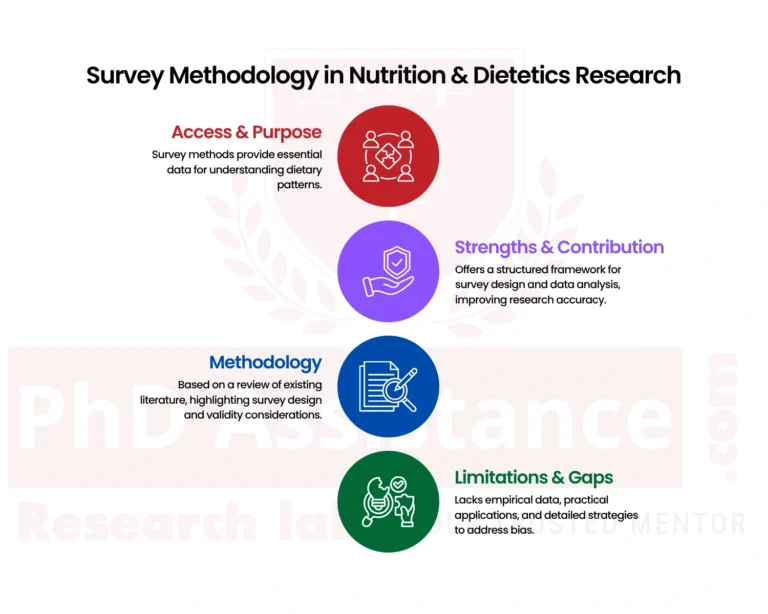
The article makes a significant contribution to the understanding of survey methodology in nutrition research by providing a structured and detailed framework for conducting survey-based studies. The study demonstrates that proper research methods must be applied because they create accurate data, which researchers need to advance their work in nutrition and dietetics.
The research study demonstrates its primary strength through its execution of multiple research components, which include Survey design in nutrition research, its methods of choosing study participants and its procedures for processing study data. The research study enables readers to comprehend survey methodology through its demonstration of how different survey elements combine to produce research findings. The article presents a scholarly contribution to research governance and risk management because it demonstrates the importance of achieving proper data quality through error reduction.
The study investigates theoretical concepts, but it does not provide enough information about practical applications. The document offers useful research principles, but it fails to demonstrate their actual research application across various research contexts, while researchers face operational difficulties during their survey research work.
Methodology and research design
The article presents its findings through a methodological review, which prevents the study from demonstrating direct proof of the proposed methods. The authors use existing literature together with established principles to describe how researchers select samples in nutrition studies and survey development work.
The research offers a full study of its subject matter, which requires scientific validation through testing. The research needs primary data and case studies to demonstrate how its methodologies operate in actual situations. The study misses important statistical evaluations, which would have enhanced its Data analysis in dietetics research.
The article establishes a solid basis that researchers can use to learn about survey research methods despite its existing restrictions. The resource presents complete survey development and implementation procedures, which help researchers and practitioners in their work.
Argumentation and Use of Evidence
The authors present a well-structured argument that emphasises the importance of proper survey design and implementation in achieving accurate research outcomes. The survey research debate on Validity and reliability in survey research establishes strong foundations because it describes various validity types that researchers need to maintain data integrity.
The study gains credibility through its use of national surveys and dietary data collection methods as examples. The researchers conducted survey research in actual fieldwork through their examples, which demonstrated both the strengths and weaknesses of their research method. The article requires additional critical examination, which should focus on assessing standard survey techniques against new technological developments.
The study investigates bias problems that affect nutrition survey research, which includes both recall bias and social desirability bias. The researchers acknowledge the challenges, but their explanation fails to provide enough details about the appropriate methods to address these biases in their research.
Ethical considerations and omissions
The article briefly examines two topics, which include data accuracy and respondent behavior because these factors directly connect to bias in nutrition survey research. The study shows that self-reported data gets shaped by different factors, which include memory errors and social desirability.
The study examines only a limited number of ethical aspects that it will investigate. The study fails to deliver a comprehensive assessment of informed consent processes and data privacy protection, and the ethical consequences of employing self-reported dietary assessment methods. Researchers need to pay more attention to these elements because current research practices use digital tools and large datasets.
The study requires more research about ethical considerations, which would enhance its significance and deliver an objective assessment of survey techniques.
Writing Style and Structure
The article presents a structured organisation that contains distinct sections which help readers navigate through various components of survey methodology used in nutrition and dietetics research. The document presents information in a logical order, which enables readers to understand the content better, while headings and examples help to make the text more understandable.
The language used is generally clear and accessible, making complex concepts understandable for a wide audience. The text contains sections that include technical terms, which present difficulties for readers who lack research method knowledge. The text would become easier to understand if certain explanations were made simpler and more real-world examples were provided.
Conclusion
The article presents a detailed overview of survey methodology used in nutrition and dietetics research because it requires researchers to follow proper design, sampling, and analysis methods. The research demonstrates how survey design and Sampling techniques in nutrition research and survey research validity and reliability assessment work together to produce accurate data.
The research study achieves its main goal through its research outcomes, but the study encounters problems because it does not provide enough proof and presents only a short overview of both ethical and technological improvements. The researchers need to focus their upcoming work on three main goals, which include creating solutions that reduce bias in nutrition research, establishing improved dietary assessment techniques and implementing new technologies for enhanced dietetics research data analysis.
The article serves as a resource that helps both researchers and practitioners because it provides essential survey methodology insights while demonstrating to researchers their development needs and areas that need improvement.
Reference
Metallinos-Katsaras, E., & Beto, J. A. (2025). Survey methodology for data collection and analysis in nutrition and dietetics research. Journal of the Academy of Nutrition and Dietetics, 125(5), 615–629. https://doi.org/10.1016/j.jand.2024.06.002.