
Call for Papers: Non-transcriptional role of mRNAs and transcriptional roles of noncoding RNAs in gametes, development, and pathology
Introduction
Developmental Biology invites contributions to a Special Issue examining emerging functions of RNA in gametes, development, reproduction, and pathology. The issue, titled “Non-Transcriptional Role of mRNAs and Transcriptional Roles of noncoding RNA in Gametes and Development and Pathology,” brings together research that challenges conventional views of RNA function and explores how RNA molecules can participate in biological processes beyond their established roles.
The Special Issue calls for research papers, reviews, and other types of papers. Of special interest are the papers that offer new information on mechanisms and functions. The deadline for submissions is 01 August 2027. Authors should refer to the journal’s submission and paper writing guidelines.
mRNAs have traditionally been studied as templates for protein synthesis. However, some mRNAs also perform structural and regulatory functions independent of protein production. Similarly, some transcripts traditionally classified as noncoding have been shown to encode functional peptides, expanding our understanding of RNA regulation.
Why publish in this issue?
In this Special Issue, researchers can place their research in a new field of study in RNA biology.
Key advantages:
Scope
Contributions are invited for original research articles, review articles and other relevant studies investigating the non-transcriptional roles of mRNAs and translational functions of noncoding RNAs in gametes, development and pathology.
Contact PhD Assistance Research Lab today for manuscript preparation and submission support tailored to Scopus- and PubMed-indexed journals.
Know More About This Issue
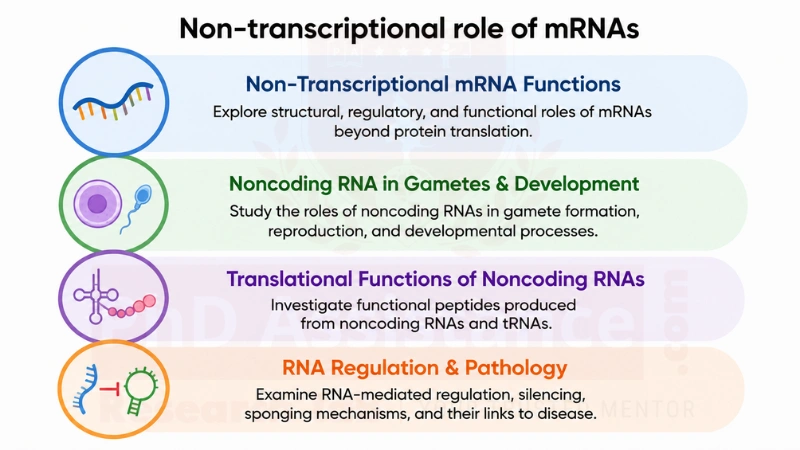
Recent discoveries have challenged the conventional view that mRNAs function primarily as templates for protein synthesis. Evidence of structural and regulatory functions has shown that RNA sequence and higher-order structures can contribute directly to cellular processes.
At the same time, research on noncoding RNAs and tRNAs has revealed previously unrecognised translational functions, including the production of short peptides with potentially important biological roles.
This Special Issue aims to bring together researchers investigating these emerging RNA functions and their implications for gamete biology, reproduction, development, and disease. Mechanistic studies, functional investigations and research exploring new RNA-mediated regulatory processes are particularly encouraged.
Key factors
How We Support Your Submission
PhD Assistance Research Lab provides research and publication support to help researchers prepare manuscripts for submission to suitable journals and Special Issues. Our services focus on improving manuscript quality, clarity, presentation, and submission readiness.
Our services include:
1. Scientific Manuscript Writing and Editing
Problem: Scientific research is complicated to describe.
Solution: Technical writing, editing and polishing of content.
Value: The production of a well-crafted manuscript.
2. Research Design & Methodology
Problem: Research methodology may require improvement or a better fit to the research problem.
Solution: Guidance on methodology and research design.
Value: More systematic research.
3. Journal Formatting & Manuscript Structuring
Problem: The manuscripts might fail to adhere to certain journal specifications.
Solution: Organisation and structuring using the pertinent guidelines.
Value: Increased submission preparedness.
4. Academic Language Editing & Proofreading
Problem: Language issues can affect clarity and readability.
Support: Academic editing and detailed proofreading.
Value: Clearer, more consistent scientific communication.
5. Pre-Submission Review & Submission Support
Problem: Manuscripts may have gaps before submission.
Support: Final manuscript review and submission-document preparation.
Value: A more organised and confident submission process.
Our publication experts can guide researchers to prepare their manuscripts in accordance with the requirements of the Special Issue “Non-Transcriptional Role of mRNAs and Transcriptional Roles of Noncoding RNAs in Gametes, Development, and Pathology.
Journal Indexing and Submission Information
Authors should refer to the journal’s official website and the relevant indexing databases for the most current information about journal indexing, eligibility, article types, submission requirements, and publication policies. Indexing status may change over time and should be independently verified by authors before submission.
Journal Guidelines:
Verify the latest author guidelines before submission
If you are a researcher working on mRNA, noncoding RNA, RNA regulation, gamete biology, reproduction, development or RNA-associated pathology, this Special Issue provides an opportunity to contribute to an emerging area of molecular research.
Is My Paper a Fit?
Your manuscript may be a good fit if it:
Check Your Manuscript’s Fit for This Special Issue
Get guidance on your manuscript’s scope, structure, and submission readiness for this Special Issue. The free guide covers manuscript preparation, formatting, Peer review, and submission readiness.
FAQs:
- What is AI’s role in developmental disability research?
AI supports the assessment, prediction, monitoring, and analysis of developmental disabilities.
It can also enable personalised and data-driven approaches to research and care. - How can AI support developmental disability interventions?
AI can provide adaptive interventions, personalised learning, digital therapies, and intelligent support systems.
These technologies can help improve independence, functioning, and overall well-being. - What AI approaches can researchers use?
Researchers can use machine learning, predictive analytics, multimodal AI, robotics, and intelligent systems.
These approaches can support assessment, intervention, monitoring, and outcome prediction. - What are AI applications in developmental disabilities?
AI can be applied to screening, diagnosis, assessment, prediction, intervention, and continuous monitoring.
It can also support assistive technologies and personalised developmental care. - How can AI improve developmental disability research?
AI can improve data analysis, early identification, prediction of outcomes, and personalised support.
It can also help researchers integrate complex and longitudinal data more effectively.
Reference
Elsevier. (2026). Call for papers: Non-Transcriptional Roles of mRNAs and Transcriptional Roles of Noncoding RNAs in Gametes, Development, and Pathology. Developmental Biology | ScienceDirect.com by Elsevier – Developmental Biology | ScienceDirect.com by Elsevier