
What makes a medical thesis different
Doctoral theses in medicine, health care and the life sciences share the structure of theses in other fields, but three features stand out. Most empirical work involves human participants, patient data, tissue or animals, so approvals are part of the scientific record. Each study design has an internationally agreed reporting guideline that examiners and journals expect. And conclusions carry clinical implications, so they must be stated with care.
That is not how clinical science works. Trials and observational studies estimate effects with uncertainty, results can be overturned, and much of medicine rests on evidence that is graded rather than settled. Writing that reflects this is more convincing to examiners, not less.
A doctorate is also a training degree. It requires an original contribution, a systematic command of the field and the ability to conceive and carry out research (QAA, 2020). Former students' advice to keep a sense of proportion, treating the thesis as an apprenticeship rather than a life's masterpiece, is consistent with how experienced examiners describe their expectations (Mullins & Kiley, 2002).
Before writing: regulations, protocols and approvals
Read your university's thesis regulations first. They set the word limit, the permitted formats (a traditional monograph or a thesis including published papers), the declaration of your own contribution and the examination procedure. The original tip to "strictly follow PhD requirements" remains the most important one.
- Ethics. Research involving human participants, identifiable data or human tissue should follow the Declaration of Helsinki, revised in 2024 (World Medical Association, 2025), and needs approval from a research ethics committee before it starts.
- National approvals. Requirements depend on the country and setting. In England, for example, research involving the NHS generally needs HRA Approval in addition to ethical review (Health Research Authority, 2026).
- Protocols and registration. For a randomised trial, write a protocol using SPIRIT 2025 (Chan et al., 2025) and register the trial before recruitment; record the registration number in the thesis.
Write these approvals into the methods of each chapter, with committee names, reference numbers and dates, and place approval letters in an appendix if your regulations allow.
Structure and reporting guidelines
Most medical and life sciences theses follow the order shown in Figure 1: preliminary pages, introduction, literature review, methods, results, discussion, conclusion, references and appendices. In a thesis with several studies, each empirical chapter often has its own methods, results and discussion, linked by an introduction and a general discussion.
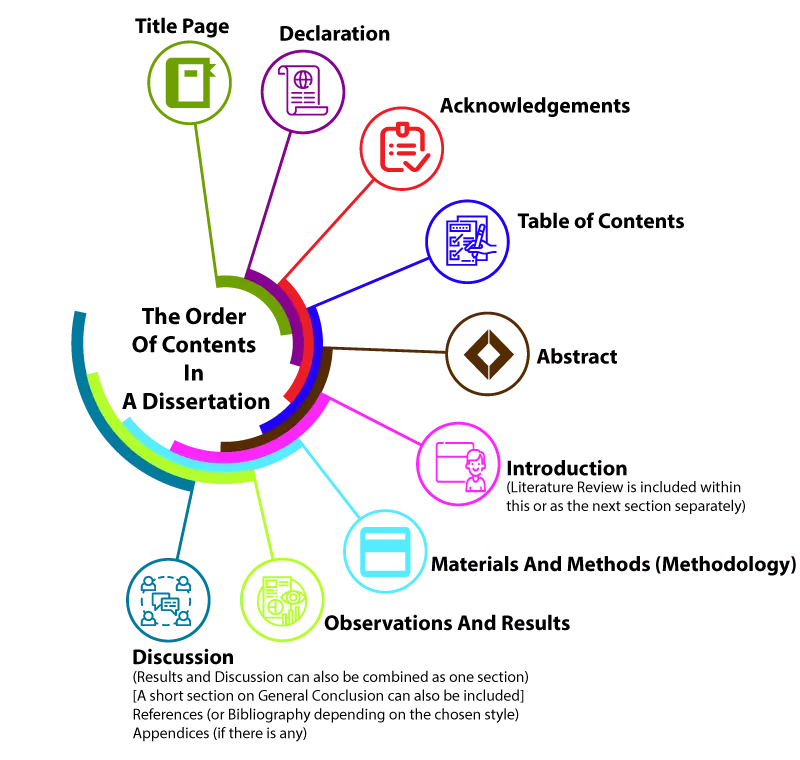
For each empirical chapter, identify the reporting guideline for its design and use its checklist as you write, not after. The table lists the main ones.
| Study design | Reporting guideline | Note |
|---|---|---|
| Randomised trial | CONSORT 2025 (Hopewell et al., 2025) | Replaces CONSORT 2010 (Schulz et al., 2010); check which version your examiners or target journal use |
| Trial protocol | SPIRIT 2025 (Chan et al., 2025) | Use when the protocol is a chapter or appendix |
| Cohort, case-control or cross-sectional study | STROBE (von Elm et al., 2007) | Report sources of bias and how confounding was handled |
| Systematic review or meta-analysis | PRISMA 2020 (Page et al., 2021) | Include the flow diagram and the search strategy |
| Interviews or focus groups | COREQ (Tong et al., 2007) | Report the researcher's role and how themes were derived |
| Prediction model, including machine learning | TRIPOD+AI (Collins et al., 2024) | Report validation and calibration, not discrimination alone |
| Statistical methods and results (any design) | SAMPL (Lang & Altman, 2015) | Basic rules for reporting statistics |
If your thesis includes published papers
Many medical schools allow a thesis that includes published or submitted papers. The papers already follow a reporting guideline, but the thesis still needs its own introduction, linking text and general discussion that show how the studies form one coherent piece of work. Check what your regulations say about co-authored papers: you will usually need a statement of your own contribution to each, agreed with your co-authors, and the examiners will question you on all of it, including parts led by others. Reformat the papers consistently and avoid repeating the same background in every chapter.
Laboratory and animal work needs the same transparency. Report the source of cell lines, reagents and animals, the licences under which the work was done, sample sizes and how they were decided, and whether outcome assessment was blinded. Keep raw data and analysis code organised so that an examiner's question about a figure can be answered from the record.
A short glossary of medical terms and abbreviations, which the original tips recommended building as you go, is worth keeping as a front-matter list. It also helps you use terms consistently across chapters.
Presenting results and writing conclusions
Report what you found before what it means. For each outcome, give the estimate, its confidence interval and the number analysed; p-values may be added but should not replace effect sizes (Lang & Altman, 2015). State how missing data were handled and report the flow of participants or samples through the study, as the relevant guideline requires (Hopewell et al., 2025; von Elm et al., 2007). Use tables for exact values and figures for patterns, and make every table and figure understandable on its own.
In the discussion, interpret the findings against previous work, state limitations honestly and avoid claims the design cannot support. Examiners look for results discussed in relation to previous work and for limitations stated honestly (Mullins & Kiley, 2002), and they often read the introduction and conclusion together to judge whether the thesis delivered what it promised (Golding et al., 2014).
The final tip from former students, to identify unanswered questions in the conclusion, is sound. Make them specific: name the population, design or measurement that a next study would need, and explain why your findings point there.
Be careful with clinical implications. A single observational study rarely justifies a change in practice, and a laboratory finding in cells or animals is a reason for further work, not a treatment recommendation. Say what level of evidence your findings add and what would be needed before they could inform care.
Worked example (illustrative)
A thesis on physical activity after cardiac rehabilitation has three studies: a systematic review, a cohort study using hospital records and an interview study with patients. The review chapter follows PRISMA 2020 and includes a flow diagram; the cohort chapter follows STROBE, reports adjusted estimates with confidence intervals and discusses confounding; the interview chapter follows COREQ. The general discussion integrates the three, and the conclusion names one question the thesis could not answer: whether a tested intervention changes activity, which would need a trial reported to CONSORT 2025. The thesis is hypothetical.
Practical habits from former doctoral students
Ten tips, grouped by when they help:
| Stage | Tip | How to apply it |
|---|---|---|
| Planning | Choose the right topic and write a proposal first | A proposal fixes the question, designs and approvals before data collection |
| Planning | Follow the university requirements | Read the regulations and examination procedures in your first months |
| Planning | Keep perspective: the thesis is an apprenticeship | Aim for a coherent, competent contribution, not a perfect one |
| Writing | Use your own voice and style | Write clearly in your own words; keep a consistent style across chapters |
| Writing | Construct a definite structure; list required terms | Draft a chapter plan and a glossary early |
| Writing | Use apps and boards | Track deadlines, references and ideas with tools you will keep using |
| Writing | Know when to end | Stop collecting data and refining when your questions are answered; agree the endpoint with supervisors |
| Concluding | Address unanswered questions | Name specific future studies in the conclusion |
| Examination | The viva matters | Prepare to explain and defend every chapter |
| Throughout | Do not procrastinate | Set small weekly writing targets from the first year |
Common mistakes
- Missing approval details, or approvals that do not cover all the data used.
- Reporting a trial to an outdated guideline without explanation (Hopewell et al., 2025).
- Presenting p-values without estimates and confidence intervals (Lang & Altman, 2015).
- Causal language in the discussion of an observational study (von Elm et al., 2007).
- A conclusion that introduces new results or claims not supported in the chapters (Golding et al., 2014).
For the viva itself, see how to prepare for your PhD viva; for qualitative studies in medicine, see qualitative research in medicine and health care; and for writing the results chapter in general, see how to write the results chapter.
Key takeaways
- Medical evidence is probabilistic; write results and conclusions with their uncertainty.
- Document ethics, national approvals and trial registration in each chapter (World Medical Association, 2025; Health Research Authority, 2026).
- Use the current reporting guideline for each design, including CONSORT 2025 for trials (Hopewell et al., 2025).
- Report effect sizes with confidence intervals, not p-values alone (Lang & Altman, 2015).
- Examiners expect coherence, competence and honest limitations, not perfection (Mullins & Kiley, 2002; Golding et al., 2014).