
What the SOR framework says
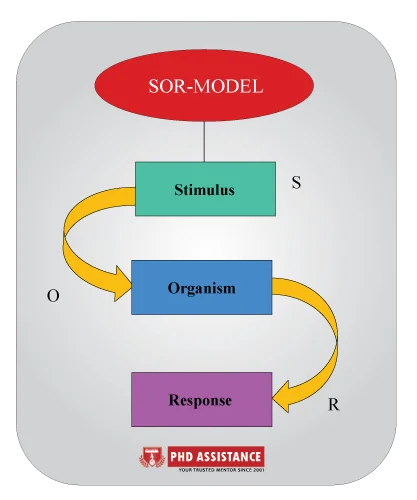
Early behaviourist accounts described behaviour as a direct response to a stimulus, as in Pavlov's work on conditioned reflexes in the early twentieth century. The stimulus-organism-response (S-O-R) formulation, usually credited to the psychologist Robert Woodworth, inserted the organism between the two: the same stimulus produces different responses because people differ in what they perceive, feel and think.
- 1Stimulus: features of the environment or offer (e.g. store design, chatbot empathy, price display)
- 2Organism: internal cognitive and affective states (e.g. pleasure, arousal, trust, perceived value)
- 3Response: approach or avoidance behaviour (e.g. intention to buy, time spent, reliance, resistance)
In consumer research the framework usually enters through environmental psychology. Mehrabian and Russell (1974) proposed that environmental stimuli shape three emotional states, pleasure, arousal and dominance (often abbreviated PAD), which in turn lead to approach or avoidance behaviour. Donovan and Rossiter (1982) applied this approach to store atmosphere, and Eroglu et al. (2001) extended it to online retailing, treating website design as the stimulus. Jacoby (2002) later revisited S-O-R as a general model of consumer behaviour, arguing for a fuller treatment of the organism than early stimulus-response accounts allowed.
Where SOR is used today
SOR has become one of the most common frameworks in marketing, tourism and information systems. A bibliometric analysis of 427 open-access, English-language management documents indexed in Scopus found that publications rose sharply from 2019, with purchase intention the most studied outcome and digital platforms, live streaming and tourism among the main contexts (Sumardi et al., 2025). The same analysis suggested social presence, interactivity and sentiment as under-explored stimuli.
Typical applications include impulse buying in retail environments, where hedonic motivation links store stimuli and responses (Chang et al., 2011), virtual reality tourism, where an extended model linked VR experience to attitudes and visit intentions (Kim et al., 2020), and conversational agents in e-commerce (Cheng et al., 2024). Other applications include social media engagement, mobile auctions, healthcare service design and hotel booking, all areas in which SOR models have been applied.
Turning S, O and R into constructs
The framework does not tell you which variables to use. You choose them from your context and from theory, then define and measure each one.
| Component | What it represents | Example constructs | Measurement notes |
|---|---|---|---|
| Stimulus | Features the researcher can describe or manipulate | Atmospherics, website design, chatbot empathy and friendliness, social presence, price cues | Measure perceived features with validated scales, or manipulate them in an experiment |
| Organism | Internal states that the stimulus changes | Pleasure and arousal, trust, perceived value, flow, perceived risk | Separate cognitive and affective states; adapt established scales and pretest them |
| Response | Approach or avoidance behaviour | Purchase or visit intention, reliance, resistance, word of mouth, actual purchases | Prefer observed behaviour where possible; intentions are a weaker proxy |
| Boundary conditions | Factors that change the strength of paths | Task complexity, disclosure, involvement, prior experience | Specify which path each moderator affects and why |
Two clarifications prevent common confusion. First, a perceived stimulus (how friendly a respondent thinks a chatbot was) is not the same as an organism state (how much the respondent trusts it); keep them as separate constructs with distinct items. Second, response does not have to be positive: avoidance responses, such as resistance, are part of the original framework (Mehrabian & Russell, 1974).
SOR, TAM and UTAUT
It is sometimes claimed that SOR suits consumer adoption decisions better than the technology acceptance model (TAM) or the unified theory of acceptance and use of technology (UTAUT). That claim is not supported as a general rule. TAM explains use through perceived usefulness and ease of use (Davis, 1989), and UTAUT through performance expectancy, effort expectancy, social influence and facilitating conditions (Venkatesh et al., 2003). These models specify their constructs; SOR specifies only a structure. SOR is useful when the research question is about how features of an environment work through internal states, including emotions, which acceptance models do not centre. Many studies combine the two, using acceptance constructs as organism states. Choose by question, and say why.
Choosing stimuli and organism states for your context
Because the framework is open, the quality of an SOR thesis depends on the choice of constructs. Start from the setting. In a physical store, stimuli are ambient (music, lighting, crowding), design-related (layout) or social (staff); online, they are features of the interface, the content and other users; in services involving agents or chatbots, they are features of the interaction. List candidate stimuli from observation, practitioner sources and earlier studies, then keep only those that your question needs and that you can define precisely.
For the organism, decide whether your argument is mainly affective, as in the PAD tradition (Mehrabian & Russell, 1974), mainly cognitive (perceived value, risk, trust), or both. Including both is common, but then you must say how they relate: does emotion shape evaluation, or the reverse? An explicit answer turns a list of mediators into a model.
Finally, choose responses that matter for the research problem and, where possible, can be observed. Purchase intention is the most studied outcome (Sumardi et al., 2025), partly because it is easy to measure. Behavioural data, such as click-through, time spent or purchases recorded by a partner organisation, make a stronger contribution and reduce reliance on self-report.
Designing and analysing an SOR study
- State the question in SOR terms. Which stimuli, acting through which internal states, lead to which responses, in which setting?
- Justify each path. Use theory and prior evidence for every hypothesised link, not the framework alone.
- Choose the design. Surveys can test associations; experiments that manipulate the stimulus give stronger evidence that it causes changes in the organism and response.
- Measure carefully. Adapt validated scales, pretest them and plan procedural remedies for common method variance, such as separating measures and protecting anonymity (Podsakoff et al., 2003).
- Analyse the model. Structural equation modelling is standard. If you use PLS-SEM, report reliability, convergent validity and discriminant validity, including the heterotrait-monotrait ratio, before the structural model (Hair et al., 2019; Henseler et al., 2015).
- Test mediation and moderation explicitly. Report indirect effects with confidence intervals, and interaction terms with plots.
An experiment fits the logic of SOR particularly well, because the stimulus is something the researcher can vary. Showing participants two versions of a website, an advertisement or a chatbot script that differ in one feature, then measuring organism states and responses, gives cleaner evidence for the first path of the model than any survey can. Include a manipulation check to show that participants noticed the difference, and keep everything else constant. A survey and an experiment together, testing the same model, make a strong doctoral design.
Worked example: how one study operationalised SOR
Cheng et al. (2024) studied text-based chatbots in Chinese e-commerce. The stimuli were two chatbot attributes, empathy and friendliness; the organism was trust in the chatbot; and the responses were reliance on the chatbot (approach) and resistance to it (avoidance). Task complexity and chatbot disclosure were tested as moderators. Each construct was measured with three items adapted from earlier studies (two for disclosure) on seven-point scales, after a 30-person pretest. Of 441 responses, 299 were usable. The authors assessed the measurement model and common method variance in SmartPLS and tested hypotheses with regression using mean-centred interaction terms.
The study shows the main design choices: a clear split between perceived features and internal states, both approach and avoidance responses, and moderators tied to specific paths. Its cross-sectional survey design is also typical, and limits causal claims.
Adapting it to a thesis (illustrative)
A hypothetical doctoral project on live-streaming commerce could treat streamer interactivity and social presence as stimuli, which the bibliometric evidence suggests are under-studied (Sumardi et al., 2025); arousal and trust as organism states; and purchase intention and actual purchases, from platform data where consent allows, as responses. A first study would test the model with a survey and PLS-SEM; a second would manipulate interactivity in an online experiment to test whether it changes trust and purchase intention. No results are implied.
Common mistakes
- Treating SOR as a theory that justifies every path without further argument.
- Measuring stimulus and organism with overlapping items, which inflates the paths between them.
- Using only intentions as the response when behaviour could be observed.
- Collecting all constructs from one respondent at one time without addressing common method variance (Podsakoff et al., 2003).
- Claiming causal mediation from a cross-sectional survey.
- Citing a reprint date as the date of an idea, or misspelling founding authors.
| Report | Why |
|---|---|
| Definitions and sources of all S, O and R constructs | Shows how the framework was operationalised |
| Measurement model results | Reliability and validity must hold before paths are interpreted (Hair et al., 2019) |
| Discriminant validity (e.g. HTMT) | Stimulus and organism constructs are often highly correlated (Henseler et al., 2015) |
| Indirect effects with intervals | Mediation through the organism is the core claim of the model |
| Design limitations | States which conclusions the design supports |
Key takeaways
- SOR places internal states between stimuli and behaviour; consumer research usually builds on Mehrabian and Russell's environmental version (Mehrabian & Russell, 1974; Donovan & Rossiter, 1982).
- The framework gives structure, not hypotheses, so every path needs its own justification (Jacoby, 2002).
- Separate perceived stimuli from organism states and include avoidance as well as approach responses (Cheng et al., 2024).
- SOR and acceptance models answer different questions and are often combined (Davis, 1989; Venkatesh et al., 2003).
- Report measurement quality, discriminant validity and indirect effects, and address common method variance (Hair et al., 2019; Henseler et al., 2015; Podsakoff et al., 2003).