

Call for papers: educational leadership, management, and policy for preparing the future workforce
January 22, 2026Global Virtual Work Dissertation Topics
January 23, 2026Identifying Original, Theoretically Grounded, and Methodologically Rigorous Law PhD Topics for Research Scholars in Germany
- January 23, 2026
- Topic Selection
Introduction
Choosing a topic for doctoral research is one of the most critical phases of a PhD journey, and especially so in the very structured and theory-driven legal education in Germany. The PhD Topic Selection for Law in Germany implicitly requires scholars to be original, clear in concepts and rigorous in methodology from the very beginning of the proposal.
German universities mandate that the titles of research projects be deeply rooted in legal theory, doctrinal reasoning or systematic legal analysis. By means of professional PhD Assistance, research scholars can metamorphose broad legal interests into narrow, approval-ready doctoral research topics that cohere with the academic expectations of Germany.
An apt PhD research topic boosts the probability of proposal approval, good supervisor alignment, and subsequent publication in prestigious legal journals substantially. In the German legal research context, the selection of a topic is not purely an administrative action but a strategic one that determines the whole doctoral process.
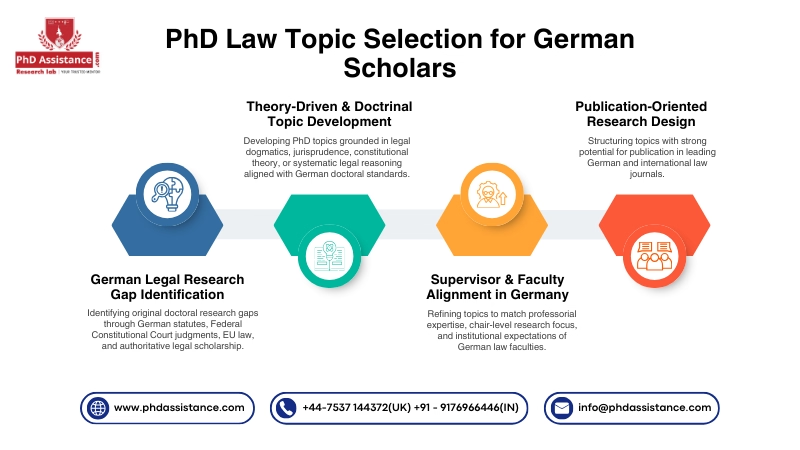
Understanding German Expectations in Law PhD Topic Selection
Germany’s law doctoral programmes are marked by a considerable amount of theoretical depth, systematic legal reasoning, and, above all, academic independence. From the very beginning of the proposal phase, PhD students are required to show not only a clear research aim, but also a good knowledge of the legal literature already published, as well as the capacity to locate their research in the midst of the ongoing legal discussions.
Legal research topic selection Germany must identify a legal problem and then present the existing research gap and justify the academic and practical significance of the study. The law faculties in Germany particularly appreciate the consistency of concepts and the research’s contribution to legal dogmatics or to assenting legal theory.
The selection of legal research topics for professionals in Germany provides guidance for scholars to help them hone their research questions, reinforce their theoretical engagement, and showcase the applicability of the study in the context of the structured German doctoral framework.
Doctrinal Legal Research: The Backbone of German Law PhDs
In Germany, doctrinal legal research is still the major methodology for PhD candidates in law, particularly I n the domains of constitutional law, administrative law, private law, criminal law, commercial law, and EU law. The basic idea of this method is to carry out a thorough and critical investigation of the laws, courts’ and judges’ decisions, so that legal doctrines can be defined and sought.
A solid doctrinal PhD topic does not simply confirm what the law is; it also investigates legal contradictions, resolves uncertainties, and, through the application of normative and analytical approaches, it reconstitutes legal reasoning. Typically, one can find German PhD dissertation topics in law concerned with constitutional interpretation, fundamental rights, proportionality analysis, or doctrinal reform.
Besides, academic law PhD thesis topic guidance in Germany guarantees that doctrinal subjects are precisely focused for doctoral depth; however, they still retain their intellectual originality and are fit for publication in peer-reviewed legal journals.
Theoretical Legal Research and Jurisprudential Engagement
In German doctoral law research, theoretical engagement is the most important criterion for judging originality. Academic research that does not have a clear jurisprudential or theoretical framework is often regarded as unimportant and thus weak.
The majority of law PhD research topics in Germany are based on the theories of legal philosophy, constitutional theory, systems theory, natural law theory, or legal positivism for the interpretation of doctrinal structures and the enhancement of conceptual depth.
Professional PhD Assistance guarantees that the theoretical frameworks are deep-rooted in the whole research design, so they are never superficial, and thus the standards of German doctorates are met.
Example:
Journal: International Journal of Clinical Legal Education
Study: Hannah Franz (2023)
This empirical socio-legal research examines the role of clinical legal education (law clinics) in Germany and how they contribute to improved access to justice and human rights protection. The study highlights how German legal clinics offer practical skills to law students while providing legal support to marginalised groups, identifying both opportunities and institutional challenges for enhancing access to justice within German legal education and practice.
Socio-Legal and Empirical Approaches in German Law Research
Despite being the most significant, doctrine research in German legal scholarship is slowly yet surely moving towards socio-legal and empirical methods, the latter being mostly recognised in labour law, migration law, access to justice, environmental regulation, and regulatory governance, at the very same time.
Socio-legal research examines the functioning of law and the effect of legal norms on people, organisations, and society. Often, empirical data is used to support legal, doctrinal, and theoretical analyses.
In Germany, the systematic legal research topic selection assistance provided ensures that socio-legal and empirical doctoral projects are legally rooted, methodologically robust, and theoretically well-grounded in the German academic milieu.
Example:
Journal: German Law Journal
Study: Hendry et al. (2020)
This paper belongs to a special issue that examines the development of socio-legal research practices in Germany, the UK and other countries, focusing on methodologies for conceptualising law in social contexts. The studies brought together in this issue showcase wide-ranging socio-legal relationships — e.g. labour law, contract law and urban law — underlining that socio-legal research has significantly helped to reveal and understand the role of law in society.
Comparative Legal Research: Strengthening Scholarly Contribution
In the legal doctoral studies in Germany, up to a certain extent, comparative legal research is one of the most important methods used. This is mainly because Germany is very much involved with EU law and other international legal systems. Many Germany PhD dissertation topics in law take a comparative view to discuss the similarities and differences between German law and the law of other jurisdictions.
Nevertheless, it is still the case that comparative approaches are the most popular ones to research and reflect on legal issues in the areas of EU governance, human rights, corporate law and constitutional courts, among others.
By getting help with a law PhD thesis topic from the experts in Germany, the researchers will be able to develop their comparative studies in such a way that they will be rigorous in terms of analysis, clear in methodology, and will result in significant academic contributions.
Aligning Research Topics with Supervisory Expertise in Germany
In Germany, it is impossible to get a doctoral topic approved without having the right kind of academic supervision and the right expertise available. If the research idea is not in line with the professor’s research interests or department strengths, then it can be turned down even at the stage of well-developed research ideas.
PhD law topic selection in Germany means that one has to expertly convert his/her research ideas so that they fit both the institution’s research priorities and the particular supervisor’s expertise.
Professional PhD Assistance makes it easier to get acceptance, it improves the interaction of the supervisor, and it also decreases the chances of the topic being changed in the later stages of the PhD process.
Overcoming Common Law PhD Topic Selection Challenges
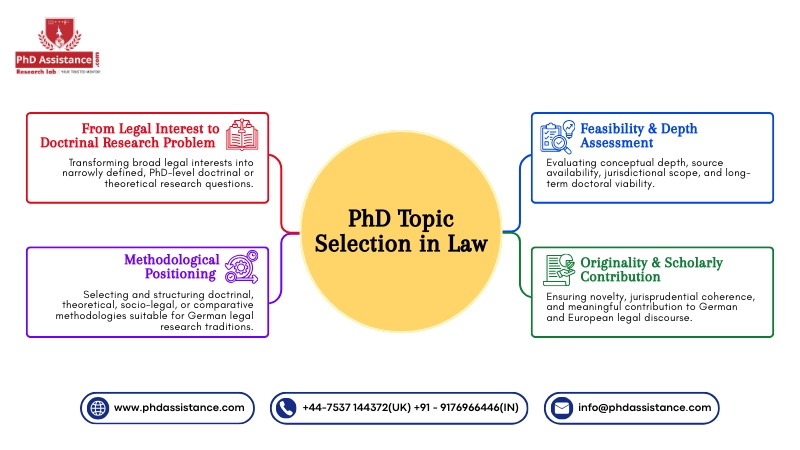
The issues of the choice of topic are common to the PhD law scholars in Germany, and they are the same as too broad research questions, a lack of proper theoretical foundations, no distinct legal research gaps, and the problem of choosing an appropriate methodology.
These difficulties often result in the modification of the proposal, delay in the admission process, or extended duration of the doctoral study.
The expert Law PhD thesis topic guidance Germany provides a literature survey, feasibility assessment, and conceptual refinement, thus ensuring that the topic is original, practical, and suitable for publication.
Conclusion
In Germany, the legal academic environment imposes strict requirements on the PhD topic selection, taking into account the necessity of being strategic, theory-driven, and methodologically rigorous.
The legal PhD topics must showcase originality, depth of analysis, and affiliation with the institution, regardless of the doctrinal, theoretical, socio-legal, or comparative approaches being taken.
With top-notch PhD Assistance, researchers can create doctoral research topics that not only comply with but also are aligned with German academic standards, gain approval from supervisors, and get support for long-term publication success.
Contact us to select a PhD research topic that aligns with your research idea, clearly addresses the legal research gap, and meets the academic standards in Germany.
References
- Franz, H. (2023). Clinical legal education as an instrument to address access to justice: A critical analysis of the clinical movement in Germany. International Journal of Clinical Legal Education, 30(2), 1–22. https://www.researchgate.net/publication/376741492_Clinical_Legal_Education
- Micklitz, H.-W., & Patterson, D. (Eds.). (2020). Socio-legal studies in Germany and the UK: Theory and methods [Special issue]. German Law Journal, 21(5), 987–1150. https://www.cambridge.org/core/journals/german-law-journal/article/sociolegal-studies-in-germany-and-the-uk-theory-and-methods/D13B8E9CD5ED7A37F011E903765EFC1C?utm
