

From Concept to Proposal: A Technical Guide to Beginning a PhD Dissertation for Research Scholars in the UAE
December 23, 2025
Designing Experimental Research Methodology in Organisational Behaviour: PhD Expert Support In the UAE
December 25, 2025Doctrinal Legal Research for PhD Scholars in the UK: Expert Guidance on Case Law and Statutory Analysis
- December 24, 2025
- Research Methodology
Introduction
Doctrinal legal research is the primary method used in law PhD programs in the United Kingdom, which it includes the systematic study of legal cases, laws, and experts’ comments. It is mostly qualitative, but its success depends on a research method that is strictly defined, and that manages the three phases of legal data gathering, analysis, and interpretation (Majeed et al., n.d.).
PhD researchers often face different methodological challenges, especially when they have to decide whether their research will rely solely on qualitative doctrinal analysis or whether they should include quantitative techniques, and at the same time, select the right application of primary and secondary data. Professional phd dissertation methodology services in UK can help the researchers overcome these challenges.
Poor methodological planning might lead to the weakening of the doctrinal arguments and loss of academic credibility, which undermines doctrinal arguments and reduces academic credibility.
The present paper suggests a framework for the practice of doctrinal legal research in the UK that is outlined by the qualitative and quantitative methodologies and primary and secondary data collection being the necessary components of rigorous doctoral research (Hamzani et al., 2023).

2. Overview of the PhD Legal Research Framework in the UK
PhD programs in law at UK universities place a premium on creativity, depth of analysis and openness of methods. Doctoral students are required not only to contribute to legal doctrine but also to explain the examination of legal materials very clearly.
The examiners pay careful attention to the fit between the chosen methodology and the research goals and the type of legal inquiry from which the dissertation springs, thus, the phd dissertation methodology guidance in UK is a great help for international and early-stage researchers.
Traditionally, doctrinal legal research has utilised qualitative methodologies such as judicial reasoning and statutory interpretation across the board. Nonetheless, the current trend in legal scholarship is to also use quantitative methods, to the extent of assessing the impact of judicial decision-making or legislative application on the doctrinal analysis (Bhat, n.d.).
Besides, scholars are supposed to deal with primary legal data (cases and statutes) and secondary data (academic literature and policy documents) in a systematic way, according to UK doctoral research standards (University of Westminster, n.d.). This methodological feature is often supported by a PhD Qualitative Research Methodology Service or a PhD Quantitative Research Methodology Service, depending on the research design.
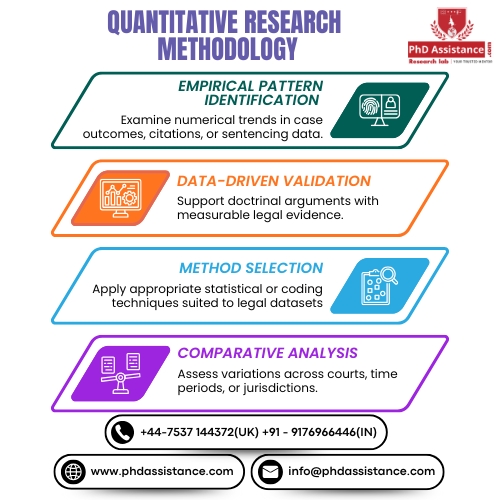
3. Doctrinal Legal Research and Methodological Foundations
Doctrinal legal research necessitates a solid methodological basis that outlines the procedure of analysing and combining legal sources. The methodology is the main factor that decides if the research is going to be only qualitative or if quantitative data will be added to it. An expert Phd dissertation methodology help in UK can help researchers in selecting a solid research methodology for doctrinal research.
On the other hand, qualitative legal methodology is directed towards interpreting the judiciary’s reasoning, revealing the intention of the legislature, and clarifying the coherence of doctrine through critical analysis. For instance, a doctoral research project that focuses on proportionality in UK public law may conduct a qualitative analysis of the Supreme Court verdicts to trace the transitions in judicial reasoning and constitutional principles. This method is typical of black-letter research, and at the same time, it means that the researcher gets to interact intensely with the legal texts (Majeed et al., n.d.; Bhat, n.d.).
In fact, the quantitative legal method allows for discovering empirical trends in jurisprudence. For instance, a scholar could apply the analysis of numeric data obtained from appellate opinions to discover the relationships concerning the length of sentences or the outcomes of appeals, in case he/she is researching the topic of uniform sentencing. Such analysis is doctrinally rational, as it delivers measurable perspectives that are subsequently used to back up and illuminate, qualitatively speaking (Hamzani et al., 2023).
4. Applying Qualitative and Quantitative Methodologies in Doctrinal Research
The selection of qualitative versus quantitative methodologies is determined by research goals and range. Qualitative techniques are very important for the interpretation of legal doctrinal changes, the different ways of judicially interpreting laws, and the legal reasoning of courts.
As a result, those legal texts that are authoritative and give room for interpretation become the ground upon which scholars build their intricate legal arguments (Bhat, n.d.), thus, they are the mainstay of Phd dissertation writing services in UK for law scholars.
Quantitative methods, however, if used correctly, provide support in doctrinal research by tracing legal changes on a larger scale, which may include the emergence of new citation practices by courts or the new laws not being enforced.
Example: mapping out how often a statute is cited in various cases can uncover changes in the focus of the judiciary over time. Pairing qualitative interpretation and quantitative findings not only increases the methodological transparency but also adds to the overall credibility of doctrinal research (Hamzani et al., 2023).
5. Primary and Secondary Data Collection in Legal Research
The systematic gathering of primary as well as secondary materials is the core of effective doctrinal legal research. Primary data collection means recognising and evaluating the most relevant legal sources, such as court decisions, statutes, statutory instruments, and regulatory frameworks. Structured assistance through a PhD Primary Data Collection Service supports accurate source selection and authoritative analysis.
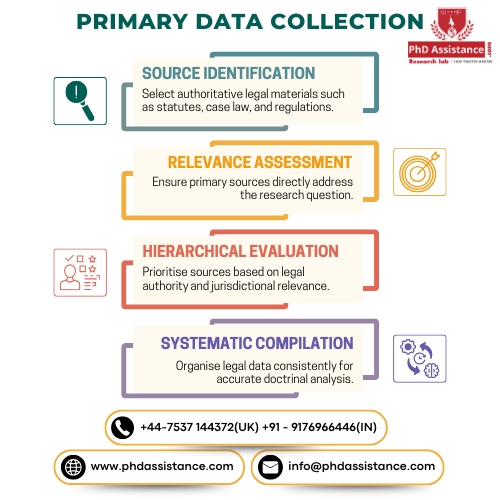
Example: a PhD student analysing the employment status in the UK labour law may look at the Supreme Court decisions along with the relevant statutes to check if there is any doctrinal consistency. The legal primary sources are the evidentiary base for the doctrinal discourse and must be picked according to authority and relevance (Majeed et al., n.d.).
The secondary data collection aids the primary analysis by adding the academic literature, textbooks, Law Commission reports, and policy documents. These sources create a theoretical background and scholarly argument that help in the legal interpretation.
The doctoral guidelines in the UK stress the need for the critical assessment of secondary sources and their integration in a systematic manner rather than descriptive (University of Westminster, n.d.). Making a PhD Secondary Data Collection Service valuable for ensuring analytical depth and methodological coherence (Hamzani et al., 2023)

6. Integrated and Iterative Methodological Planning
Doctrinal legal research is fundamentally an iterative process, which in turn entails the continual upgrading of the applicability of methods as research develops. It is not so much the data collection or analysis that is affected, but rather the unfolding situation in the judicial, legislative, or academic arenas during that period. In this context, phd research methodology writing services in UK support doctoral scholars by helping them maintain methodological consistency and clarity throughout the research process.
Maintaining the same methodological approach to both primary and secondary legal data is necessary if the doctoral research is to exhibit the same level of analytical rigour throughout (Hamzani et al., 2023). The integration of methodologies allows the PhD students to provide an effective reply to the supervisors’ comments without losing the coherence and depth of the doctrinal analysis.
Conclusion
High-quality doctrinal legal research in the UK is built on a solid methodological ground. The quality of research is significantly increased, and the academic credibility is improved by the effective use of qualitative and quantitative methods along with systematic gathering of primary and secondary data.
Methodological clarity empowers the PhD candidates to perform thorough case law and statute analysis, fulfil the requirements of UK doctoral programs and make significant contributions to the legal literature. As a result, phd dissertation methodology services play a crucial role in ensuring that their research design aligns with UK doctoral standards.
References
- Bhat, P. I. (n.d.). Qualitative legal research: A methodological discourse. Oxford University Press. https://www.researchgate.net/publication/338777161_Qualitative_Legal_Research_A_Methodological_DiscourseA_Methodological_Discourse
- Hamzani, A. I., Widyastuti, T. V., Khasanah, N., & Rusli, M. H. M. (2023). Legal research method: Theoretical and implementative review. International Journal of Membrane Science and Technology. https://www.researchgate.net/publication/375917477_Legal_Research_Method_Theoretical_and_Implementative_Review
- Majeed, N., Hilal, A., & Khan, A. N. (n.d.). Doctrinal research in law: Meaning, scope and methodology. Bulletin of Business and Economics. https://bbejournal.com/BBE/article/view/666
- University of Westminster. (n.d.). Dissertations: Methodology – Methods. https://libguides.westminster.ac.uk/methodology-for-dissertations/methods
