

Explain the skills needed for PhD data analysis. And explain how this activity enriches the researcher’s experience
October 7, 2020
Developing a PhD dissertation research problem: A guide for doctoral students
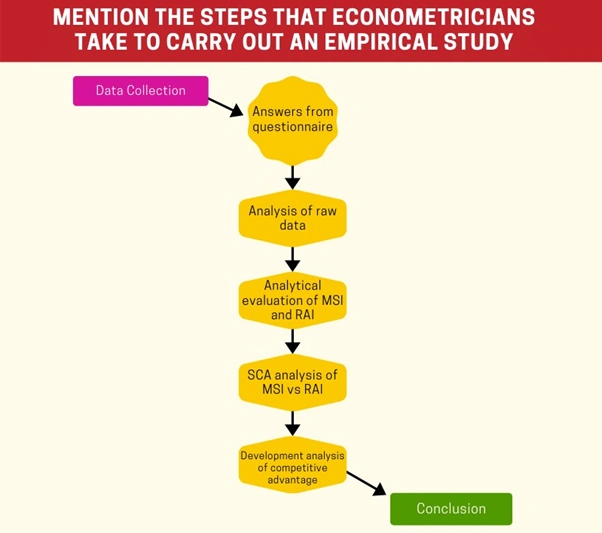
October 14, 2020Mention the steps that econometricians take to carry out an empirical study
Brief:
- PhD Econometrics & Statistics help understand the situation by observing from the ground level then predict the value of economic variables.
- PhD thesis on econometrics provides you with an insight phenomenon that carried to obtain the optimal state of the trend.
- An empirical study starts with writing a hypothesis at the beginning of the process. If there is no hypothesis, will not be able to proceed further to test any cause and effect of the relationship. Therefore, it’s essential to write a hypothesis that can be tested and can offer some great insights into a situation.

Introduction:
Econometrics is about running the collected data or a given phenomenon with the help of the various mathematical and statistical tool. To perform quantitative analysis in a PhD in Econometrics and Statistics, it is necessary to test the hypothesis or observe the trend to determine if the data is economically viable or not.
How to write a hypothesis:
The entire study or experience revolves around the hypothesis. So a slight mistake in hypothesis could result in wastage of time, money and effort.
Testing a hypothesis is a complicated procedure. It is wholly thinking about the right question, for example, a question that tested and results obtained from it that enhance your understanding or meet your objectives.
Types of Hypothesis:
There are two types of hypothesis,
Null Hypothesis:
A null hypothesis is one which sample observation results based on the chances. This type of hypothesis is not influenced by some non-random effect.
Alternative Hypothesis:
An alternative hypothesis is the one where some non-random effect influences sample observations.
Hypothesis Testing:
Hypothesis testing refers to a formal process to investigate to decide whether to accept or reject. The hypothesis should have consistents then it is accepted, or otherwise, rejected.
Selection of a hypothesis:
It begins with the hypothesis selection. PhD by Research in Economics consultation helps with the selection of hypothesis with two simple steps they are
- By defining the theory that needs testing
- By determining the variables for which the cause and effect relationship conducted
The selection process does not rely on quantifications, experiments, skills that affect the research result. The factors can be anything but depend upon the hypothesis want to test. The hypothesis at this stage only establishes a qualitative relationship and does not offer any economic indicator, which is essential for the study.
Establishing the objectives of the study:
This step is critical because it directs the study. Decide what is your objective of the study plays a crucial role. This step is essential because effort money and time spending to the research work should not get wasted. PhD Research Topics in Econometrics Help to carry out empirical research without any object may mislead and waste time consumed to carry out the process. So set an achievable research objective.
The purpose of establishing the objective,
- To determine the scope of the hypothesis
- To determine the limitation of the research
- To identify how compensations affect individual data productivity.
Developing an Economic Model:
Once you set the goal, you can now develop a classic economic model. This step carried out to drive economic relations or for quantitative analysis, which means it is much needed to have an economic model for your hypothesis to review and overcome the issues related to the research. This step doesn’t require detailed information, so develop a simple model which is less formal economical to sort out the problem.
Developing an Econometric Model
The purpose of the step is to test the Economic model; it is essential to convert it into an Econometric Model to carry out the study.
Estimating the Values of Coefficients
The next step is to estimate the obtained value of the econometric model that we derived. To evaluate the values, data are required. However, there is several consideration that you need to take into account at this stage.
- For this step, it preferred to use non-experimental data to determine the non- correct result.
- Choose an appropriate statistical method, knowing all the pros and cons.
- The doctoral programme in Econometrics and Statistics helps in the selection of the data type according to the time series, panel data for the study.
Two types are,
- Non-experimental data observed through already data collected by observing the real world.
- Experimental data is collected in a controlled environment.
Selection of Data Type,
The data type is selected based on the data that are driving economic relations. The data were chosen depending upon the,
- size of your sample
- type of study you want to carry out
- time constraint
Data Analysis and Validation:
Once the Data Collection process is over put the data in the econometric model, for the estimation of the study. The hypothesis is validated if,
- If the coefficients have expected magnitudes
- The estimates of data have anticipated value
- The results satisfy the established assumptions
In this step, we also check the goodness-of-fit, which is about determining if the selected econometric model is the right fit for the type of data used in conducting the study.
Conclusion:
The empirical study aims to evaluate statistical analysis between the variables or to establish the phenomena to utilize Quantitative Methods.
This kind of survey describes who, what phenomenon and thus descriptive but cannot answer the why question. PhD program Econometrics statistics answer the question of why an analytical or experimental study needed for your research work.
Reference:
- Fildes, R. (1985). Quantitative forecasting—state of the art: econometric models. Journal of the Operational Research Society, 36(7), 549-580.
- Anselin, L., & Hudak, S. (1992). Spatial econometrics in practice: A review of Regional science and urban economics, 22(3), 509-536.
- Pagan, A. (1987). Three Econometric Methodologies: A Critical Appraisal 1. Journal of Economic surveys, 1(1‐2), 3-23.
