

How to Format Your Education Research Paper for Journal Submission: A Guide for Academics in the UAE
December 29, 2025
Applying Advanced Data Analytics Techniques in Doctoral Research: Expert PhD Guidance for Scholars in the UK
January 5, 2026Performing literature review in Network Security: Professional PhD Guidance on Security Protocols for researchers in UAE
- December 30, 2025
- Literature Review
Introduction
In doctoral research on Network Security, the literature review functions as the intellectual foundation upon which the entire study is constructed. For PhD scholars in UAE universities, a literature review is not a descriptive summary of past studies but a rigorous analytical exercise demonstrating theoretical awareness, methodological competence, and scholarly originality. This requirement is particularly pronounced in network security research, where rapid technological advancement, evolving threat landscapes, and interdisciplinary approaches complicate the synthesis of existing knowledge.
Modern fields of study, including quantum cryptography, zero-trust architectures, AI-based anomaly detection, and secure wireless sensor networks, require continuous interaction with large amounts of very technical literature. Consequently, more and more doctoral researchers prefer to get literature review writing help in UAE with a structured literature review to make sure that the output is in accordance with the institutional expectations, but at the same time, they do not lose their academic independence. This paper is a guide for PhD students in UAE, introducing them to the best practices of carrying out a doctoral literature review in network security and specifically concentrating on conceptual framework development, theoretical framework alignment, and research gap identification.
Systematic Literature Review in Network Security Research
A systematic literature review (SLR) is considered the most vigorous method for the ordering and synthesising of information scattered in network security. Traditional narrative reviews differ from SLRs in their use of transparent search strategies, predefined inclusions and exclusions, and structured thematic analysis that is structured. The need for this methodological rigour is even greater in security, as the latter field consists of such diverse study areas as cryptography, machine learning, graph theory, and systems engineering.
In their systematic review, Imran et al. (2024) not only discuss quantum cryptography for future network security but also showcase that transparent database selection, keyword refinement, and security protocols classification together enhance the reliability and reproducibility of the findings from the review. Their work demonstrates that SLRs are tools that allow doctoral researchers to identify new paradigms while at the same time avoiding repeating the same studies. Just like Lagraa et al. (2024), who present the systematic synthesis of graph-based security monitoring approaches as the basis for comparative evaluation of botnet detection methods across various network environments, have done.
For those pursuing a PhD in the UAE, it is very important to use well-organised methods so that they can satisfy the elders’ expectations. A literature review writing service in UAE is an option to consider at this point, as it can assist in making sure that review protocols are up to the mark of doctoral quality with no loss of creativity or analysis.
Conceptual Framework Development in Network Security Research
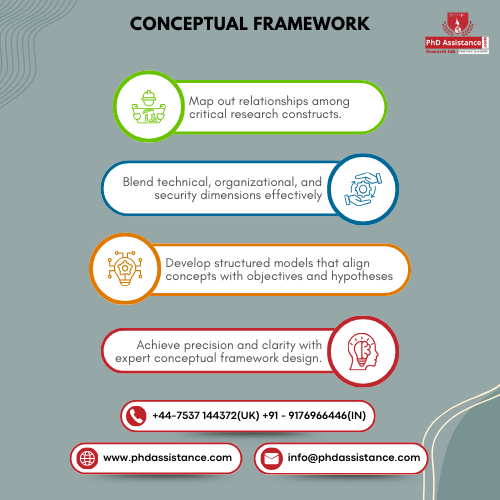
A conceptual framework can be described as a systematic and organised visualisation of the interrelationships between important constructs in a particular research study. In the arena of network security, the mentioned constructs could be such as threat models, security mechanisms, protocol efficiency, system scalability, and performance outcomes. However, one of the main problems faced by doctoral researchers is the difficulty of presenting a coherent analytical model that integrates concepts from different technical domains, a challenge that often leads scholars to seek structured academic guidance through a PhD Conceptual Framework Service.
In the paper dealing with the security of wireless sensor networks using machine learning techniques, Ghadi et al. (2024) ask the audience to imagine a picture where the different kinds of attacks, learning algorithms, evaluation metrics, and deployment constraints are mapped out. This would then be a great way to avoid many of the conceptual limitations. The review not only highlights the necessity for conceptual frameworks but also emphasises their role in the choice of variables and the design of the whole research process, which is indeed a great support.
Example:
In the field of security protocols based on blockchain research, the conceptual frameworks typically put together decentralisation, consensus mechanisms, trust models and network resilience. However, without systematic synthesis, such frameworks become fragmented and scattered. The literature review writing help in UAE for experts supports researchers to change disjointed discoveries into unified conceptual models, which, at the same time, are in harmony with the research goals.
A dissertation literature review writing service can deliver organised academic feedback that reinforces the conceptual coherence for doctoral students who are looking for consistency and clarity.
Theoretical Framework Alignment for Security Protocol Studies
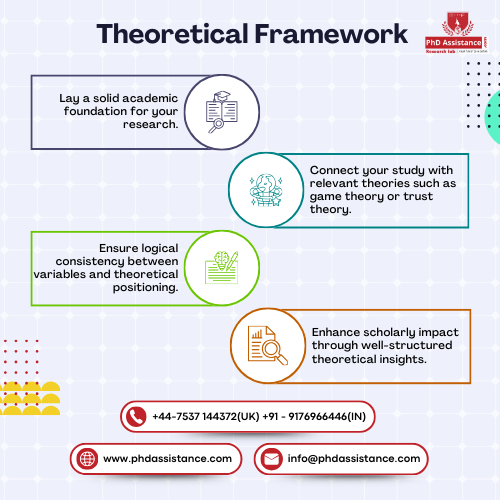
Theoretical grounding is highly emphasised in the UAE PhD programmes, particularly in the areas of engineering and computer science. The main theories applied in the research work comprised game theory, trust theory, information assurance theory, and socio-technical systems theory, which are very much seen in the field of network security research. Nonetheless, theories are mostly referred to only in a descriptive manner in literature reviews, which reduces their overall academic contribution and, in turn, confirms the necessity of a structured academic support, such as a PhD Theoretical Framework Service.
In the paper by Lim et al. (2024), a review of generative adversarial networks (GANs) for anomaly detection, has aligned machine learning architectures with decision-making and adversarial learning theories quite clearly. Their research has shown that the theory impacts the model selection, evaluation criteria and also the interpretation of results. Such alignment between theory and practice is a doctoral-level requirement.
In the same manner, Itodo and Ozer (2024), by means of a multivocal literature review on zero-trust security implementation, connect theoretical viewpoints with the industry frameworks. This method is very appropriate for the UAE research, where enterprise security and cloud governance are the leading policy matters.
Through literature review thesis help in UAE, PhD scholars can critically compare competing theoretical perspectives, justify theory selection, and demonstrate how theory underpins methodological decisions. This level of engagement not only signals analytical maturity to examiners but also contributes to the strengthening of the literature review’s power.
Research Gap Identification Through Systematic Synthesis
It is considered one of the hardest stages in the PhD research process to detect a research void that is not only of high importance but also defensible from an academic point of view. In the area of network security, the voids commonly appear as a result of the absence of real-world experiments, dependence on old datasets, or inadequate assessment of new threat models. Without thorough synthesis and critical justification, PhD researchers might suggest gaps that are either poor or exaggerated, a problem that often requires formal academic support via a PhD Literature Review Gap Identification Service.
According to Lagraa et al. (2024), the problems regarding the scalability and the real-time usability of the graph-based botnet detection methods are considered to be gaps, while Imran et al. (2024) refer to the difficulties of using quantum cryptographic protocols in the real-world network infrastructures as the remaining challenges. These cases are the perfect illustrations of how comprehensive synthesis not only leads to but also strengthens the gap identification through evidence.
A PhD dissertation focusing on zero-trust security can potentially point out a lack of empirical assessment in the Middle East’s hybrid cloud environments by combining the discoveries from academic and practitioner sources, as it has been shown in the research of Itodo and Ozer (2024).
Getting the best literature review writing services supports the researchers to present the gaps that are mentioned, original, justified, and defensible to the examiner, which in turn has a positive impact on the proposal acceptance and performance during the viva.

Supporting PhD Researchers in the UAE
International benchmarking, methodological transparency, and publication readiness are becoming more and more paramount in doctoral research at UAE universities. The UAE has provided a professional literature review writing service that offers structured academic guidance to researchers, which is a supporting activity rather than a replacement one. The support provided to the researchers includes critical synthesis, plagiarism-free writing, and adherence to the examiner’s expectations.
The PhD Assistance Research Lab continues with this scholarly support model, helping doctoral students during the systematic review design, the conceptual and theoretical framework development, and the solid gap identification. This method allows the researchers to reach the needed institutional standards without losing the rights of ownership over their work.
Conclusion
A comprehensive literature review is the key to getting successful PhD research in network security. By means of systematic synthesis, coherent conceptual and theoretical framework development, and defensible gap identification, doctoral researchers can increase the academic quality and originality of their work. The further UAE universities get in their alignment with global doctoral standards, the more structured guidance and expert feedback continue to play an essential role in supporting high-impact research outcomes. If approached with care, professional academic support not only increases the clarity of the scholars’ work but also contributes to the readiness for publication of doctoral research.
References
- Imran, M., Altamimi, A. B., Khan, W., Hussain, S., & Alsaffar, M. (2024). Quantum cryptography for future networks security: A systematic review. IEEE Access, 12, 180048–180078.
- Lim, W., Yong, K. S. C., Lau, B. T., & Tan, C. C. L. (2024). Future of generative adversarial networks (GAN) for anomaly detection in network security: A review. Computers & Security, 139, 103733.
- Ghadi, Y. Y., Mazhar, T., Al Shloul, T., Shahzad, T., Salaria, U. A., Ahmed, A., & Hamam, H. (2024). Machine learning solutions for the security of wireless sensor networks: A review. IEEE Access, 12, 12699–12719.
- Lagraa, S., Husák, M., Seba, H., Vuppala, S., State, R., & Ouedraogo, M. (2024). A review on graph-based approaches for network security monitoring and botnet detection. International Journal of Information Security, 23(1), 119–140.
- Itodo, C., & Ozer, M. (2024). Multivocal literature review on zero-trust security implementation. Computers & Security, 141, 103827.
