

Hydrogen Embrittlement of Repurposed Natural-Gas Pipeline Steels for Germany’s Hydrogen Core Network: Fracture-Mechanics Testing Under Cyclic Pressure
October 16, 2026
fsQCA Versus Regression for Family-Business Succession Research in the UAE: Designing a Configurational Methodology for Small-N, Causally Complex Cases
October 17, 2026Using the IAB Establishment Panel for a PhD: Data Access, Panel Attrition, Weighting and Fixed-Effects Specification Choices
- September 24, 2026
- PhD Research proposal
Most methodology guidance assumes you collected your own survey. German administrative and establishment data does not work that way, and the places it costs people months are not the places a generic panel-data tutorial warns about.
Who is this for: PhD scholars in management, economics, industrial relations and sociology planning empirical work on German establishment data; and supervisors signing off those proposals.
Scope. This article separates published evidence, cited to source, from research hypotheses, labelled as such, and design guidance. It is not legal or data-protection advice, and access rules change — check the current FDZ pages before applying.
What the dataset actually is
The IAB Establishment Panel is an annual representative employer survey of roughly 15,000 establishments a year, drawn as a stratified random sample of establishments with at least one employee subject to social insurance contributions [1]. The FDZ data report documents waves from 1993 for West Germany and 1996 for East Germany through 2024 [3].
Two features follow from that and shape everything else. It is a survey, not a register, so unit non-response and attrition are real and documented. And it is stratified, so the sample is not self-weighting — which is why the weighting question in §7 becomes unavoidable.
Three places these costs people months
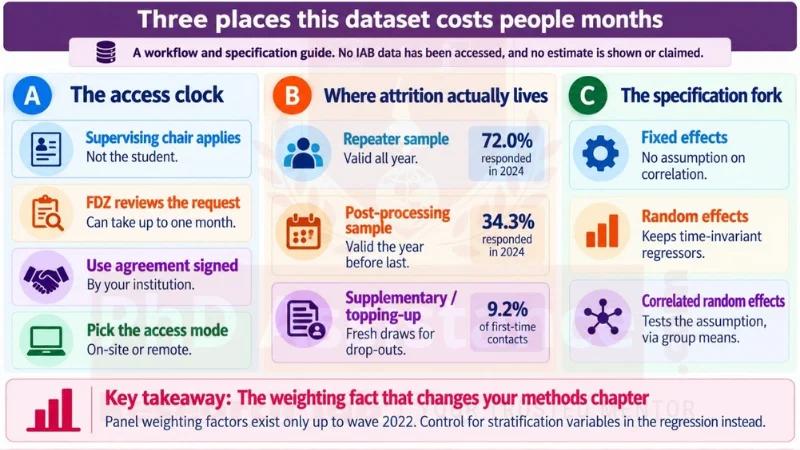
Figure 1. Three places this dataset costs people months. Panel A is the access workflow and its lead times; Panel B is the panel’s subsample structure with 2024 response figures; Panel C is the fixed-effects, random-effects and correlated-random-effects choice. All figures are quoted from the FDZ documentation and access pages.
Access: the workflow, and the rule most students miss
Data access runs through the Research Data Centre (FDZ). Four facts belong in a proposal’s feasibility section [2]:
- A student cannot apply alone. Data may be used for a final thesis, but the supervising chair submits the application, and at least one member of that chair must be listed as a user.
- Review takes time. The FDZ states a request review “could take up to one month”, before any analysis begins.
- The request must be a Word document. The FDZ warns that requests not submitted as Word documents will not be processed — a trivial rule that costs a cycle when missed.
- Agreements need a handwritten or qualified electronic signature, between the researcher’s institution and the FDZ.
Plan backwards from the viva, not forwards from today. Add the review window, the agreement, scheduling, and the fact that changes of institution or project content require a new request rather than an amendment [2].
Which access mode, and what each costs you
Mode | How it works | What it costs |
On-site use | Analysis at FDZ guest workplaces; advisory staff in Nuremberg | Travel and booked time; visits normally notified at least two weeks ahead and appointments are binding |
Remote desktop | Data stays on FDZ servers, reached from your office | Still under development, limited to a few data products, and currently open only to research institutions in Germany; your institution must document a data-security concept |
Remote execution | Scripts submitted through JoSuA; output disclosure-checked before release | No interactive debugging; you write code against documentation rather than against the data |
Two constraints catch international students specifically: stays of under nine months in the USA, Canada or the UK cannot use on-site access, though remote execution remains available; and non-EU locations require additional anonymisation that cannot be reversed [2]. Publications must cite the datasets and the access mode used, and a copy goes to the FDZ.
The three subsamples, and what “panel” means here
The sample is not one pool. The FDZ data report distinguishes a repeater sample of establishments with a valid interview in the previous year — this is what makes panel evaluation possible — a post-processing sample with a valid interview from the year before last, which mainly increases cross-sectional case numbers, and a supplementary and topping-up sample of fresh draws that replace panel drop-outs, meet target case numbers by state and for East German manufacturing, and reflect structural change [3].
Knowing which you are in changes what you can estimate. For 2024, the response figures were 72.0% for repeaters, 34.3% for the post-processing sample and 9.2% for first-time respondents, giving 16,246 evaluable interviews from 72,677 gross cases [3]. State which subsamples your analysis sample is built from. “I used the IAB Establishment Panel” is not a sample definition.
Attrition: diagnose it rather than hope
Attrition is tracked through the wave identifier variables, which carry drop-out codes [3]. That makes diagnosis possible, which in turn makes silence inexcusable.
Three things belong in the methods chapter. Describe the attrition: how many establishments appear in how many waves, and how your analysis sample shrinks at each restriction. Test whether it is selective: variable-addition and quasi-Hausman tests detect selectivity in panel models without requiring the response process to be known or modelled [7], which is what makes them usable here. And state what you did about it: a balanced panel is a convenience that discards exactly the establishments most likely to differ, so if you balanced, say so and show the unbalanced result alongside.
Weights: the thing that changed
This is the single most outdated statement in guidance on this dataset.
Cross-sectional analyses use the supplied cross-sectional weighting factor, which makes results proportional to establishments and, through a derived factor, to employees [3]. But panel weighting factors are no longer provided from the 2023 wave; they exist only up to and including wave 2022. For panel analyses, the FDZ suggests controlling for the stratification variables in the regression instead [3].
That is a methods-chapter decision, not a footnote. It also lands you in a live methodological debate: weighting for descriptive population quantities is one thing, weighting for causal or structural estimation is another, and the two are routinely conflated [6]. Say which you are doing. If the target is a population descriptive quantity, weights matter, and their absence constrains what you can claim; if the target is a conditional relationship, controlling for the stratification variables is defensible — and now also what the data provider recommends.
Fixed, random, correlated random
Examiners notice this choice, and the defensible answer is rarely “I ran a Hausman test”.
Fixed effects sweeps out the establishment-specific effect, so time-invariant regressors drop out, and nothing is assumed about correlation between that effect and the covariates. Random effects keep time-invariant regressors but assume the effect is uncorrelated with them — usually implausible for establishments, where size, sector and region drive both.
Correlated random effects is the one to default to. Adding the within-establishment means of the time-varying covariates recovers the fixed-effects estimates for those covariates while retaining the time-invariant ones [4]. The coefficients on the group means are themselves the test: jointly zero, and random effects is adequate; not zero, and they are not. That is the same comparison the classical specification test makes [5], but it is visible in the output, robust to the clustered standard errors you will be using anyway, and it tells you which variables are driving the rejection.
And know what the design cannot do. Fixed effects absorb works-council status, sector and anything else that never changes within an establishment. If your variable of interest rarely moves, report the number of switchers rather than presenting within-establishment identification as a strength it does not have.
Inference and the slips examiners catch
Cluster standard errors at the establishment, which is the sampling and treatment unit. Watch the number of clusters rather than observations. Remember that the survey is annual and establishments enter and leave, so your panel is unbalanced by construction — and that unbalancedness is informative, not noise. If the outcome is binary and you include an interaction, the interaction effect in a logit or probit is not the coefficient on the product term; report marginal effects or justify a linear probability model.
And check question wording across waves before building any variable that spans them. The core questionnaire is stable, but rotating modules are not, and a trend that is really a questionnaire change is the kind of error that is only found at examination.
Study design checklist
Dimension | Evidence to hold before submission | Risk if unresolved |
Access route | Supervising chair, access mode, lead time [2] | Months lost before analysis starts |
Sample definition | Which subsamples and waves, with case counts [3] | “I used the panel” is not a sample |
Attrition description | Waves per establishment; sample loss at each step [3] | A selected sample presented as representative |
Attrition test | A selectivity test reported, not just mentioned [7] | An examiner runs it for you |
Weights | Cross-sectional versus panel, and the 2023 change [3] | Guidance applied that is no longer current |
Estimand | Descriptive population quantity or conditional relationship [6] | Weighting argued at cross purposes |
Specification | CRE reported, with the group-mean test [4,5] | “Hausman said so” as the whole justification |
Switchers | The count, where the key variable rarely changes | Weak identification presented as strong |
Wave comparability | Question wording checked across waves [1] | A questionnaire artefact read as a trend |
What to prespecify before the first regression
Write these down before you see an estimate: the analysis sample and the restrictions that produce it; the waves and why those; the weighting decision and its justification; the specification and the test that justifies it; the clustering level; and the robustness runs you will report regardless of outcome. Prespecification is not a formality here — with a dataset this rich, the distance between “what I planned” and “what fitted” is where credibility goes.
What an examiner will ask
Expect: which subsamples your data comes from and why; what your attrition looks like and whether you tested it; why you weighted or did not; why FE, RE or CRE, and what the group-mean test said; how many establishments actually identify your key coefficient; and whether your variables mean the same thing across every wave you used.
Common weaknesses that require revision: a sample described only by dataset name; attrition acknowledged but never tested; panel weights cited from guidance written before the 2023 change; a Hausman test reported as the entire specification argument; a balanced panel used without comment; and a cross-wave variable built without checking the questionnaires.
Need a methods review before you apply for the data?
The methodological problem is straightforward: a proposal can name the right dataset and still specify something the data cannot support, and the access clock means you find out late.
What the review covers: the access route and realistic timeline; the sample definition and wave selection; the attrition diagnostic plan; the weighting decision against your estimand; the FE, RE and CRE choice and its test; and the inference strategy. The deliverable is a written methods assessment — a data-feasibility memo and a specification plan — stating what can be estimated, what must be narrowed and what must be verified in the questionnaires first.
Request a Panel Data Methods Review with PhD Assistance’s research-methodology team. The consultation advises on methodology; you carry out the research.
Related support: PhD research proposal development · PhD data analysis and statistics · PhD literature review support
FAQs:
1.Can a PhD student apply for the IAB Establishment Panel?
Yes, for a final thesis — but the supervising chair submits the application, not the student, and at least one member of that chair must be listed as a user. The FDZ states that review of a request could take up to one month [2].
2.Can I analyse the data from outside Germany?
Remote execution through JoSuA is available, and on-site use is possible at several locations — but stays of under nine months in the USA, Canada or the UK cannot use on-site access, and non-EU locations require additional, irreversible anonymisation [2]. Remote desktop access is currently open only to research institutions in Germany.
3.Should I use the survey weights in a panel regression?
You may not be able to. Panel weighting factors are no longer provided from the 2023 wave and exist only up to and including wave 2022; for panel analysis, the FDZ suggests controlling for the stratification variables instead [3]. Whether weighting was ever the right choice depends on whether your target is a population descriptive quantity or a conditional relationship [6].
4.Fixed effects or random effects?
Usually neither as a bare choice. Correlated random effects keeps time-invariant regressors, reproduces the fixed-effects estimates for the time-varying ones, and makes the specification test visible as the coefficients on the group means [4,5] — which is a more informative answer than a single test statistic.
References
- Institute for Employment Research (IAB). The IAB Establishment Panel. https://iab.de/en/the-iab/surveys/the-iab-establishment-panel
- Research Data Centre (FDZ) of the Federal Employment Agency at the IAB. Data access: on-site use. https://fdz.iab.de/en/data-access/on-site-use/
- Bellmann L, Gensicke M, Grau K, Kohaut S, Möller I, Oberfichtner M, Schwengler B, Tschersich N, Umkehrer M. IAB Establishment Panel (IAB-BP) 1993–2024. FDZ-Datenreport 01/2026 (EN). Nuremberg: Research Data Centre of the Federal Employment Agency at the IAB; 11 February 2026. https://doku.iab.de/fdz/reporte/2026/DR_01-26_EN.pdf
- Mundlak Y. On the pooling of time series and cross section data. Econometrica. 1978;46(1):69–85. doi:10.2307/1913646
- Hausman JA. Specification tests in econometrics. Econometrica. 1978;46(6):1251–1271. doi:10.2307/1913827
- Solon G, Haider SJ, Wooldridge JM. What are we weighting for? J Hum Resour. 2015;50(2):301–316. doi:10.3368/jhr.50.2.301
- Verbeek M, Nijman T. Testing for selectivity bias in panel data models. Int Econ Rev. 1992;33(3):681–703.
