
fsQCA Versus Regression for Family-Business Succession Research in the UAE: Designing a Configurational Methodology for Small-N, Causally Complex Cases
- 1. Why this is a research problem, not a method preference
- 2. The institutional facts a UAE design can stand on
- 3.. What each method claims
- 4. . Choosing between them: the question decides
- 5. Case selection, and the small-N question
- 6. Conditions and calibration: where the design lives or dies
- 7. The analysis, in order
- 8. . Robustness, and the critiques a reviewer will raise
- 9. Finite-element crack modelling: what it adds, and what it cannot
- 10. Laboratory feasibility — the constraint that decides the topic
- 11. From gap to contribution
- 12. Traps that sink hydrogen-materials proposals
- 13. Study design checklist
- 14. What a committee will ask

Recent Post
“Should I use fsQCA or regression?” is the wrong question, and supervisors hear it most weeks. The right one is what claim the thesis wants to defend — because the two methods answer different questions, and a scholar who picks the method first will spend the viva defending an estimand they never wanted.
Who is this for: PhD scholars in management, entrepreneurship, family business and organisational research; and supervisors scoping small-N empirical projects in the UAE and GCC.
Scope. This article separates published evidence, cited to source, from research hypotheses, labelled as such, and design guidance. It is research-methodology guidance only. It is not legal, governance, valuation or succession-planning advice for any family business, and nothing here describes how any firm should arrange its ownership or leadership. Readers with a live succession question should consult qualified legal and advisory professionals.
1. Why this is a research problem, not a method preference
Intra-family succession fails or succeeds through combinations. Published work on why succession is prevented identifies factors that sit across the individual, family, firm and context levels at once, rather than a single dominant cause [1]. That is a description of causal complexity: conditions that only make sense jointly, and outcomes reachable by more than one route.
Regression and fsQCA both take that seriously; they disagree about what to report. Regression estimates how much one condition moves the outcome with the others held constant. Set-theoretic methods ask which combinations of conditions are sufficient for the outcome, and whether several different combinations each suffice [2,3]. Neither is the more rigorous method. One is the answer to a question about average contribution; the other is the answer to a question about sufficient configurations.
2. The institutional facts a UAE design can stand on
A UAE succession study has an advantage that most comparative family-business work lacks: parts of the phenomenon are now codified. Federal Decree-Law No. 37 of 2022 concerning Family Businesses was issued on 3 October 2022 and came into force on 10 January 2023 [4]. Three of its features matter for research design rather than for compliance:
- Article 4 establishes a unified family business register maintained by the Ministry in coordination with local authorities. A register is a potential sampling frame, and whether it is accessible to researchers is a question to settle before the proposal, not after.
- Article 6 provides for a family charter covering ownership rules, share valuation mechanisms and profit distribution. Whether a firm has adopted one is closer to an observable, codeable condition than most governance constructs in this literature.
- Articles 19–20 create a Family Business Dispute Settlement Committee in each emirate, with a reconciliation stage before a decision. Dispute escalation becomes, in principle, a recorded event rather than a self-reported perception.
This is institutional context, not a finding. No claim is made here about how many firms have registered, adopted charters or used the Committee; those are empirical questions, and a thesis that asserts answers without data will be asked for them.
3.. What each method claims
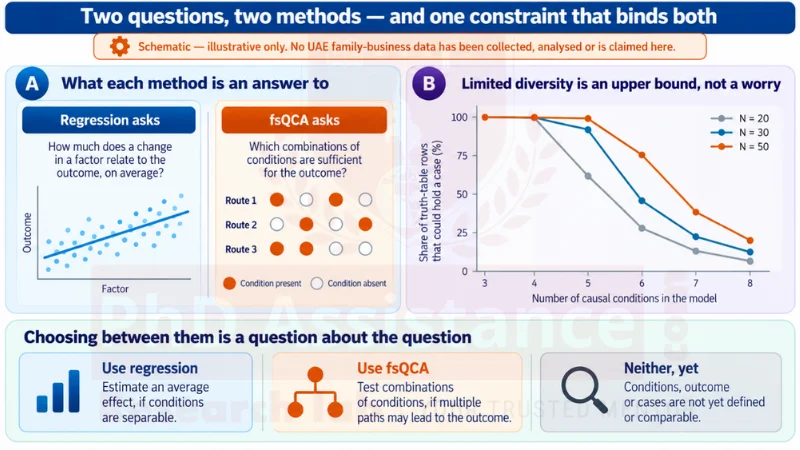
Research-design schematic titled “Two questions, two methods — and one constraint that binds both”, labelled as illustrative only, with no UAE family-business data collected, analysed or claimed. Panel A contrasts the two questions side by side: on the left, regression is shown as a scatter of firms with a single fitted line, captioned “one coefficient, one estimand”, asking how much succession planning moves the outcome on average across firms; on the right, fsQCA is shown as three rows labelled Route 1, Route 2 and Route 3, each a different pattern of four filled or open circles denoting conditions present or absent, captioned “several sufficient paths”, asking which combinations of conditions are sufficient for the outcome. Panel B plots the share of truth-table rows that could hold a case against the number of causal conditions in the model, for samples of twenty, thirty and fifty cases: all three stay at one hundred per cent up to four conditions, then fall steeply, so that at six conditions a thirty-case study can populate at most forty-seven per cent of rows. A closing panel gives three selection rules — use regression when the estimand is an average effect, use fsQCA when several combinations each suffice, and neither when conditions and calibration are not yet settled — and notes that Panel A is a drawing of two estimands while Panel B is arithmetic.
Two questions, two methods — a research-design schematic. Panel A is drawn, not estimated; Panel B is arithmetic, not a result.
fsQCA treats each case as a configuration, calibrates membership in sets against substantively meaningful thresholds, and analyses necessity and sufficiency rather than net effects [3]. It distinguishes core conditions, for which the evidence of a causal relationship is strong, from peripheral ones, where it is weaker, and allows different permutations of peripheral conditions around the same core to be equally effective [5]. That vocabulary — equifinality, core and periphery, neutral permutations — is what the method buys. If the thesis does not need it, it does not need fsQCA.
4. Choosing between them: the question decides
If the claim is… | Then the method is… | And the reviewer will ask… |
“Succession planning raises firm performance, on average” | Regression | Is the sample large enough, and is the effect identified? |
“There are several distinct routes to successful succession” | fsQCA | Are the configurations theorised in advance, or read off the output? |
“Condition X is necessary for the outcome” | Necessity analysis, before sufficiency | Does it hold with a consistency and relevance threshold stated beforehand? |
“This combination is what distinguishes these fifteen firms” | fsQCA, or structured case comparison | Are the cases comparable, and on what grounds were they chosen? |
“Both: an average effect and its configurational structure” | Sequential mixed design (§9) | Which came first, and did the second step get to see the first step’s results? |
The honest answer is sometimes that neither method is ready. If the conditions are not yet defined, the outcome not yet calibrated, or the cases not yet comparable, the next step is conceptual work, not software.
5. Case selection, and the small-N question
Small-N is not a defect to apologise for; it is a design choice that imposes obligations. Cases must be comparable on the dimensions not being studied, chosen on stated criteria rather than convenience, and known in enough depth to be calibrated. Best-practice guidance for QCA in strategy and organisation research treats sampling, calibration and reporting as explicit, defensible stages rather than technical afterthoughts [2].
The honest constraint is in Panel B of the figure, and it is arithmetic rather than opinion. A model with k conditions has 2^k truth-table rows. Thirty cases can populate at most 47% of the rows in a six-condition model, and at most 23% in a seven-condition one. Everything else is a logical remainder — a configuration with no empirical case — resolved by counterfactual assumptions the researcher must state and justify [3]. This is why condition count is settled before fieldwork, not after.
6. Conditions and calibration: where the design lives or dies
Calibration converts raw measures into set membership against externally justified thresholds rather than sample statistics [10], and it is the step most often reported too thinly to replicate. Three commitments make it defensible:
- Anchors are theoretical, not distributional. Full membership, full non-membership and the crossover point should be justified by substance — a charter either exists or it does not; a successor either holds an operating role or does not — rather than set at sample percentiles because the data suggested it.
- The outcome is calibrated as carefully as the conditions. “Successful succession” is not self-defining. Continuity of family ownership, continuity of family management, firm survival and post-transition performance are different outcomes with different sets.
- Calibration decisions are recorded before analysis and reported in full, including the ones that were revised and why [2].
Configurational theorising is itself a staged activity — scoping the relevant conditions, linking them into plausible combinations, and naming the orchestrating themes that hold a configuration together — and it is iterative by design rather than a single pre-registration moment [6]. A thesis should say which iterations happened and on what basis.
7. The analysis, in order
Necessity first and separately, with a consistency threshold stated in advance; then the truth table, with a frequency cutoff justified against sample size; then consistency and PRI thresholds set before inspecting solutions; then the intermediate solution, with the directional expectations for remainders declared and defended; then coverage and consistency reported for each configuration and for the solution as a whole. Report the parsimonious and complex solutions alongside the intermediate one, so a reader can see which conditions are core.
8. Robustness, and the critiques a reviewer will raise
A thesis that presents fsQCA as self-evidently rigorous will be challenged, and the challenges are documented. A permutation-based test has shown that QCA findings which look robust can plausibly arise from chance, which is an argument for formal significance testing rather than against the method [7]. The field’s own review literature documents a shift from the small-N case-oriented tradition toward larger-N applications, and the two are not interchangeable [8].
Hold the following before submission: sensitivity of solutions to calibration anchors; sensitivity to consistency and frequency thresholds; the effect of adding or removing a condition; a stated treatment of contradictory rows; and an explicit account of how remainders were handled. Reporting that a solution survived none of these is more defensible than not reporting the tests.
9. Mixed and sequential designs
The methods combine, provided the order is declared. Regression first, with fsQCA used to examine configurational structure the average effect conceals, is one defensible sequence; fsQCA first, with the resulting configurations tested on an independent sample, is another. What is not defensible is running both and reporting whichever agrees with the hypothesis. Configurational work in family-business research has been done at scale — one recent study analyses 275 private family firms with fsQCA [9] — so a small-N UAE design should say explicitly why depth was chosen over breadth, rather than implying no alternative existed.
10. Data access and the UAE-specific constraint
This is the feasibility gate, settled before the proposal is written. Access to the family business register established under Article 4 is a matter for the Ministry and local authorities, and a research-access route to it is not established in the sources reviewed for this research design. Work down this order: a written request for register-based sampling, with a named contact; an industry or chamber-brokered sample, with the selection rule and its biases stated; purposive recruitment through professional advisers, acknowledging that it over-samples firms already engaged with succession planning. Interview and charter data are personal and commercially sensitive; consent, confidentiality and anonymisation have to be designed in, and institutional ethics approval obtained. If no route is achievable, the thesis becomes a methodological and institutional contribution — defensible if declared, not if discovered late.
11. Study design checklist
Dimension |
| Evidence to hold before submission | Risk if unresolved |
Estimand |
| A written statement of the claim the thesis defends | The method answers a question nobody asked |
Condition count |
| Justified against sample size, using the 2^k arithmetic | Limited diversity silently drives the solution |
Calibration |
| Anchors, sources and revision history recorded | The result is a calibration artefact |
Outcome definition |
| One outcome, defined and calibrated separately | Four studies reported as one |
Remainders |
| Directional expectations declared and defended | Counterfactual assumptions doing unseen work |
Robustness |
| Threshold, calibration and condition sensitivity run | The reviewer runs them instead |
Access and ethics |
| A written route, consent design and approval | The commonest feasibility failure |
12. Research questions, contribution, and what a reviewer will ask
RQ1 (primary): which configurations of family, firm and governance conditions are sufficient for successful intra-family succession among UAE family businesses? Configurational identification, not hypothesis testing. RQ2: is any single condition necessary for the outcome, at a stated consistency and relevance threshold? RQ3: do the configurations for succession and for its absence differ, as causal asymmetry would predict? RQ4 (exploratory): is adoption of a family charter under Article 6 [4] a core or a peripheral condition across configurations? RQ5 (exploratory): conditional on access, do register-based and adviser-recruited samples yield different configurations — a question about selection, not about firms.
A completed thesis would deliver a defended statement of estimand and method choice; a calibrated, fully reported configurational analysis; a robustness suite; and a clear account of what the design cannot establish. Coverage bounds generalisation, configurations are not causal mechanisms, and no conclusion about any identifiable family or firm is supportable.
Common weaknesses that require revision: a method chosen before the claim; conditions added until the solution looked clean; calibration anchors set at sample percentiles without justification; remainders handled silently; robustness checks omitted; fsQCA presented as a way around a small sample rather than a way to ask a different question.
Need a methodology review for your configurational study?
If you are unsure whether fsQCA fits the claim you want to defend, or whether your condition count and sample can support the solution you are hoping for, that is what a methodology review is for.
Start a research-methodology consultation with PhD Assistance’s research-methodology team: a design review of your topic, case selection, calibration plan and analysis sequence, delivered as a written recommendations summary for a supervisor meeting. The consultation advises on methodology; you carry out the research.
Related support: PhD research proposal development · PhD data analysis and statistics · PhD literature review support
Frequently asked questions
No, and framing it that way is the fastest route to a hostile review. fsQCA answers a different question from regression; it does not lower the evidentiary bar. A small-N study still needs comparable cases, defensible calibration and a condition count the sample can support.
The arithmetic sets the ceiling: k conditions produce 2^k rows, and your sample can populate at most N of them. At thirty cases and six conditions, more than half the truth table is empty by construction. Four or five conditions is where most small-N designs can defend themselves.
No. Sequential designs are legitimate if the order and the decision rule are declared in advance. Running both and reporting the agreeable one is not.
It makes parts of the phenomenon codified and in principle observable — a register, charters, a dispute committee [4]. Whether any of that is accessible to a doctoral researcher is a separate question, and §10 is the honest answer to it.
Reference
1. De Massis A, Chua JH, Chrisman JJ. Factors preventing intra-family succession. Fam Bus Rev. 2008;21(2):183–199. doi:10.1111/j.1741-6248.2008.00118.x
2. Greckhamer T, Furnari S, Fiss PC, Aguilera RV. Studying configurations with qualitative comparative analysis: best practices in strategy and organization research. Strateg Organ. 2018;16(4):482–495. doi:10.1177/1476127018786487
3. Schneider CQ, Wagemann C. Set-Theoretic Methods for the Social Sciences: A Guide to Qualitative Comparative Analysis. Cambridge: Cambridge University Press; 2012. ISBN 978-1-107-01352-0
4. United Arab Emirates. Federal Decree by Law No. (37) of 2022 Concerning the Family Businesses. Issued 3 October 2022; in force 10 January 2023. UAE Legislation portal. https://uaelegislation.gov.ae/en/legislations/1608
5. Fiss PC. Building better causal theories: a fuzzy set approach to typologies in organization research. Acad Manage J. 2011;54(2):393–420.
6. Furnari S, Crilly D, Misangyi VF, Greckhamer T, Fiss PC, Aguilera RV. Capturing causal complexity: heuristics for configurational theorizing. Acad Manage Rev. 2021;46(4):778–799. doi:10.5465/amr.2019.0298
7. Braumoeller BF. Guarding against false positives in qualitative comparative analysis. Polit Anal. 2015;23(4):471–487.
8. Misangyi VF, Greckhamer T, Furnari S, Fiss PC, Crilly D, Aguilera R. Embracing causal complexity: the emergence of a neo-configurational perspective. J Manage. 2017;43(1):255–282. doi:10.1177/0149206316679252
9. Duong PA, Voordeckers W, Vandekerkhof P, Lambrechts F, Kelleci R. A configurational approach to strategic change in family firms. J Small Bus Manag. 2025. doi:10.1080/00472778.2024.2443654
10. Ragin CC. Redesigning Social Inquiry: Fuzzy Sets and Beyond. Chicago: University of Chicago Press; 2008. ISBN 978-0-226-70275-9